
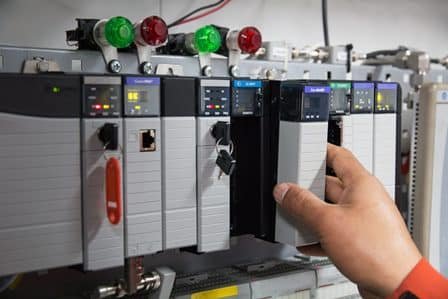
Allen-Bradley 5570 Networking: EtherNet Modbus & DeviceNet
Allen-Bradley ControlLogix 5570: Mastering Industrial Network Protocols
The Allen-Bradley ControlLogix 5570 controller, engineered by Rockwell Automation, stands as a cornerstone in modern industrial automation. This high-performance Programmable Automation Controller (PAC) excels due to its versatile communication capabilities. It seamlessly connects I/O devices, motor drives, and HMI panels across complex enterprise networks. This guide explores how the 5570 series manages various protocols to ensure robust factory automation performance.

The Versatile Architecture of ControlLogix 5570 Communications
The 5570 series utilizes a modular backplane design. This structure allows engineers to customize communication interfaces based on specific project needs. Unlike fixed controllers, the ControlLogix platform separates processing power from network hardware. Therefore, users can upgrade individual communication modules without replacing the entire CPU. At PLCDCS HUB Limited, we often see clients leverage this flexibility to bridge the gap between legacy hardware and modern IIoT systems.
EtherNet/IP: The Gold Standard for Modern Control Systems
EtherNet/IP serves as the backbone for most ControlLogix 5570 installations. It relies on the Common Industrial Protocol (CIP) to handle real-time data exchange. This protocol supports high-speed I/O, motion control, and peer-to-peer messaging between controllers. Moreover, it integrates easily with standard IT infrastructure, simplifying data flow to MES and ERP systems.
- Primary Modules: 1756-EN2T, 1756-EN3TR, and 1756-EN4TR.
- Key Benefit: High bandwidth for complex control systems.
- Best For: Distributed I/O and high-axis count motion control.
Maintaining Deterministic Control with ControlNet
While Ethernet is popular, ControlNet remains vital for specific time-critical applications. It provides a deterministic network where data collisions are impossible. Consequently, it is the preferred choice for synchronized control tasks and redundant controller chassis. However, many new facilities now opt for EtherNet/IP with DLR (Device Level Ring) as a modern alternative to ControlNet.
Connecting Field Devices via DeviceNet
For low-level device integration, the 5570 series supports DeviceNet. This CAN-based protocol is highly efficient for simple components like limit switches and valve manifolds. It provides both power and signal over a single cable, reducing wiring costs. Professionals typically use the 1756-DNB scanner module to manage these networks.
Integrating Third-Party Systems: Modbus and PROFIBUS
In many industrial automation environments, multi-vendor interoperability is essential. The ControlLogix 5570 does not support Modbus or PROFIBUS natively on the CPU. Instead, it utilizes specialized gateway modules from partners like ProSoft Technology. These modules allow the 5570 to act as a master or slave in a Modbus TCP or RTU network. This capability is crucial for connecting power meters and third-party flow sensors.
Legacy Migration using Data Highway Plus (DH+)
Retrofitting older plants often requires communication with vintage PLC-5 or SLC 500 systems. The 1756-DHRIO module enables the 5570 to communicate over Data Highway Plus. While slow by modern standards, DH+ support ensures a smooth migration path for aging infrastructure. It allows for phased upgrades rather than risky “rip-and-replace” strategies.
Safety First: CIP Safety Protocols
When paired with GuardLogix firmware, the 5570 supports CIP Safety. This protocol runs alongside standard control data on EtherNet/IP or ControlNet. It meets SIL 3 and PLe safety standards, ensuring that emergency stop signals and light curtains operate reliably. This integration reduces hardware complexity by using the same cable for both safety and standard control.
Technical Summary Checklist
- EtherNet/IP: Use for high-speed, scalable network architectures.
- ControlNet: Select for deterministic, scheduled data requirements.
- DeviceNet: Implement for simple, cost-effective field device wiring.
- Modbus/PROFIBUS: Utilize ProSoft modules for third-party integration.
- DH+: Reserved for legacy Rockwell system migrations.
Practical Application Scenarios
In a large-scale automotive assembly plant, a ControlLogix 5570 might simultaneously manage three different networks. It uses EtherNet/IP for high-speed robot synchronization, DeviceNet for the conveyor sensors, and a Modbus TCP gateway to monitor the building’s energy consumption. This multi-protocol handling is why the 5570 remains a top choice for complex DCS and PLC applications.
For genuine parts and expert technical support for your ControlLogix systems, visit PLCDCS HUB Limited.
Frequently Asked Questions (FAQ)
1. Can I use the 5570 controller for Modbus TCP without a ProSoft module?
While possible via custom socket programming in ladder logic, it is not recommended for mission-critical tasks. A dedicated communication module provides much better stability, easier troubleshooting, and lower CPU overhead.
2. Is there a limit to how many communication modules I can add?
The limit is generally defined by the number of slots in your 1756 chassis and the controller’s available memory. However, adding too many modules can increase backplane traffic and impact overall scan times.
3. Why choose EtherNet/IP over ControlNet for new designs?
EtherNet/IP offers higher speeds and easier integration with enterprise software. With the advent of Gigabit modules and DLR technology, the reliability of Ethernet now matches or exceeds that of legacy ControlNet systems.
Related Posts

One Comment
Comments are closed.
Brian Wallace
January 7, 2026 at 8:50 am
The exploration of 5570 networking options reveals how crucial flexible communication is for U.S. industrial networks. Ethernet/IP handles high-speed integration to MES and cloud services, Modbus RTU is perfect for legacy sensor networks, and DeviceNet remains useful in segmented machine I/O. In a recent plastics molding facility in Ohio, engineers leveraged dual Ethernet/IP and DeviceNet stacks to unify their older presses with a new PLC backbone, enabling centralized recipe management and fault reporting across 20 machines. This underlines that hybrid network architectures often unlock the most value in existing estates.