
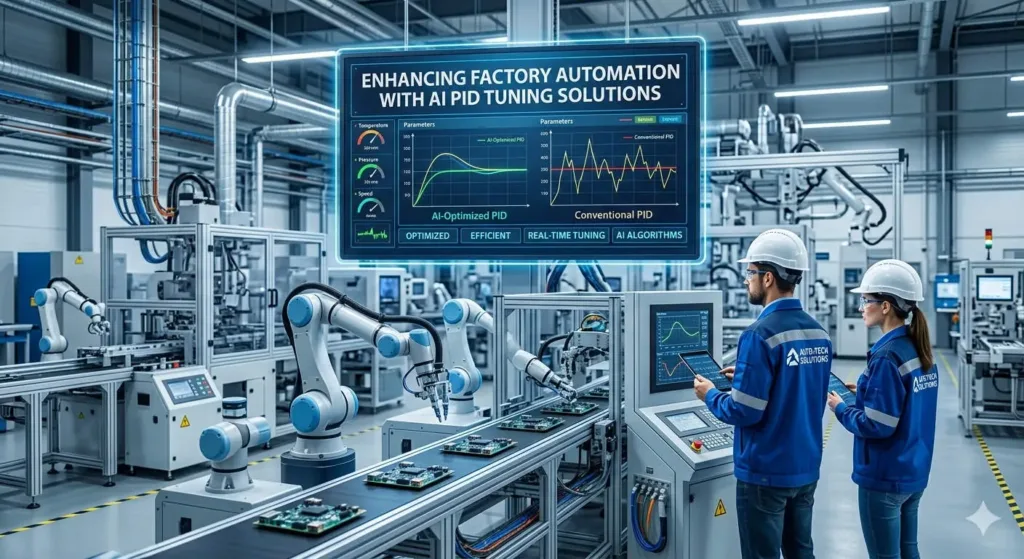
Enhancing Factory Automation with AI PID Tuning Solutions
Revolutionizing PLC PID Tuning with AI-Driven Optimization
Manual PID tuning remains a persistent bottleneck in modern industrial control. Conventional methods often struggle with fluctuating process conditions in chemical or pharmaceutical plants. As a result, systems experience oscillations, wasted energy, and inconsistent product quality.
Integrating Machine Learning into the control layer enables continuous self-tuning for engineers. This shift reduces commissioning time and stabilizes loops without constant human oversight. At PLCDCS HUB, we believe AI is transforming how factory automation handles complex dynamics.
Achieving Faster Adaptive Response Times
AI algorithms dynamically modify PID gains (Kp, Ki, Kd) using real-time feedback data. This proactive adjustment significantly cuts down settling times after a process disturbance occurs. Consequently, production lines maintain higher stability during feedstock or load changes.
- ✅ Reduce overshoot in temperature-critical pharmaceutical batch reactors.
- ✅ Minimize mechanical wear on valves and dampers.
- ✅ Outperform static tuning rules like Ziegler–Nichols in volatile environments.
Solving Complexity in Nonlinear Control Systems
Traditional PID controllers assume linear behavior, which rarely exists in complex industrial automation. However, AI models like reinforcement learning excel at managing nonlinearities. They easily handle valve hysteresis, dead time variations, and multi-variable coupling issues.
From our experience at PLCDCS HUB, distillation columns often fail with standard tuning during throughput shifts. AI-based models adapt automatically to these changes. Therefore, you eliminate the need for manual gain scheduling or multiple PID profiles.
Strategic Integration and Protocol Compatibility
Engineers can deploy AI optimization through edge computing or embedded DCS functions. These modules connect to the PLC via standard protocols like Modbus TCP or OPC UA. This approach ensures minimal disruption to your existing control architecture.
- ⚙️ Scale deployments easily across hundreds of control loops.
- ⚙️ Bridge legacy systems using industrial communication gateways.
- ⚙️ Verify scan cycle limitations before high-frequency parameter updates.
Best Practices for Installation and Maintenance
AI performance depends entirely on the integrity of the incoming data stream. Unstable signals from poorly grounded transmitters will mislead the optimizer. Moreover, you should always start in “Advisory Mode” during the initial commissioning phase.
- 🔧 Install signal isolators to ensure clean data for the AI.
- 🔧 Implement watchdog timers to handle communication failures safely.
- 🔧 Follow IEC 61000 standards for grounding and shielding.
Always include a fallback logic to the last known stable PID parameters. This prevents system crashes if the external AI node loses its network connection. Safety remains the priority in high-availability oil and gas systems.
Application Scenario: Batch Reactor Stability
A chemical manufacturer integrated AI tuning into their Siemens S7-1500 PLC via an edge gateway. The AI reduced temperature fluctuations by 40% during exothermic reactions. This led to higher yield consistency and lower energy consumption across the plant.
Explore high-performance controllers and modules to upgrade your system at PLCDCS HUB Limited. We offer the technical hardware necessary for advanced AI integration.
Expert Questions & Answers
How can I verify if my current PLC hardware supports AI tuning?
Your PLC must allow online parameter changes and support Ethernet-based communication like Modbus TCP. If your controller is restricted to “Stop-to-Download” for PID changes, you may need a modern PLC or DCS upgrade.
Does AI replace the existing safety logic in my control system?
No. AI serves as a supervisory layer to optimize efficiency. It must never override Safety Instrumented Systems (SIS). Always maintain hard-coded limits within the PLC logic to stay within safe operating envelopes.
What is the most cost-effective way to pilot AI optimization?
Start with a non-critical loop using an OPC UA data logger and an external PC running optimization software. This “Advisory” setup allows you to validate improvements without risking production downtime or hardware investment.
Industry Note: PLCDCS HUB recommends following ISA-5.9 standards when documenting new tuning strategies to ensure long-term maintainability for plant technicians.


