
Honeywell CC-PCNT02 Guide: Bidirectional Pulse Counting & Quadrature
Mastering Bidirectional Precision with the Honeywell CC-PCNT02 Pulse Counter
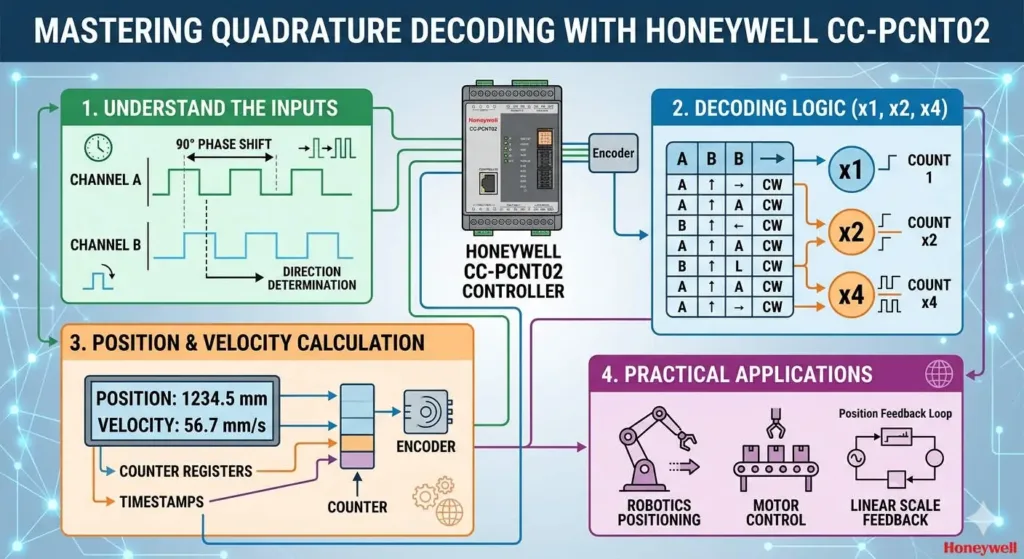
The Honeywell CC-PCNT02 pulse counter module delivers advanced quadrature decoding for complex control systems. It supports bidirectional counting through A/B phase inputs. Consequently, the module tracks both pulse count and rotational direction simultaneously. This capability makes it indispensable for encoder feedback and precise length measurements. Modern industrial automation demands this level of motion-aware accuracy.
Core Value in Directional Process Feedback
Accurate position feedback is vital in high-speed packaging and pharmaceutical manufacturing lines. The CC-PCNT02 eliminates the need for external logic modules to interpret motion direction. It handles direction-aware counting natively. This feature ensures reliable conveyor tracking and motor shaft monitoring. Therefore, operators can detect reversing motions without signal ambiguity or data errors.
Technical Insights: Quadrature Decoding and High-Frequency Performance
Unlike basic single-channel counters, the CC-PCNT02 processes two phase-shifted signals to determine travel direction. This reduces DCS logic complexity significantly. Furthermore, the module handles high-frequency inputs in the kHz range. This speed prevents missed pulses in bottling or high-speed sorting applications. As a result, you avoid cumulative errors that lead to expensive product waste.
Expert Insight from PLCDCS HUB: We often see engineers struggle with signal mismatch. The CC-PCNT02 supports TTL and open collector inputs. However, you must match the signal type to your environment. Improper matching often causes noise susceptibility in heavy industrial plants. Always verify your encoder electrical specs before finalizing the hardware configuration.
Installation Standards for High-Vibration Environments
Field installations in cement or mining sectors face extreme mechanical stress. Vibration frequently loosens terminal connections over time. Loose signals on A or B channels cause direction misinterpretation rather than simple signal loss. We recommend using spring-clamp terminals to maintain constant pressure. Additionally, apply thread-locking compounds on screw-type terminals to ensure long-term stability.
Best Practices for Shielding and Surge Protection
Encoder cables often run parallel to high-voltage power lines in factory automation layouts. This proximity introduces electromagnetic interference. To mitigate this, use shielded twisted-pair cables. Ground the shield at only one end to prevent ground loops. Moreover, consider external surge suppressors for outdoor conveyor systems. Protecting these signal lines prevents costly module failure during lightning events.
Strategic Buyer’s Perspective on Pulse Counter Upgrades
Before purchasing, determine if your application truly requires quadrature features. You need the CC-PCNT02 for reversible motors or position tracking with rollback. It functions as a drop-in replacement for simpler modules in many cases. However, check your Honeywell C300 firmware compatibility first. Ensure the system supports full parameterization to unlock every hardware capability.
- ✅ Signal Check: Confirm encoder A/B phase compatibility.
- ✅ Speed Rating: Verify kHz requirements for high-speed rotors.
- ✅ Wiring Audit: Use dedicated conduits for low-voltage signals.
- ✅ Logic Setup: Update DCS blocks for bidirectional data.
Application Scenarios and Solutions
- Automated Warehouse Shuttles: Ensures precise positioning for pallet retrieval and storage.
- Steel Rolling Mills: Tracks strip length accurately even during emergency reversals.
- Oil & Gas Metering: Provides high-speed pulse counting for turbine flowmeters.
For high-performance components and technical guidance on your Honeywell projects, visit PLCDCS HUB Limited. Our team provides the reliable hardware your industrial automation infrastructure requires.
Frequently Asked Questions (FAQ)
1. How do I troubleshoot “shimmering” or oscillating counts in a stationary motor?
This usually indicates high electrical noise on the A/B lines or a lack of proper shielding. Check your single-point grounding. If the motor is truly still, the quadrature logic should prevent false counts unless noise mimics a phase shift.
2. Can I use the CC-PCNT02 with a 24V HTL encoder?
You must verify the specific input card revision. Some CC-PCNT02 variants are optimized for 5V TTL. Using 24V on a 5V input will damage the module. Always use a signal level converter if the voltages do not match.
3. Is there a performance limit when using long cable runs for encoders?
Yes, long cables increase signal capacitance and reduce high-frequency clarity. For distances over 50 meters, we recommend using differential (RS-422) signals or active repeaters to maintain pulse integrity for the counter.


