
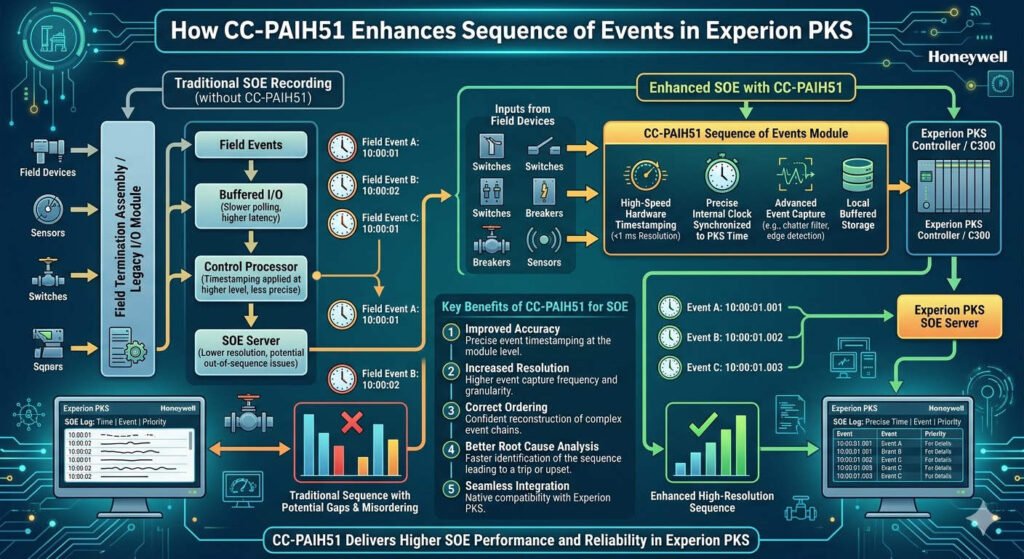
How CC-PAIH51 Enhances Sequence of Events in Experion PKS
Maximizing DCS Reliability with Honeywell CC-PAIH51 Time Sync Modules
The Honeywell CC-PAIH51 serves as the heartbeat of time synchronization within the Experion PKS architecture. This module aligns clocks across controllers, I/O subsystems, and event logs with microsecond precision. In high-stakes sectors like petrochemicals and power generation, timing accuracy remains a critical safety requirement. Without precise synchronization, operators cannot perform reliable root cause analysis after a system trip. At PLCDCS HUB Limited, we recognize that the CC-PAIH51 is essential for maintaining plant-wide data integrity.

The Role of Sub-Millisecond Accuracy in Fault Analysis
Modern control systems require sub-millisecond synchronization to capture Sequence of Events (SOE) data correctly. A minor 15ms deviation can hide the actual trigger of a turbine trip. Consequently, the CC-PAIH51 utilizes Precision Time Protocol (PTP) to eliminate timing drift across the control network. This level of detail ensures that event logs reflect the true physical sequence of a process disturbance. Therefore, engineers can diagnose failures faster and reduce expensive downtime.
Redundancy Strategies for Uninterrupted Time Distribution
The CC-PAIH51 supports a primary and secondary pairing to eliminate single points of failure. Interestingly, many technicians ask if these modules must occupy adjacent slots. While Honeywell does not strictly mandate side-by-side placement, it remains a best practice for maintenance. Redundancy functions at the logic level within the chassis or node. However, separating them physically can sometimes complicate wiring and diagnostic checks during a critical hardware failure.
Navigating NTP and PTP Protocol Compatibility
This module bridges the gap between external GPS clocks and internal DCS layers. It supports both Network Time Protocol (NTP) and PTP integration for maximum flexibility. Nevertheless, poor-quality upstream sources often introduce jitter into the system. In multi-vendor environments, protocol mismatches frequently lead to hidden synchronization errors. We recommend using a high-stability master clock to feed the CC-PAIH51 for the best results.
Field Installation and EMI Mitigation Best Practices
Refineries often present harsh electromagnetic environments that disrupt sensitive digital signals. Therefore, installers should use high-grade shielded Ethernet cables for all time-sync connections. Single-point grounding prevents ground loops that might degrade signal quality. Additionally, placing external surge suppressors on incoming GPS lines protects the module from lightning strikes. Proper shielding ensures the CC-PAIH51 maintains a steady lock on its reference clock.
Validating Synchronization During System Commissioning
A “Green Status” light does not always mean your timing is perfect. During commissioning, engineers should use advanced diagnostic tools to measure actual clock offset. We once encountered a refinery project where a misconfigured server caused a 150ms drift. This error stayed hidden until an SOE audit revealed inconsistent log timestamps. Always verify the actual jitter and offset values before declaring the system ready for production.
PLCDCS HUB Expert Perspective
From our experience at PLCDCS HUB Limited, time sync issues usually stem from the network, not the hardware. When designing your system, consider the entire “timing chain” from the GPS antenna to the I/O module. The CC-PAIH51 is a powerful tool, but it requires a clean network environment to perform. Investing in a redundant pair is almost always worth the cost for mission-critical plants.
Engineering Checklist for CC-PAIH51
- ✅ Verify the upstream NTP/PTP source stability and accuracy.
- ✅ Place redundant modules in adjacent slots for easier maintenance.
- ✅ Use shielded CAT6 cables to minimize industrial noise interference.
- ✅ Check controller firmware compatibility before module installation.
- ✅ Audit SOE logs monthly to identify any emerging time drift.
Solution Scenarios
- Power Plant Trip Analysis: Using CC-PAIH51 to identify the millisecond difference between breaker openings.
- Regulatory Compliance: Meeting IEC standards for high-precision event logging in hazardous chemical zones.
- Plant-Wide Integration: Synchronizing legacy PLC systems with a modern Experion PKS DCS backbone.
Frequently Asked Questions (FAQ)
1. Does the CC-PAIH51 require a specific slot in the Honeywell chassis?
While it can fit in various slots, you must follow the specific backplane rules of your chassis model. Adjacent slots are preferred for redundant pairs to simplify loop checks, but they are not technically mandatory for the logic to function.
2. Can I use a single CC-PAIH51 module for my entire DCS?
A single module works, but it creates a single point of failure. If the module fails, your controllers will eventually drift apart. For critical processes, we always recommend a dual-module configuration for high availability.
3. How do I know if my CC-PAIH51 is compatible with my current firmware?
You should check the Honeywell Compatibility Matrix for your specific Experion PKS release. Older R300 or R400 systems may have limitations regarding PTP support. Contact a specialist to validate your version before purchase.
Need to upgrade your Honeywell timing infrastructure?
Find the latest CC-PAIH51 modules and expert technical support at PLCDCS HUB Limited.