Intelligent Automation Solutions for Bioprocessing Efficiency
Transforming Bioprocessing Through Intelligent Automation Systems
The bioprocessing industry faces unprecedented challenges. Manufacturers must produce complex therapeutics faster while maintaining strict quality standards. According to MarketsandMarkets, the industrial automation market will reach $306.2 billion by 2027, with bioprocessing representing a significant growth segment.
The Connectivity Challenge in Bioprocessing Automation
Traditional bioprocessing facilities often struggle with equipment interoperability. Multiple vendors use proprietary communication protocols, creating integration barriers. Consequently, manufacturers implement costly workarounds that limit innovation.
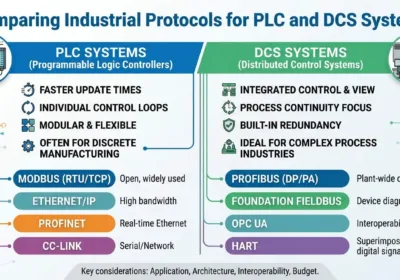
Open standards like OPC UA and ISA-88 provide solutions. These protocols enable seamless data exchange between PLCs, DCS, and other control systems. Therefore, companies can create unified automation architectures that scale efficiently.
Moving Beyond Basic Automation to Intelligent Systems
True automation value comes from intelligent system integration. Modern bioprocessing combines advanced sensors, PAT, and data analytics. These technologies work together to reduce process variability and improve product quality.
As PLCDCSHUB notes, “Automation without intelligence provides limited benefits. The real transformation occurs when systems not only execute tasks but also learn and adapt.” This approach requires robust validation strategies to meet regulatory requirements.
Driving Operational Efficiency Through Automation
Modern manufacturers face intense pressure to optimize resources. Automation enables significant improvements in several key areas:
- Higher yields through precise process control
- Faster changeovers between production batches
- Reduced energy consumption and waste generation
- Improved facility utilization and throughput

Figure 1: Manufacturers must get the most out of their processes.
Democratizing Advanced Automation Technologies
User-friendly automation platforms are transforming workforce capabilities. Modern SCADA and HMI systems feature intuitive interfaces that require less specialized training. Moreover, cloud-based analytics make advanced insights accessible to operational teams.
However, technology accessibility alone isn’t sufficient. Organizations must develop data literacy across their workforce. Employees need skills to interpret automation insights and take appropriate actions.
The Critical Role of Industry Collaboration
Successful automation implementation requires extensive collaboration. Technology providers, manufacturers, and regulators must work together. This cooperation accelerates standards development and technology validation.
Leading companies approach automation as an evolutionary process. They start with pilot projects, then scale successful implementations. This incremental strategy minimizes risk while demonstrating tangible benefits.
Practical Implementation Strategies
Based on industry experience, PLCDCSHUB recommends these implementation steps:
- Conduct comprehensive process mapping to identify automation priorities
- Select modular control systems that support future expansion
- Implement robust data governance frameworks from the beginning
- Develop cross-functional teams combining process and automation expertise
- Establish clear metrics to measure automation effectiveness
Future Outlook for Bioprocessing Automation
The automation journey continues evolving rapidly. Emerging technologies like AI and digital twins will further transform bioprocessing. These innovations will enable predictive maintenance and virtual process optimization.
Companies that invest in flexible automation architectures today will be better positioned for future advancements. Strategic planning now ensures organizations can adopt new technologies as they mature.
Getting Started with Your Automation Journey
Successful automation requires the right technology partners. PLCDCSHUB offers comprehensive industrial automation solutions specifically designed for bioprocessing applications. Our expertise in PLC, DCS, and control systems can help you develop a tailored automation strategy that delivers measurable results.
Frequently Asked Questions
What are the first steps in automating an existing bioprocess?
Begin with a thorough process analysis to identify bottlenecks and quality variation points. Then prioritize automation projects based on potential impact and implementation complexity.
How do open standards benefit bioprocessing automation?
Open standards reduce vendor lock-in and enable easier system integration. They also facilitate data exchange between equipment from different manufacturers, creating more flexible automation environments.
What ROI can companies expect from bioprocessing automation?
Typical returns include 20-40% productivity improvements, 15-30% quality enhancement, and 25-50% reduction in manual documentation efforts. However, specific outcomes depend on process characteristics and implementation quality.
Related Posts