Maintaining Modicon Momentum I/O for Industrial Reliability
The Mechanics of Backplane Signal Integrity
In brownfield factories and oil and gas skids, engineers often overlook a critical failure point: the physical interface between the Schneider Electric Momentum base unit and its electronic module. While these systems remain workhorses of industrial automation, poor contact integrity frequently triggers intermittent I/O faults. Addressing these issues correctly can stabilize legacy PLC architectures without requiring a full system overhaul.
Modicon Momentum systems utilize a unique spring-loaded connector design to bridge the base and the module. These pins facilitate both 24 VDC power distribution and high-frequency communication. Over time, environmental factors cause oxidation on these gold-plated surfaces. Consequently, signal resistance increases, leading to “ghost” errors that vanish upon reboot but inevitably return during peak production.

Environmental Stress and Connector Fatigue
Standard factory automation panels often exceed ideal temperature ranges, especially in chemical processing plants. When cabinet temperatures climb above 50°C, thermal expansion puts mechanical stress on the I/O interface. Furthermore, vibration from nearby pumps or compressors induces fretting corrosion. This microscopic wear eventually degrades the spring tension within the base unit, making the connection unreliable.
Ensuring Precise Mechanical Alignment
Proper installation requires more than just snapping a module onto a DIN rail. Momentum bases are sensitive to rail torsion and alignment. If the DIN rail is uneven, the electronic module may not sit flush against the base. This misalignment creates uneven pressure across the pin array. Therefore, technicians must verify that the mounting surface is perfectly flat to ensure uniform electrical contact.
Field-Proven Maintenance and Cleaning Protocols
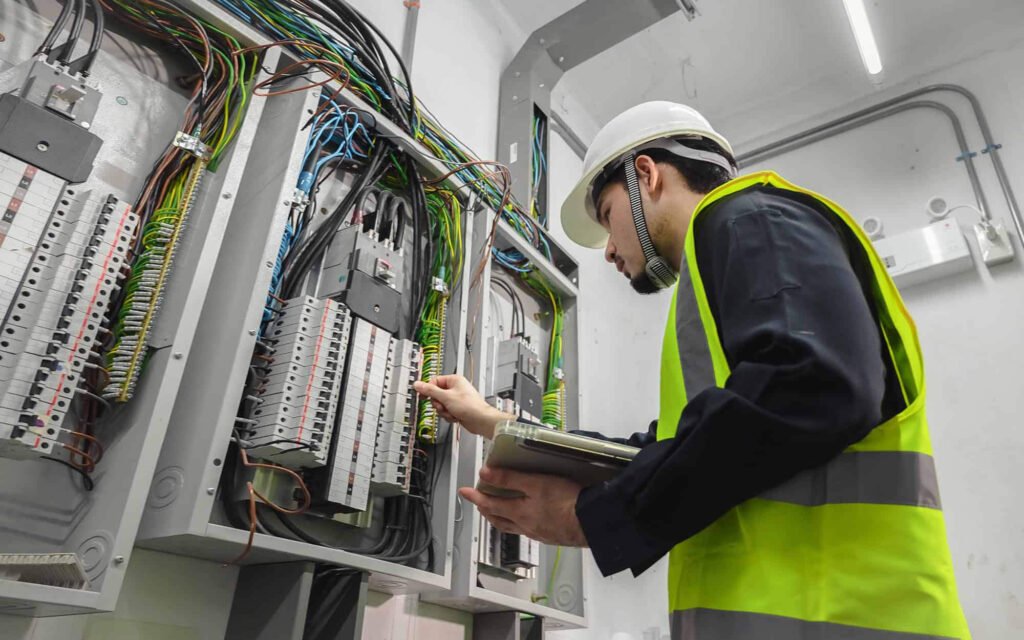
Maintaining legacy hardware requires a delicate touch to avoid permanent damage. PLCDCS HUB recommends a systematic approach to cleaning:
Isolate Power: Always disconnect power sources per IEC 60204-1 safety standards.
Visual Audit: Use high-intensity lighting to check for bent pins or debris.
Chemical Cleaning: Use a residue-free, electronics-grade contact cleaner.
Air Dry: Allow the solvent to evaporate fully before reassembling components.
Avoid Abrasives: Never use brushes or files on gold-plated contact surfaces.
Strategic Reinforcement for High-Vibration Areas
In demanding sectors like Oil & Gas, standard mounting is often insufficient. To mitigate micro-movements, install heavy-duty end stops on both sides of the Momentum assembly. These stops prevent lateral shifting on the DIN rail. Moreover, ensuring the rail is rigidly grounded reduces electromagnetic interference, which can exacerbate the effects of poor physical contact.
When to Repair vs. Replace
Deciding when to decommission a base unit is vital for control systems longevity. If cleaning fails to resolve a localized fault, the internal spring mechanism has likely lost its elasticity. In these instances, replacing the electronic module is a waste of resources. You must replace the base unit to restore the mechanical integrity of the connection.
Technical Best Practices Checklist
Verify DIN rail rigidity to prevent base twisting.
Use end-stops to lock modules in high-vibration zones.
Monitor cabinet thermals to stay below 50°C.
Maintain a stock of spare base units for legacy rows.
Document “ghost” faults to identify failing backplane slots.
Author Insights by PLCDCS HUB
From our perspective at PLCDCS HUB, the Modicon Momentum series represents a pinnacle of modular flexibility, yet its age is becoming a liability. We often see plants spending thousands on sensor replacements when the root cause is simply a loose base-to-module fit. While cleaning extends life, we recommend a phased migration to M580 or X80 platforms for mission-critical paths. If you need assistance sourcing hard-to-find legacy components or planning your next upgrade, explore the extensive inventory and technical resources at PLCDCS HUB Limited.
Application Scenarios
Offshore Rigs: Preventing I/O drops caused by engine room vibrations and salty air.
Pharmaceutical Packaging: Ensuring high-speed signal accuracy for precision sorting.
Water Treatment: Maintaining distributed I/O stability in humid, corrosive environments.
Frequently Asked Questions (FAQ)
Q1: How can I tell if the fault is in the module or the base?
Perform a “swap test.” Move the electronic module to a known-good base. If the error follows the module, the electronics are faulty. If the error stays at the original location, the base unit’s contacts are compromised.
Q2: Is it safe to use generic contact cleaners on Schneider hardware?
Only use cleaners labeled “safe for plastics” and “no-residue.” Some generic lubricants contain oils that attract dust, which will eventually insulate the contacts and cause more frequent failures.
Q3: What is the most cost-effective way to manage a failing Momentum rack?
Instead of a total “rip-and-replace,” identify the most critical I/O points. Replace those specific bases with new-old-stock (NOS) units and use the salvaged parts as emergency spares for non-critical loops.
Related Posts