
Semiconductor Equipment Growth Drives Industrial Automation Advances
SEMI Reports Global Semiconductor Equipment Billings Increased 24% Year-Over-Year in Q2 2025
Global Semiconductor Growth Fuels Industrial Automation Advancements
Strong Market Expansion in Q2 2025
Global semiconductor equipment billings reached $33.07 billion in Q2 2025. This represents a significant 24% year-over-year increase. Moreover, quarter-over-quarter growth registered at 3%. This sustained expansion reflects robust investment in manufacturing technology. Leading-edge logic and advanced memory applications primarily drive this growth. These components are essential for next-generation industrial automation systems.
Key Drivers Behind the Growth
The AI revolution continues to fuel semiconductor demand. Consequently, chipmakers are investing heavily in production capacity. Advanced High Bandwidth Memory (HBM) for DRAM is a critical growth area. Furthermore, shipments to Asia showed a notable increase. According to MarketsandMarkets, the industrial automation market will exceed $300 billion by 2028. This growth directly depends on semiconductor availability.
Industry Leadership Perspective
SEMI President and CEO Ajit Manocha confirmed the strong market performance. He stated, “The market registered a strong first half of 2025.” The industry built on record 2024 billings of $117 billion. Manocha emphasized that investments support both AI innovation and supply chain resilience. This strategic focus benefits the entire industrial automation sector.
Regional Market Performance Analysis
The data reveals varying growth rates across different regions. Taiwan maintained its leading position with $8.72 billion in billings. China followed closely with $7.92 billion. North America showed impressive 17% quarterly growth. Europe also demonstrated solid expansion at 9%. These regional investments will enhance global manufacturing capabilities for automation components like PLCs and DCS.
Implications for Industrial Automation
This semiconductor growth has direct positive effects on factory automation. More chips mean better availability of controllers, sensors, and drives. Therefore, automation projects can proceed with shorter lead times. At PLCDCSHUB, we observe that reliable semiconductor supply enables faster implementation of control systems. This acceleration helps manufacturers maintain competitive advantage.
Future Market Outlook
The SEMI Equipment Market Data Subscription provides comprehensive market analysis. It includes detailed reports on equipment billings and market forecasts. The current data suggests continued investment throughout 2025. Companies should plan for ongoing technology evolution. Strategic partnerships with reliable suppliers become increasingly important.
Practical Applications and Solutions
✅ Enhanced Control Systems: Semiconductor advances enable more powerful PLCs and DCS.
⚙️ Improved Connectivity: Better chips facilitate Industrial IoT implementation.
🔧 Predictive Maintenance: Advanced semiconductors support more sophisticated analytics.
Expert Commentary from PLCDCSHUB
The semiconductor equipment growth directly benefits industrial automation. As chip manufacturing expands, we expect better performance from control systems. Furthermore, costs may decrease for essential components. Manufacturers should evaluate their automation technology roadmap. Consider upgrading systems to leverage these semiconductor advancements. Explore our control systems solutions to enhance your operations.
Frequently Asked Questions
How does semiconductor growth affect industrial automation pricing?
Increased semiconductor production often leads to better component pricing. However, advanced features may maintain premium pricing for cutting-edge systems.
Which automation segments benefit most from semiconductor advances?
Edge computing devices, sophisticated controllers, and vision systems show immediate improvements from better semiconductors.
Should companies delay automation projects waiting for better technology?
We recommend proceeding with current projects while planning for technology refreshes. The semiconductor evolution continues delivering improvements regularly.
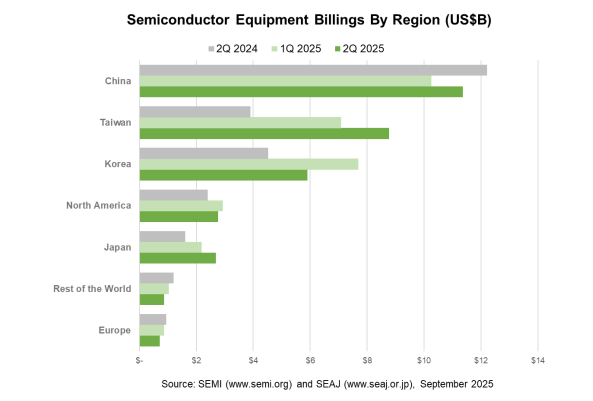
Compiled from data submitted by members of SEMI and the Semiconductor Equipment Association of Japan (SEAJ), the WWSEMS Report is a summary of the monthly billings figures for the global semiconductor equipment industry.