
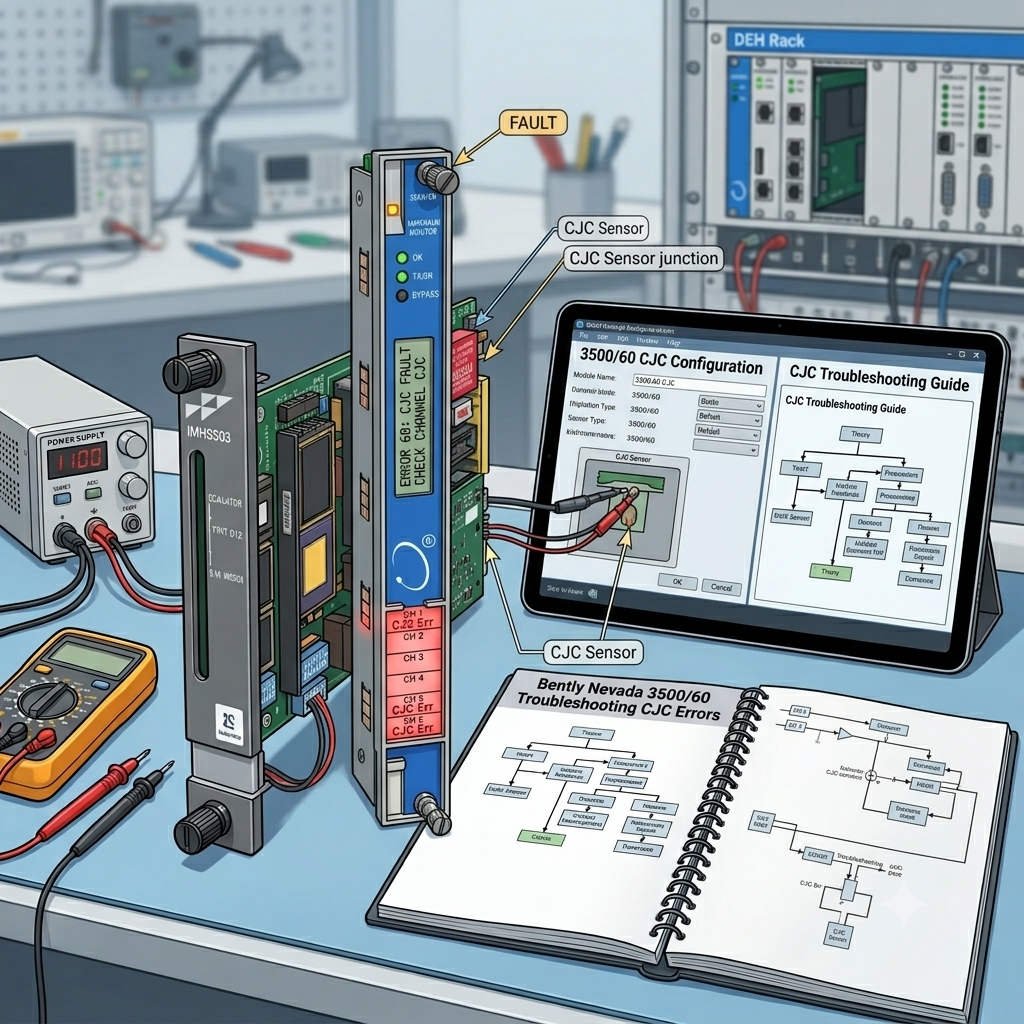
Troubleshooting Bently Nevada 3500/60 CJC Temperature Errors
Troubleshooting Cold Junction Compensation Errors in Bently Nevada 3500/60 Modules
Understanding Cold Junction Compensation (CJC) in Control Systems
The Bently Nevada 3500/60 Temperature Monitor is a staple in industrial automation for monitoring bearings and critical process temperatures. Many technicians misdiagnose “CJC errors” as faulty hardware. However, our team at PLCDCS HUB has discovered that over 80% of these issues stem from external installation factors rather than module failure. Achieving precise temperature tracking is vital for DCS stability and machinery protection, as even minor deviations can trigger unnecessary emergency shutdowns.
The Impact of Wiring and Thermal Management
K-type thermocouples rely on specific metal alloys to generate accurate millivolt signals. If you replace these with standard copper wires, you create parasitic junctions that invalidate the 3500/60’s cold junction calculation. Moreover, local heat sources within a control cabinet—such as power supplies or frequency drives—can cause the module’s terminal area to exceed the ambient room temperature. As a result, the reported CJC value often differs from the cabinet’s general environment.
Key Factors Influencing CJC Accuracy
- Using improper wire materials that do not match K-type thermocouple standards.
- Allowing dissimilar metals at terminal blocks to create unwanted thermal potentials.
- Installing the 3500 rack too close to high-heat components like VFDs or UPS units.
- Grounding thermocouple shields at multiple points, which introduces electrical noise and ground loops.
- Misconfiguring the sensor type (e.g., selecting J-type instead of K-type) in the software.
Expert Troubleshooting Strategies
Before replacing your module, you should follow a systematic verification process to isolate the root cause. We suggest testing the raw input signal against the documented ambient temperature at the module’s terminal block. At PLCDCS HUB, we often advise our clients to use specialized thermocouple terminal blocks to minimize thermal errors. Reliable factory automation depends on maintaining these precise connection points throughout the equipment lifecycle.
Best Practices for Installation and Maintenance
- ⚙️ Maintain continuous K-type extension wire from the probe to the module.
- 🔧 Use forced ventilation to eliminate hot spots inside your instrumentation cabinets.
- ✅ Perform annual calibrations to check CJC sensors against an external reference.
- ⚙️ Ensure shields are grounded at only one point to prevent signal drift.
- 🔧 Verify your configuration settings in the 3500 software periodically.
Frequently Asked Questions
Q1: Should I immediately replace the 3500/60 module if the CJC reading is unstable?
No, you should first check for grounding issues and ensure that your wiring uses proper thermocouple-grade materials. Hardware failure is rare compared to installation-related signal corruption.
Q2: How do I select the right thermocouple for my 3500 series system?
Always choose sensors that comply with IEC 60584 or ANSI standards. For high-temperature or high-vibration applications, mineral-insulated (MI) thermocouples offer superior durability and reduced risk of signal degradation.
Q3: Does the CJC value need to match the temperature measured by my cabinet’s thermometer?
Not exactly. The 3500/60 measures the temperature at its specific terminal block. If your cabinet has hotspots, the CJC value may be higher than the general room temperature, which is normal behavior.
For more technical support or to source high-quality replacement modules for your control systems, please visit PLCDCS HUB.