
Allen-Bradley Communication Modules Technical Comparison

Allen-Bradley CompactLogix Communication and Support Modules: Complete Technical Guide
Introduction to Industrial Network Connectivity
Industrial communication networks form the backbone of modern automation systems. According to Statista, the Industrial IoT market will reach $110 billion by 2028. Therefore, selecting proper communication modules ensures reliable data exchange.
Network Scanner Modules: DeviceNet vs Ethernet/IP
These modules enable connectivity with field devices and sensors.
- ✅ 1769-ADN: Provides DeviceNet scanner functionality for sensor-level networks
- ✅ 1769-AENTR: Offers dual-port Ethernet/IP adapter capabilities
The 1769-ADN excels in cost-effective device-level networking. However, the 1769-AENTR supports modern Ethernet-based architectures.
System Support and Memory Modules
These components ensure system reliability and data integrity.
- ⚙️ 1769-ARM: Address reserve module for memory management
- 🔧 1769-BA: Backup battery for controller memory preservation
The 1769-ARM manages memory allocation efficiently. Meanwhile, the 1769-BA prevents data loss during power interruptions.
Serial Communication: 1769-ASCII Module
This module handles legacy device communication. The 1769-ASCII enables serial data exchange with barcode readers and printers. Moreover, it supports multiple serial protocols for versatile integration.
Industrial Application Scenarios
Different communication modules serve specific industrial needs.
- Automated Assembly Lines: Use 1769-ADN for distributed I/O and sensor networks
- Process Control Systems: Deploy 1769-AENTR for seamless SCADA integration
- Legacy Equipment Integration: Implement 1769-ASCII for serial device communication
Network Selection Guidelines
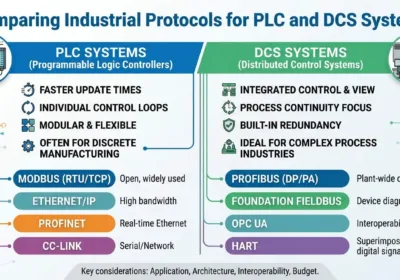
Choosing between network protocols depends on application requirements. DeviceNet offers cost savings for simple devices. In contrast, Ethernet/IP provides higher bandwidth and easier IT integration. As a result, engineers must evaluate both technical and economic factors.
System Reliability Considerations
Support modules enhance overall system robustness. The 1769-BA battery maintains program memory during outages. Additionally, the 1769-ARM ensures consistent memory allocation for complex applications.
Expert Insights from PLCDCSHUB
Our experience at PLCDCSHUB shows proper network selection impacts long-term maintenance costs. We recommend 1769-AENTR for new installations due to Ethernet dominance. However, 1769-ADN remains valuable for existing DeviceNet infrastructure.
Frequently Asked Questions
What maintenance considerations apply to the 1769-BA backup battery?
Replace the battery every 2-3 years during planned maintenance. Always verify battery status during routine system checks to prevent unexpected data loss.
How does the 1769-ASCII module handle communication with non-Allen-Bradley devices?
It supports standard serial protocols like RS-232 and RS-485. Configuration software allows custom string formatting for various equipment types.
What factors determine whether to use DeviceNet or Ethernet/IP for new projects?
Consider device availability, network speed requirements, and existing infrastructure. Ethernet/IP generally offers better future-proofing for new installations.
For complete technical specifications and expert guidance on Allen-Bradley communication modules, visit PLCDCSHUB Limited. Our specialists provide professional support for all industrial networking requirements.
Related Posts