
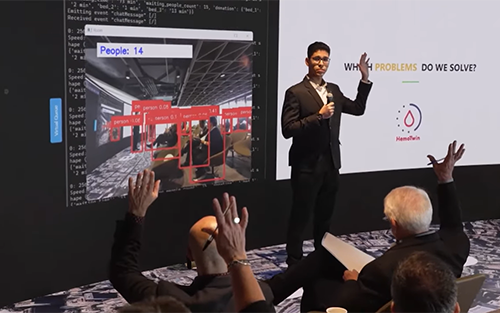
Bentley Systems, Enactus Announce Winner of the 2025 iTwin4Good Challenge

Digital Twin Innovation: Students Tackle Sustainability Challenges in Global Competition
Bentley Systems and Enactus have revealed the winners of their 2025 iTwin4Good Challenge. This international competition united university students from multiple countries. Participants applied digital twin technology to solve real-world infrastructure problems. The event successfully connected academic learning with practical engineering innovation.
Global Competition Drives Sustainable Infrastructure Solutions
The iTwin4Good Challenge attracted student teams worldwide. Participants came from the United States, Germany, Canada, United Kingdom, Ireland, and Brazil. They focused on critical sustainability issues using digital twin platforms. This approach demonstrates how emerging technologies address environmental challenges. According to MarketsandMarkets, the digital twin market will reach $110.1 billion by 2028.
Winning Project: Revolutionizing Construction Waste Management
SiTESalvage from the UK and Ireland claimed the top prize. Their project addresses construction and demolition waste. The World Bank estimates 2.24 billion tons of solid waste generated globally. Construction contributes up to 40% of this total. The team developed a digital twin-powered marketplace platform.
Their solution uses iModels to track demolition projects. Stakeholders can identify reusable materials before demolition. This enables better planning for material repurposing. The platform helps divert waste from landfills effectively. It significantly reduces the construction industry’s environmental impact.
Runner-Up: Converting Plastic Waste into Valuable Fuel
German team Basola earned second place with their innovative approach. They created a solar-powered pyrolysis reactor. This system transforms discarded plastics into usable fuel. The solution integrates iTwin technology with IoT sensors. These components monitor reactor performance continuously.
The digital twin integration enhances operational safety. It also simplifies maintenance procedures. This approach demonstrates circular economy principles. Waste plastics become valuable energy resources. The system supports sustainable energy production goals.
Second Runner-Up: Repurposing Mines for Renewable Energy
Canadian team EcoTwins secured third position with their land-use solution. They addressed renewable energy expansion challenges. Their project focuses on abandoned gold mine sites. These locations often remain unused after mining operations cease. The team developed an assessment framework for repurposing.
Their approach integrates multiple evaluation factors. Technical, social and environmental indicators guide decisions. Digital insights help identify optimal sites for solar and wind projects. This strategy aligns energy development with community needs. It promotes better environmental stewardship practices.
Industry Leaders Praise Student Innovation and Creativity
Bentley Systems executives expressed strong enthusiasm for the projects. Chris Bradshaw, Chief Sustainability Officer, commended the student teams. He highlighted their innovative application of digital twin technology. The projects demonstrate technology’s potential for sustainable infrastructure.
Enactus President George Tsiatis emphasized the business impact. Student projects prove innovation drives positive change. Young leaders combine technology with entrepreneurial thinking. They create meaningful solutions for global challenges.
Digital Twin Technology in Industrial Automation Context
Digital twins are becoming essential in industrial automation systems. They create virtual representations of physical assets. These models enable real-time monitoring and simulation. Manufacturing facilities use digital twins for process optimization. They help predict equipment maintenance needs accurately.
According to PLCDCSHUB analysis, digital twin adoption is accelerating. Industries recognize their value for predictive maintenance. They also support better operational decision-making. Integration with PLC and DCS systems enhances their utility.
Practical Applications for Industrial Automation Professionals
Digital twin technology offers multiple benefits for automation engineers. These applications demonstrate its growing importance:
- Predictive maintenance for motors and control systems
- Process optimization through virtual simulation
- Training operators using realistic virtual environments
- Integration with existing SCADA and HMI systems
- Energy management and efficiency improvements
Future Implications for Infrastructure and Manufacturing
The competition projects indicate broader industry trends. Digital twins are becoming crucial for sustainability initiatives. They enable better resource management and waste reduction. The technology supports circular economy implementation. Industrial automation will increasingly incorporate these capabilities.
Conclusion: Emerging Technologies Drive Sustainable Innovation
The iTwin4Good Challenge demonstrates technology’s evolving role. Digital twins provide powerful tools for sustainability challenges. Student innovations show practical application possibilities. These approaches will influence future industrial automation strategies. The competition highlights next-generation engineering talent.
SiTESalvage will present their project at the Enactus World Cup 2025. This international recognition underscores their achievement’s significance.
For insights on implementing digital twin technology in industrial automation systems, explore resources at PLCDCSHUB. Our platform provides technical guidance for automation professionals.
Frequently Asked Questions
How do digital twins integrate with existing industrial automation systems?
Digital twins connect with PLC, DCS, and SCADA systems through standard protocols. They use real-time operational data from control systems. This enables accurate simulation and predictive analytics for improved decision-making.
What industries benefit most from digital twin technology?
Manufacturing, energy, infrastructure, and construction sectors gain significant advantages. Digital twins optimize processes, reduce costs, and improve sustainability across these industries.
Can small and medium enterprises implement digital twin solutions effectively?
Yes, cloud-based digital twin platforms are becoming more accessible. They offer scalable solutions that fit various budget levels and operational requirements.


