
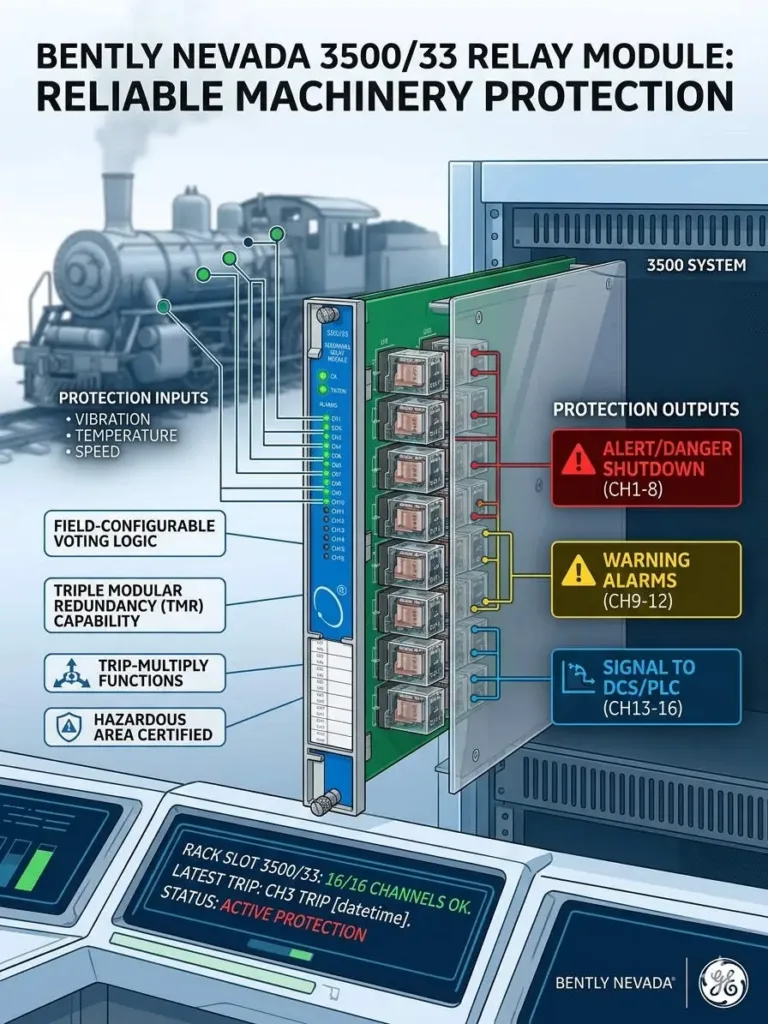
Bently Nevada 3500/33 Relay Module: Reliable Machinery Protection
Maximizing Machinery Uptime with the Bently Nevada 3500/33 Relay Module
The Bently Nevada 3500/33 serves as a vital safeguard in critical machinery protection systems. This 16-channel relay module converts vibration and process data into actionable alarm signals. Consequently, it triggers immediate shutdowns to prevent catastrophic equipment failure. In high-stakes sectors like oil & gas and power generation, every millisecond counts. This module ensures a deterministic response to abnormal conditions, protecting multi-million dollar assets from severe mechanical damage.
Environmental Tolerance and Cabinet Deployment
The 3500/33 module operates effectively within a temperature range of -30°C to +65°C. This range covers most standard industrial automation control rooms. However, extreme desert heat or sub-zero winters present significant challenges for outdoor installations. Without proper climate control, relay contacts may drift or fail prematurely. Therefore, we recommend using climate-controlled enclosures for any deployment outside of a regulated facility.
Expert Insight from PLCDCS HUB: We often see modules fail because of “passive cooling” assumptions. In our experience, high-density 3500 racks generate internal heat that exceeds ambient temperatures. Always calculate the thermal load of your cabinet before commissioning.
Optimizing Relay Response and System Reliability
Fast relay actuation is critical for protecting rotating equipment like turbines and compressors. The 3500/33 processes signals from the backplane with minimal latency. This speed ensures timely machine trips, which reduces mechanical stress during a surge event. Furthermore, the module supports complex DCS voting logic, such as 2-out-of-3 configurations. These schemes significantly improve system reliability by reducing the risk of nuisance trips while maintaining safety integrity.
Strategic Integration within the 3500 Series
The 3500/33 integrates seamlessly into the 3500 Series Machinery Protection System. It provides highly configurable logic through the 3500 Rack Configuration Software. Moreover, it maintains backward compatibility with older rack versions. Engineers must verify firmware revisions during integration, as mismatches can trigger communication faults. Proper configuration ensures that the factory automation layer receives accurate status updates from the protection system.
Technical Best Practices for Installation
Successful field performance depends on rigorous installation standards. Follow these technical guidelines to ensure long-term stability:
- ✅ Enclosure Rating: Use IP54 or higher enclosures to protect against dust and moisture.
- ✅ Condensation Control: Install anti-condensation heaters in humid or coastal environments.
- ✅ Vibration Resistance: Secure all wiring with industrial-grade cable clamps to prevent loose terminals.
- ✅ Surge Mitigation: Add external transient voltage protectors on relay outputs for long cable runs.
Buyer’s Selection Strategy for Protection Modules
Selecting the right relay module requires a deep understanding of your operational environment. While the 3500/33 offers high channel density, its performance relies on stable power and cooling. If you are upgrading a legacy control system, evaluate your current rack power supply capacity. High-density relay modules can increase the overall current draw of the 3500 rack significantly.
Application Scenarios and Solutions
- Gas Turbine Protection: Triggers emergency shutdowns during high-vibration events to save the rotor.
- Centrifugal Compressor Safety: Integrates with anti-surge systems to provide secondary mechanical protection.
- Remote Pumping Stations: Offers reliable, unattended alarm monitoring in isolated geographical locations.
For genuine Bently Nevada components and expert technical support, visit PLCDCS HUB Limited. Our team provides the reliable hardware your machinery protection systems require to operate safely.
Frequently Asked Questions (FAQ)
1. Can I use the 3500/33 for safety-instrumented functions (SIF)?
Yes, the 3500/33 is often used in safety loops. However, you must verify the SIL (Safety Integrity Level) rating of the entire rack configuration to meet your specific plant safety requirements.
2. How do I handle a “Configuration Mismatch” error after replacement?
This usually happens when the new module has a different firmware version than the rack. Use the 3500 Configuration Software to upload the current rack settings to the new module.
3. Is there a specific torque setting for the terminal blocks?
Yes, refer to the Bently Nevada manual for specific torque specs. Over-tightening can damage the board, while under-tightening leads to intermittent signal spikes in high-vibration areas.


