
Bently Nevada 3500/22M to Siemens S7-1500 Integration Guide
Integrating Bently Nevada 3500/22M with Siemens S7-1500 PLC Systems
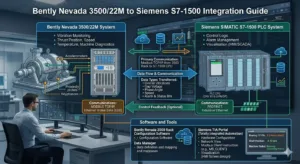
The Bently Nevada 3500/22M Transient Data Interface (TDI) serves as a critical communication gateway. It bridges the gap between specialized machinery protection and standard industrial automation layers. This module collects vital vibration and temperature data for high-speed machinery. Consequently, it allows engineers to feed condition monitoring data directly into a Siemens S7-1500 PLC. This integration is essential for modern predictive maintenance strategies in oil & gas and power generation.
Optimizing Modbus TCP Protocol Compatibility
The 3500/22M utilizes Modbus TCP to share data with external control systems. However, the Siemens S7-1500 requires specific configuration to act as a Modbus client. You must utilize TIA Portal MB_CLIENT blocks or a dedicated communication processor (CP). Mismatched protocol settings often cause delayed commissioning or unstable data links. Therefore, engineers should verify communication parameters early in the design phase to avoid integration bottlenecks.
Expert Insight from PLCDCS HUB: We often see projects stall due to simple Modbus mapping errors. Always confirm your register map before writing complex PLC logic. A small offset error can lead to completely incorrect vibration readings in your DCS or SCADA interface.
Aligning Data Throughput with PLC Scan Cycles
Timing issues often arise when high-speed protection systems meet standard factory automation controllers. The 3500/22M transmits buffered data, but the S7-1500 operates on a fixed scan cycle. If the PLC polls too slowly, operators see stale values on their HMI. Conversely, polling too fast may overload the network. Achieving the right balance ensures that the system detects machinery faults in real time without compromising network stability.
Architectural Redundancy and System Reliability
Critical rotating equipment like turbines requires a robust system architecture. The 3500 rack often features internal redundancy for maximum protection. However, a single-point failure in the PLC can undermine this safety. To maintain balance, consider using a redundant S7-1500R/H CPU. In addition, implementing a Media Redundancy Protocol (MRP) ring topology enhances the reliability of the entire industrial automation network.
Technical Best Practices for Field Installation
Industrial environments generate significant electromagnetic interference (EMI) near large motors. This noise can easily corrupt Ethernet packets and drop communication links. Follow these technical steps for a stable installation:
- ✅ Shielded Cabling: Use industrial-grade Cat6A STP cables to block external noise.
- ✅ Proper Grounding: Ground the shield at one end only to prevent ground loops.
- ✅ Network Segregation: Use VLANs to separate time-critical control traffic from plant IT data.
- ✅ Address Validation: Use a Modbus test tool to verify register data before PLC integration.
Effective Power Management and Surge Protection
Voltage transients can damage sensitive electronics in the 3500 rack and the PLC. In outdoor or remote locations, lightning strikes pose a serious threat to uptime. We recommend installing external surge protection devices (SPD) on all communication and power lines. Moreover, providing a dedicated Uninterruptible Power Supply (UPS) prevents data loss during transient power events. These steps ensure that your control systems remain online during critical machinery startups.
Strategizing Your Machinery Protection Upgrades
Upgrading legacy monitoring systems requires careful planning. While the 3500/22M is powerful, it has limited direct compatibility with older Bently Nevada 3300 series hardware. Often, a full system migration provides better long-term value than a partial upgrade. Before procurement, confirm that your current firmware versions support the necessary Modbus TCP features. This prevents unexpected hardware conflicts during the installation phase.
Looking for genuine 3500 series modules or S7-1500 components? Visit PLCDCS HUB Limited for expert technical advice and high-quality parts. Our team helps you build reliable industrial automation solutions that last.
Application Scenario: Turbine Monitoring
In a gas turbine application, the 3500/22M monitors bearing vibration and axial thrust. The Siemens S7-1500 receives this data to trigger an orderly shutdown if vibration exceeds safety limits. This setup prevents catastrophic mechanical failure while providing detailed data for post-event analysis.
Frequently Asked Questions (FAQ)
1. Can I connect the 3500/22M directly to a Siemens PLC without a gateway?
Yes, you can use the built-in PROFINET port on the S7-1500 via Modbus TCP blocks. However, for systems with high data traffic, a dedicated CP module or gateway often improves overall PLC performance and reliability.
2. How do I handle “Endians” when reading vibration values?
The 3500/22M and S7-1500 often use different byte orders for floating-point numbers. If your vibration readings look like random characters, you likely need to swap the bytes or words in the PLC buffer. Most experienced integrators use a “SWAP” function to fix this instantly.
3. Does the 3500/22M support data logging if the PLC connection drops?
The 3500/22M focuses on data transmission and transient capture. While it has internal memory for event files, it is not a long-term historian. We recommend using a DCS or dedicated historian software to store data for long-term trend analysis.
Related Posts


No Comments