
CC-PFB401 Profibus DP Module Performance & Installation Tips
Enhancing Network Determinism with the Honeywell CC-PFB401 Profibus DP Module
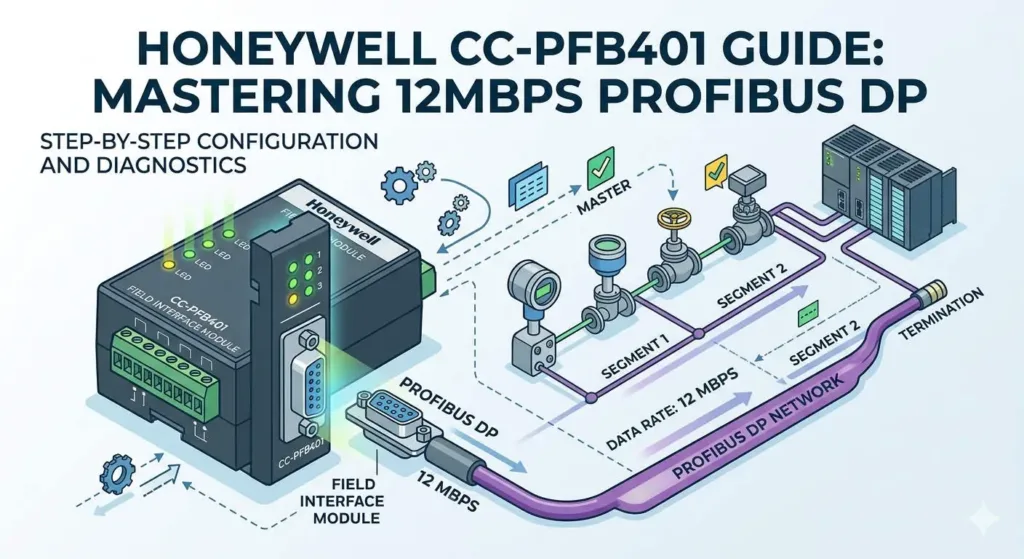
The Honeywell CC-PFB401 serves as a high-performance Profibus DP interface within the Experion DCS architecture. It enables stable and deterministic communication between central controllers and distributed field devices. This module is essential for industries requiring rapid data exchange, such as pharmaceutical and petrochemical sectors. By providing a robust link to the field, it ensures that critical process data remains synchronized and reliable.
Maximizing Throughput with 12 Mbps Communication
The CC-PFB401 supports the full spectrum of Profibus DP baud rates up to 12 Mbps. This high-speed capability significantly reduces network scan cycles for the control systems. Fast polling is vital for high-speed batching and burner management systems. However, 12 Mbps operation demands strict adherence to installation standards. According to PROFIBUS & PROFINET International (PI), high speeds limit segment lengths to approximately 100 meters without repeaters.
Expert Insight from PLCDCS HUB: We often observe engineers choosing 1.5 Mbps or 6 Mbps for long-term stability. Unless your process requires microsecond responsiveness, a slightly lower baud rate offers much better noise immunity. In industrial automation, reliability usually trumps raw speed.
Optimizing Maintenance via Profibus DP-V1 Support
This module supports both DP-V0 and DP-V1 communication profiles for comprehensive device management. While DP-V0 handles cyclic I/O data, DP-V1 allows for acyclic diagnostics and parameterization. This feature enables engineers to configure smart valve positioners and analyzers remotely. Consequently, maintenance teams can troubleshoot field devices without leaving the control room. This capability directly reduces plant downtime and improves overall factory automation efficiency.
Ensuring Network Stability in High-Interference Zones
Industrial environments often face significant electromagnetic interference (EMI) from large motor drives. The CC-PFB401 features advanced isolation to maintain signal integrity under these harsh conditions. However, the physical network design ultimately determines the success of the communication link. Proper grounding and shielding are mandatory to prevent random node dropouts. We recommend using double-shielded cables specifically rated for Profibus DP applications.
Installation Guidelines for Reliable Profibus Deployment
Poor installation remains the leading cause of communication faults during commissioning. Follow these technical best practices to ensure a stable network:
- ✅ Shielding Protocol: Ground the cable shield at one side to prevent ground loops.
- ✅ Distance Accuracy: Match your baud rate to the actual segment length of the cable.
- ✅ Termination Check: Confirm exactly two active termination resistors exist per segment.
- ✅ Cable Separation: Route Profibus data lines away from high-voltage power cables.
Strategic Selection for Legacy System Upgrades
The CC-PFB401 is highly compatible with legacy Profibus DP-V0 slave devices. This makes it an excellent choice for modernizing older PLC or DCS networks. However, you must always verify the GSD file version of third-party hardware. Mismatched GSD files often lead to intermittent communication loss that mimics hardware failure. Performing a comprehensive network scan before full integration is a best practice for any migration project.
Application Scenarios and Solutions
- Pharmaceutical Batching: Ensures precise timing and synchronization for sensitive chemical mixing processes.
- Refinery Offloading: Manages distributed flow meters across large distances with high reliability.
- Power Generation: Provides fast data updates for auxiliary control loops in turbine management.
Are you looking to optimize your Profibus network or source genuine Honeywell modules? Discover our full range of technical solutions and inventory at PLCDCS HUB Limited today. We help you build more resilient automation infrastructures.
Frequently Asked Questions (FAQ)
1. Can I mix different baud rates on the same CC-PFB401 segment?
No, every device on a single Profibus segment must operate at the same baud rate. If you need 12 Mbps for some devices and lower speeds for others, you must use a bridge or separate segments.
2. How do I know if my network can realistically support 12 Mbps?
Perform a cable length audit first. If any segment exceeds 100 meters without a repeater, 12 Mbps will likely cause errors. We recommend a baud rate of 1.5 Mbps for segments up to 400 meters.
3. What should I do if the module reports a “GSD Error”?
This usually means the configuration in your DCS does not match the device hardware version. Download the latest GSD file from the device manufacturer and re-import it into your Honeywell configuration tool.
Related Posts



No Comments