
CC-TAID01 Base Module | Insulation Stability in Industrial Automation
Ensuring Signal Integrity with the Honeywell CC-TAID01 I/O Base
The Honeywell CC-TAID01 base module provides essential electrical isolation for high-stakes industrial automation environments. In sectors like steel processing and petrochemical refining, heat often degrades insulation. This module maintains stable performance even when temperatures exceed 60°C. Therefore, it prevents signal drift and costly unplanned shutdowns. High-quality base modules protect the entire DCS architecture from intermittent faults.
Maintaining Insulation Stability in High-Heat Zones
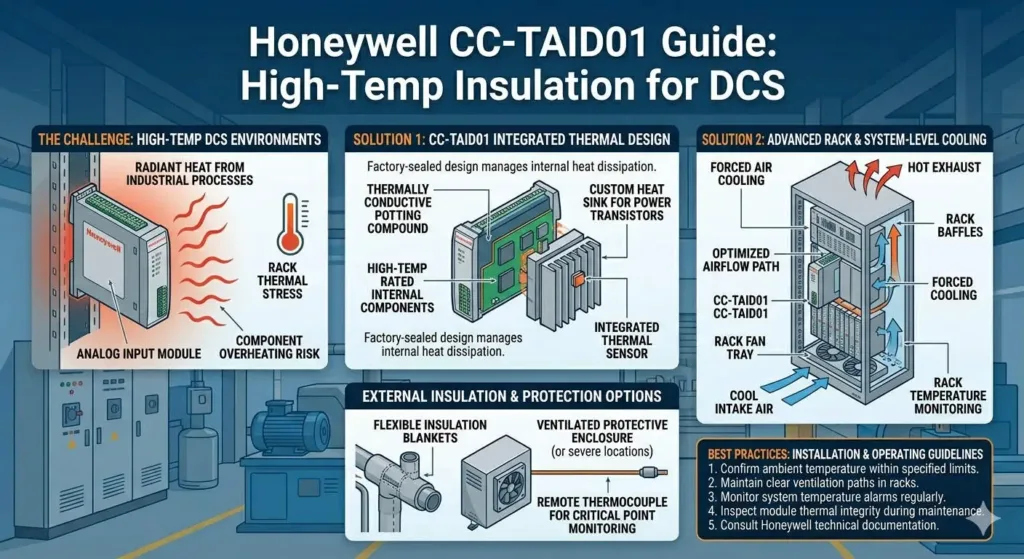
Industrial environments frequently reach temperatures up to 70°C inside control cabinets. The CC-TAID01 excels by resisting the natural drop in insulation resistance at these levels. However, poor ventilation near heat sources can still increase leakage currents. High heat often introduces noise into sensitive 4–20 mA analog signals. As a result, measurement drift can lead to off-spec products in continuous manufacturing.
Expert Insight from PLCDCS HUB: We often see engineers overlook cabinet internal temperatures. While the room might feel cool, the space near PLC processors often runs 15°C hotter. Always verify local thermal conditions to protect your signal accuracy.
Dielectric Strength and Environmental Reliability
The CC-TAID01 adheres to strict IEC 61010 and IEC 60068 standards for environmental stress testing. This compliance ensures the module survives thermal shocks and high humidity. In coastal chemical plants, humidity combined with heat accelerates insulation weakening. This can cause channel-to-channel interference or false signal spikes. Relying on certified hardware reduces the risk of ground leakage trips during critical operations.
Strategic Thermal Management for Control Systems
Thermal design directly impacts the Mean Time Between Failures (MTBF) of your hardware. The CC-TAID01 reliability depends heavily on proper factory automation cabinet layouts. For every 10°C increase above nominal ratings, insulation materials age twice as fast. Consequently, engineers should avoid placing these bases directly above power supplies. Forced ventilation or heat exchangers remain the best defense against heat-induced aging.
Installation and Maintenance Technical Best Practices
Optimizing the lifespan of your I/O base requires disciplined installation and regular checks. Use the following technical guidelines to ensure maximum uptime:
- ✅ Thermal Layout: Maintain vertical spacing between I/O bases and high-heat modules.
- ✅ Wiring Standards: Use cables rated for at least 90°C in high-temperature zones.
- ✅ Terminal Maintenance: Regularly tighten terminals to counter thermal expansion and vibration.
- ✅ Insulation Testing: Use a megohmmeter during shutdowns to verify resistance against baselines.
Buyer’s Guide for Honeywell Series C Hardware
When procuring the CC-TAID01, verify your specific system revision levels first. While this base fits within the Experion PKS family, mechanical fit and firmware compatibility vary. Do not assume every Series C base is a universal drop-in replacement. We recommend cross-referencing Honeywell documentation to avoid delays during your maintenance window. Investing in genuine, high-temp rated bases prevents the “ghost faults” that plague older systems.
Application Scenarios and Industry Solutions
- Petrochemical Refining: Maintains accurate pressure monitoring in high-ambient-heat distillation units.
- Steel Manufacturing: Protects I/O signals near furnaces where thermal radiation is extreme.
- Offshore Platforms: Resists insulation degradation caused by combined salt spray and high temperatures.
For high-performance components and expert technical guidance, visit the PLCDCS HUB Limited website today. Explore our full range of control systems hardware to secure your plant’s future.
Frequently Asked Questions (FAQ)
1. Can the CC-TAID01 handle continuous operation at 70°C?
The module can survive these peaks, but long-term reliability drops significantly. We recommend keeping the sustained temperature below 60°C to maximize the hardware lifespan and prevent signal noise.
2. Why does my DCS show analog fluctuation despite the I/O card being new?
The issue often lies in the base insulation rather than the card. In our experience, heat-damaged bases create leakage currents that “pollute” the signal before it reaches the card electronics.
3. Is the CC-TAID01 compatible with third-party mounting rails?
This base is designed specifically for the Honeywell Series C carrier system. Using non-standard mounting can compromise grounding and heat dissipation, so we advise sticking to the original architectural specifications.
Related Posts


No Comments