
CC-Link vs EtherCAT vs EtherNet/IP: Industrial Ethernet Guide
Comparing CC-Link, EtherCAT, and EtherNet/IP for Modern Industrial Networks
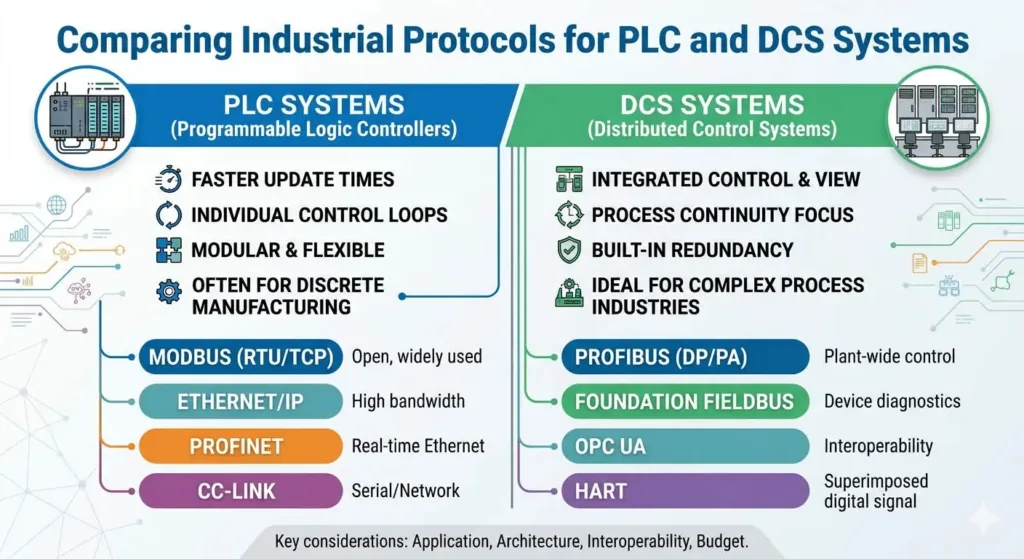
Industrial Ethernet protocols dictate the efficiency and scalability of modern industrial automation. Choosing between CC-Link, EtherCAT, and EtherNet/IP involves more than just comparing spec sheets. These standards define how control systems interact with field devices in real-time. Engineers must balance raw speed with long-term maintainability and global hardware availability.
At PLCDCS HUB, we believe the right protocol choice prevents costly bottlenecks. While EtherCAT dominates high-speed motion, EtherNet/IP offers unparalleled IT-layer integration. Meanwhile, CC-Link remains the gold standard for many Asian manufacturing ecosystems. Understanding these nuances ensures your factory automation remains future-proof.

Speed and Determinism: Meeting Real-Time Demands
Timing accuracy varies significantly across these three major protocols. EtherCAT utilizes “processing on the fly” to achieve sub-millisecond cycle times. This makes it the premier choice for synchronized servo drives and robotics. In contrast, CC-Link IE typically operates in the 1ms range, which suits most discrete manufacturing tasks perfectly.
- ✅ EtherCAT: Offers ultra-low jitter for precise motion control.
- ✅ CC-Link IE: Provides high-bandwidth gigabit speeds for data-heavy applications.
- ✅ EtherNet/IP: Leverages CIP Sync for synchronization over standard Ethernet.
We often notice that EtherNet/IP performance depends heavily on network infrastructure. Without proper segmentation, standard office traffic can introduce unpredictable delays. Therefore, engineers must implement Quality of Service (QoS) to maintain control stability.
Network Topology and System Scalability
Each protocol handles physical connections differently. EtherCAT supports flexible line, tree, or ring structures without requiring expensive managed switches. This reduces hardware costs and simplifies the physical layout. However, CC-Link IE emphasizes reliability through native ring redundancy, which is vital for continuous production lines.
EtherNet/IP follows a traditional star topology using standard Ethernet switches. This approach allows for massive scalability in large-scale DCS environments. However, it increases the complexity of switch configuration. For large petrochemical plants, the familiarity of EtherNet/IP with existing IT tools provides a significant operational advantage.
Global Ecosystem and Vendor Compatibility
Market presence often dictates protocol selection. Rockwell Automation and Schneider Electric strongly support EtherNet/IP through the ODVA organization. It integrates seamlessly with Enterprise Resource Planning (ERP) systems. Alternatively, Mitsubishi Electric champions CC-Link, making it highly prevalent across the Asian automotive industry.
- ⚙️ EtherNet/IP: Best for deep integration with MES and IT networks.
- ⚙️ EtherCAT: Offers a vast ecosystem of high-performance third-party I/O.
- ⚙️ CC-Link: Known for extreme robustness in high-interference environments.
A frequent mistake we see is assuming all “compatible” devices work identically. Always verify the specific profile support for third-party modules. Minor firmware differences can lead to intermittent communication dropouts during commissioning.
Best Practices for Installation and Maintenance
Physical layer integrity is critical for all industrial automation networks. High-noise environments, such as steel mills, require strict adherence to shielding standards. Improper grounding often leads to mysterious “ghost” faults that are difficult to diagnose.
- 🔧 Use industrial-grade Cat5e or Cat6 cables with proper shielding.
- 🔧 Separate communication lines from high-power VFD cables.
- 🔧 Implement single-point grounding to prevent damaging ground loops.
During one refinery project, moving EtherNet/IP cables just 30cm away from power lines eliminated random I/O errors. Never underestimate the impact of electromagnetic interference on your network stability.
Application Case: High-Speed Packaging Line
A recent packaging client moved from a legacy fieldbus to EtherCAT for their PLC system. This change reduced cycle times by 40% and improved labeling accuracy. By utilizing EtherCAT’s distributed clocks, the client achieved perfect synchronization across twenty servo axes.
For high-quality communication modules and replacement parts, visit PLCDCS HUB Limited. We stock essential hardware for all major industrial protocols.
Industrial Protocol FAQ
Which protocol is easiest to troubleshoot for maintenance teams?
EtherNet/IP is often the easiest because it uses standard IT diagnostic tools. Most technicians already understand basic Ethernet troubleshooting, IP addressing, and ping commands.
Can I mix EtherCAT and EtherNet/IP on the same physical cable?
Generally, no. EtherCAT uses a unique frame structure that standard Ethernet switches do not support. You should maintain dedicated cabling or use a specialized gateway to bridge these networks.
Is CC-Link IE still relevant for new global projects?
Yes, especially if you use Mitsubishi hardware. It offers one of the most stable gigabit architectures available and provides exceptional noise immunity in heavy industrial settings.
Expert Note: The “best” protocol is the one your team can support effectively. Performance specs matter, but local technical expertise and spare parts availability usually determine long-term success.
Related Posts
