
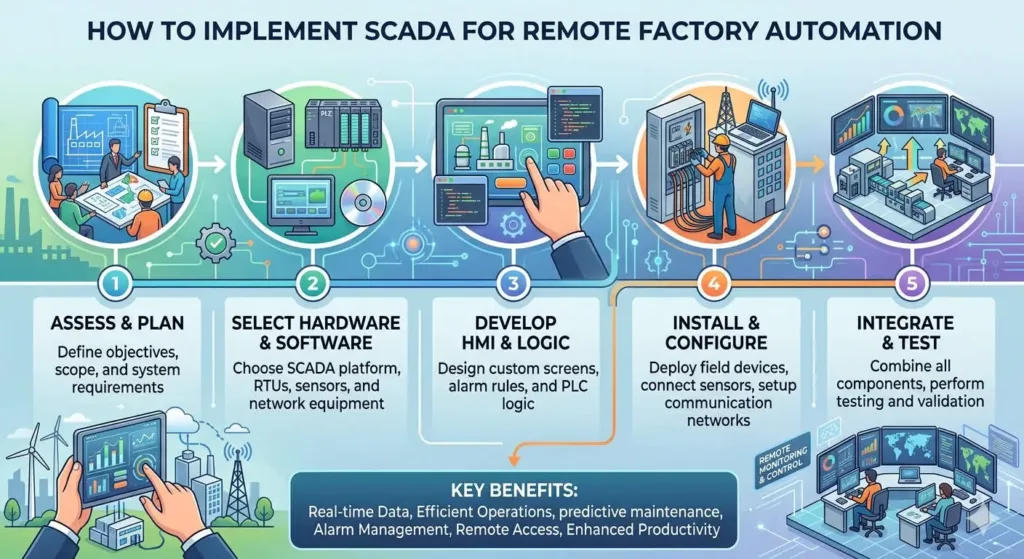
How to Implement SCADA for Remote Factory Automation
Modern Strategies for Remote SCADA Monitoring in Distributed Factories
Managing multi-site industrial operations presents significant visibility challenges for modern engineers. Geographically dispersed plants often suffer from delayed decision-making due to fragmented data. A robust SCADA system bridges this gap by centralizing alarms, monitoring, and historical analysis. Therefore, companies can maintain operational continuity across various locations simultaneously.
In high-stakes industries like oil and gas, remote monitoring ensures safety and efficiency. It allows expert teams to oversee operations even with limited on-site staffing. This architectural approach transforms raw data into actionable insights for better factory automation management.
Ensuring Protocol Compatibility Across Heterogeneous Systems
Your SCADA platform must support diverse industrial protocols to function effectively. Common standards include Modbus TCP, OPC UA, and DNP3. Compatibility determines if you can integrate existing PLCs or DCS units without expensive hardware changes.
- ✅ Prioritize OPC UA for secure and vendor-neutral data exchange.
- ✅ Validate protocol converter performance in brownfield environments early.
- ✅ Avoid data gaps by ensuring native driver support.
At PLCDCS HUB, we notice that legacy Modbus RTU devices often struggle with high latency. Adding too many converters can destabilize communication. We recommend auditing your device library before selecting a SCADA software vendor.
Balancing Data Latency and Network Polling Rates
The polling interval defines the responsiveness of your remote monitoring system. Faster polling improves alarm reaction times but increases the network load significantly. Conversely, slower rates save bandwidth but might delay critical fault detection.
In chemical processing, engineers typically set critical pressure loops to sub-second polling. However, non-critical utility levels can function perfectly with 5 to 10-second intervals. Finding this balance prevents network congestion while maintaining strict safety standards.
Strengthening Cybersecurity and Network Reliability
Remote SCADA relies heavily on WAN connections like VPNs or 5G cellular networks. Modern industrial automation requires encrypted tunnels and firewall segmentation to protect sensitive data. Unstable networks lead to false alarms or unauthorized system access.
- 🛡️ Follow IEC 62443 standards for comprehensive industrial cybersecurity.
- 🛡️ Implement redundant communication paths to ensure high availability.
- 🛡️ Use IPSec VPNs to protect data across public networks.
Cybersecurity is no longer optional for control systems. Adhering to NIST SP 800-82 guidelines helps safeguard your infrastructure from external threats. A secure network is the backbone of any successful remote operation.
Deploying Edge Gateways for Local Data Buffering
Directly connecting a remote PLC to a central server via the internet is risky. Instead, use an industrial IoT gateway to act as a local buffer. This “store-and-forward” capability prevents data loss during temporary network outages.
From our experience at PLCDCS HUB, missing data can ruin compliance reports in pharmaceutical plants. A simple 4G drop can delete hours of traceability without edge buffering. Always place a rugged gateway near your field devices for maximum reliability.
Advanced Maintenance: Surge Protection and Alarms
Remote sites in mining or oil fields face high exposure to lightning. Communication modules often fail before the main CPU during a power surge. Therefore, installing external surge protection devices (SPD) is a critical maintenance step.
- 🔧 Maintain grounding resistance below 4 ohms for safety.
- 🔧 Categorize alarms based on ISA 18.2 industry standards.
- 🔧 Filter redundant alerts to prevent operator alarm fatigue.
Effective alarm management is just as important as technical connectivity. If operators receive 3,000 unfiltered alerts, they will eventually ignore the system. Streamlining these notifications ensures that critical issues get the attention they deserve.
Solution Scenario: Multi-Site Water Treatment
A regional water authority successfully integrated twenty remote pump stations into a central SCADA hub. By using cellular VPNs and edge gateways, they reduced on-site inspections by 40%. The system now provides real-time flow data and instant leak detection alerts.
To find the best hardware for your remote monitoring project, visit PLCDCS HUB Limited. We offer a wide range of PLC and DCS modules to keep your factory connected.
Frequently Asked Questions
How can I tell if my old PLC is ready for remote SCADA?
Verify if your controller supports Ethernet ports or OPC UA communication. If it only uses serial RS232/RS485, you will need a protocol gateway to bridge it to the modern network.
Will a new SCADA system work with my legacy field equipment?
Most platforms support legacy protocols like Modbus RTU. However, advanced diagnostics often require modern hardware. Always request a compatibility matrix from your vendor before purchasing.
What is the most common cause of remote communication failure?
In our experience, electrical noise and poor grounding cause the most frequent drops. Ensure your shielding is correct and use high-quality industrial-grade switches to minimize these issues.
Author’s Note: Successful remote SCADA depends on meticulous architectural design rather than just software brand selection. Integrating networks, field devices, and cybersecurity requires a system-level perspective to survive real-world industrial constraints.


