
PLC Synchronization for Real-Time Motion Control | PLCDCS HUB
High-Speed PLC Synchronization for Real-Time Industrial Automation
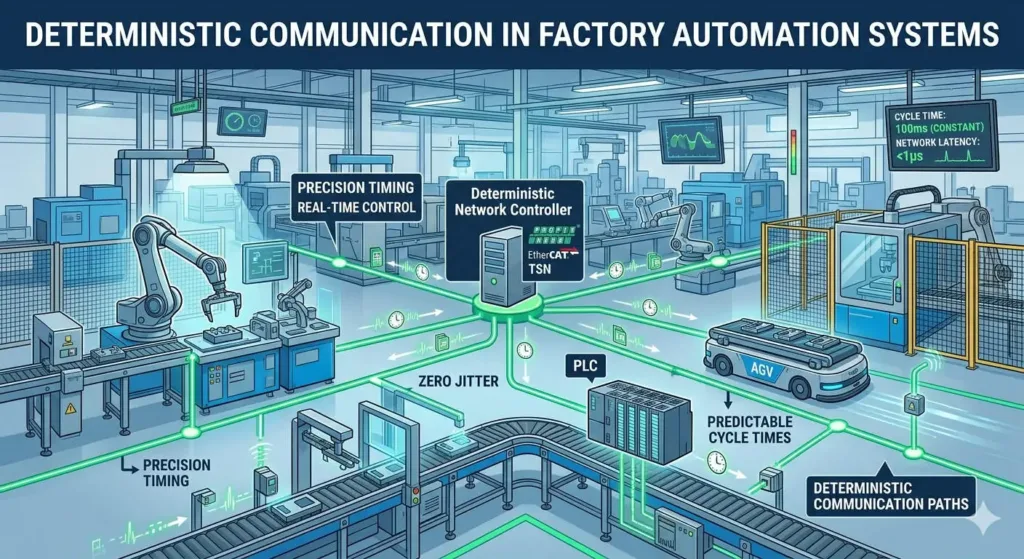
Precision synchronization between PLCs is vital for high-speed motion control applications today. Microsecond-level coordination directly impacts both product quality and equipment safety. Industries like semiconductor manufacturing and precision assembly rely on this timing. Misalignment often leads to product defects or mechanical damage. Therefore, engineers must build a deterministic data exchange architecture. This ensures tightly coordinated actions across the entire factory automation line.

Achieving Deterministic Communication Cycle Times
Cycle time defines how frequently controllers exchange critical synchronization data. In motion control, speed alone is insufficient. The communication must be deterministic. Most systems operate within the range of 250 µs to 10 ms. Inconsistent cycle times introduce jitter, which creates positional errors in multi-axis systems.
- ✅ Use EtherCAT for sub-millisecond precision requirements.
- ✅ Implement PROFINET IRT to guarantee bounded latency.
- ✅ Avoid standard Ethernet for high-speed labeling or packaging tasks.
At PLCDCS HUB, we have seen 1 ms delays cause significant misplacement in labeling machines. Choosing the right protocol from the start prevents these costly hardware recalibrations later.
Optimizing Network Topology and Bandwidth
The physical layout of your network determines how efficiently synchronization data travels. Poorly designed networks with excessive nodes introduce unpredictable delays. However, ring topologies like MRP or DLR significantly improve fault tolerance and reliability.
- ⚙️ Isolate real-time control traffic from standard IT data.
- ⚙️ Configure VLANs and QoS to prioritize motion synchronization packets.
- ⚙️ Follow IEC 62443 standards for control network isolation.
Moreover, mixing heavy diagnostic traffic with control loops can saturate bandwidth. We recommend dedicated switches for motion-intensive segments to ensure maximum stability.
Ensuring Precision Through Clock Alignment
Clock synchronization keeps all controllers on the same time base. Without alignment, even fast communication fails to produce coordinated execution. This is especially critical for electronic cam profiles and gearing. Most modern systems utilize IEEE 1588 PTP for sub-microsecond accuracy.
- 🔧 Deploy hardware-based timestamping for complex motion profiles.
- 🔧 Use EtherCAT Distributed Clocks for advanced axis coordination.
- 🔧 Verify that all modules support CIP Sync in EtherNet/IP environments.
Industrial Installation and Maintenance Best Practices
Electromagnetic interference (EMI) frequently plagues petrochemical plants and heavy industrial sites. Proper cable selection and grounding are the first lines of defense. Field experience shows that most synchronization losses stem from physical layer failures rather than software bugs.
- ✅ Select Cat6a shielded cables for high-noise environments.
- ✅ Terminate shields properly to avoid creating ground loops.
- ✅ Run communication lines away from high-power motor cables.
In addition, always use managed industrial switches. Commercial IT switches lack deterministic forwarding capabilities. They often cause sporadic motion faults that are difficult to diagnose during full production loads.
Strategic Guide for System Selection
Choosing the right protocol depends on your specific performance needs. For ultra-fast motion, EtherCAT remains the industry leader. However, for plant-wide compatibility across different brands, PROFINET IRT offers a more flexible architecture.
Always check if your CPU natively supports these protocols. Adding third-party gateways usually breaks determinism. If you are upgrading legacy systems, remember that software-only synchronization rarely reaches true real-time performance levels.
Application Case: Precision Packaging Line
A client recently integrated a multi-axis packaging system using EtherCAT. By leveraging distributed clocks, they reduced jitter to under 1 µs. This allowed the line to increase speed by 20% while maintaining perfect label alignment. If you need high-performance hardware for such demanding tasks, visit PLCDCS HUB Limited. We offer a wide range of motion control solutions and PLC modules.
Industrial FAQ
Which protocol is best for sub-millisecond motion control?
EtherCAT is generally the top choice due to its hardware-based distributed clock mechanism. It provides the lowest jitter for high-axis counts.
Can I use a standard Wi-Fi bridge for PLC synchronization?
No. Wireless networks introduce unpredictable latency. High-speed synchronization requires a wired, deterministic connection to ensure safety and precision.
How do I diagnose intermittent synchronization loss?
Start by checking your managed switch’s error counters for packet loss. Often, electrical noise or a loose shield termination on the Ethernet cable is the culprit.


