
CC-TUIO31 Switchover Glitch Analysis: Achieving Bumpless Transfer
Evaluating Signal Stability: Does the CC-TUIO31 Redundant Base Cause Glitches?
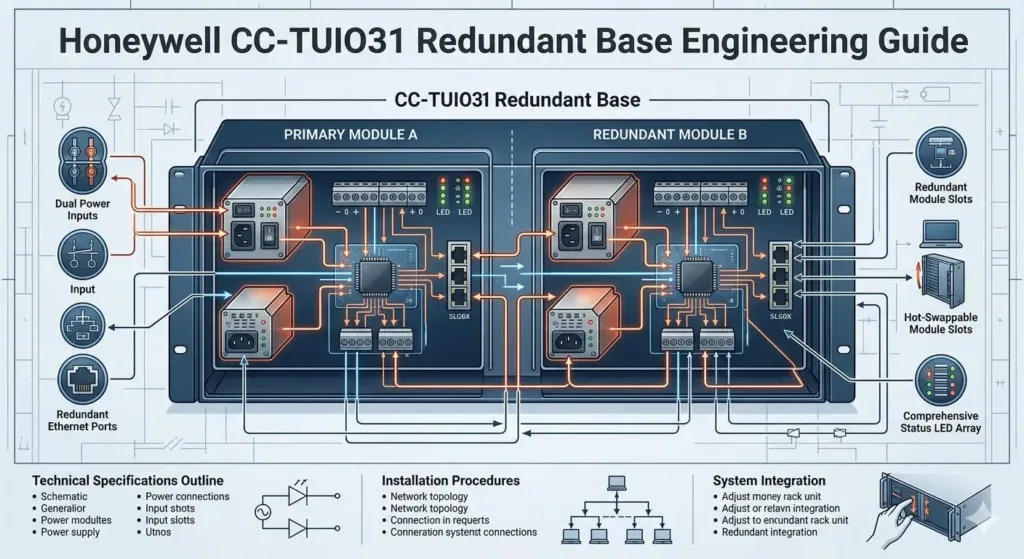
The Honeywell CC-TUIO31 redundant base serves as a critical safeguard against single-point failures in control systems. Its primary role involves facilitating a seamless transition between paired I/O modules during hardware or controller faults. In high-stakes environments like pharmaceutical manufacturing or oil and gas, signal continuity is mandatory. Even a brief disruption can trigger costly safety interlocks or process shutdowns. However, field data suggests that the CC-TUIO31 itself rarely introduces glitches when engineers follow proper design standards.
Understanding Switchover Response and Signal Continuity
Honeywell engineers the CC-TUIO31 with hot-standby redundancy logic for nearly instantaneous transitions. The secondary module takes control within milliseconds, ensuring factory automation processes remain stable. Moreover, the system utilizes state synchronization to mirror output values in real time. This mechanism supports a “bumpless transfer,” preventing sudden jumps in valve positions or motor speeds. While high-speed relays might detect micro-transients, a well-configured system avoids functional disruptions.
Expert Insight from PLCDCS HUB: In our observations, “glitches” reported by users often stem from external electrical artifacts. If your DCS architecture lacks synchronization, the fault usually lies in firmware mismatches rather than the physical baseplate hardware.
Backplane Integrity and Electrical Isolation Standards
The CC-TUIO31 provides dedicated redundant signal paths and channel isolation to prevent cross-talk. This design protects the system against transient coupling during active module switching. Furthermore, robust isolation helps mitigate ground loops, which frequently cause perceived signal spikes. In older plants, grounding often fails to meet modern IEC 61000 standards. Consequently, engineers may misdiagnose EMC-related noise as a hardware glitch. Maintaining electrical discipline is therefore vital for redundancy performance.
Managing Inductive Loads and Output Behavior
The module must hold its last-state value during the critical transition window. While resistive loads handle this transition easily, inductive loads like solenoids present unique challenges. These devices can generate back-EMF, appearing as a spike on diagnostic tools. As a result, engineers should always implement surge suppression to stabilize the electrical environment. Proper load management ensures the industrial automation hardware performs as intended during a switchover event.
Installation Best Practices for Maximum Reliability
Maximizing the performance of your PLC and DCS hardware requires meticulous installation. Follow these technical steps to eliminate phantom glitches:
- ✅ Shielding Discipline: Utilize shielded cables with single-point grounding to block high-frequency noise.
- ✅ Cable Separation: Maintain a 30 cm gap between low-voltage I/O and high-power cables.
- ✅ Load Protection: Install flyback diodes or RC snubbers on all inductive field devices.
- ✅ Pre-Live Testing: Perform manual switchover tests under load to verify system synchronization.
Strategic Buyer’s Perspective on Redundancy Hardware
The CC-TUIO31 offers practically bumpless transfer, but it is not a standalone solution for poor engineering. Total system health depends on grounding, shielding, and firmware alignment. When upgrading legacy systems, always check the Honeywell hardware compatibility matrix. Selecting the right combination of modules and bases is essential for long-term reliability in industrial automation projects.
For high-quality redundant hardware and expert technical guidance, explore the full catalog at PLCDCS HUB Limited. We provide the genuine components and expertise needed to secure your process uptime.
Application Case: Offshore Safety Systems
In offshore platforms, the CC-TUIO31 manages critical fire and gas detector inputs. By using redundant signal paths, the system remains active even during module maintenance. This prevents nuisance alarms and ensures the safety of the entire crew in hazardous zones.
Frequently Asked Questions (FAQ)
1. Can unsynchronized firmware cause a signal glitch during switchover?
Yes, this is a leading cause of instability. If the primary and secondary modules run different firmware versions, the “bumpless” transfer logic may fail. Always ensure both modules are identical before commissioning.
2. How can I distinguish between a hardware glitch and EMI?
Monitor the output with a high-resolution oscilloscope during a manual switchover. If noise persists while the system is idle, the issue is likely EMI or poor grounding rather than the redundant base.
3. Does the CC-TUIO31 require specific mounting orientations for cooling?
While the base is robust, vertical mounting is preferred to optimize airflow. Proper cooling prevents thermal drift, which can occasionally impact the precision of analog signals during high-load operations.
Related Posts


No Comments