
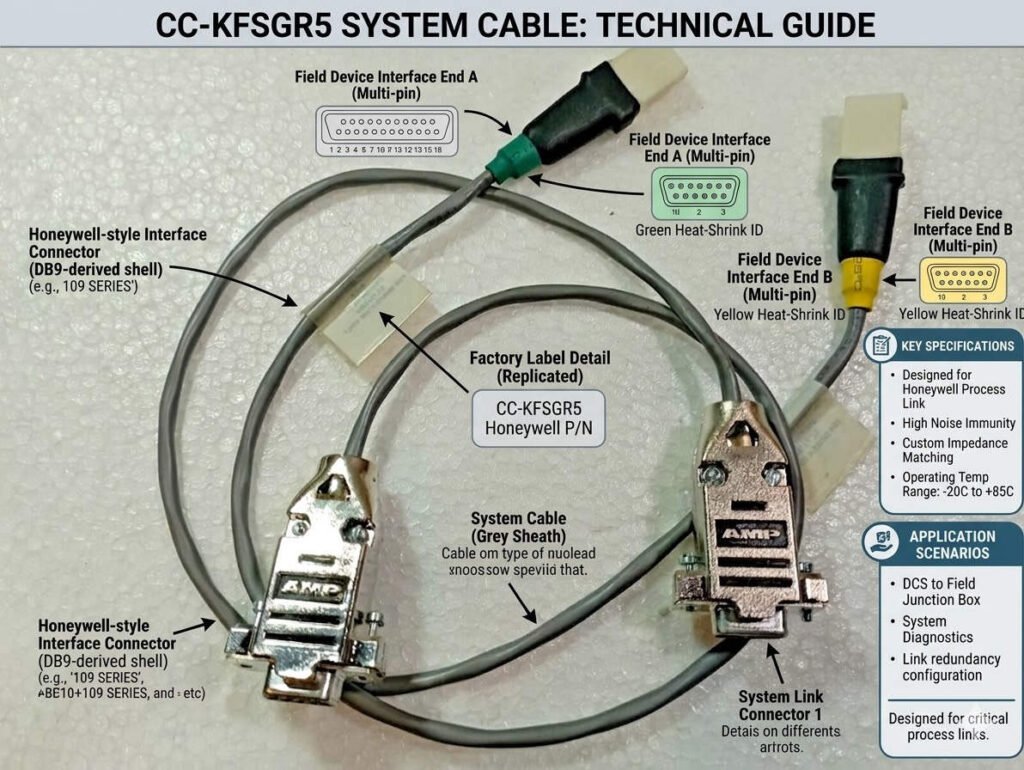
Honeywell CC-KFSGR5 Grounding Cable: C300 Cabinet Best Practices
Maximizing DCS Stability with the Honeywell CC-KFSGR5 Grounding Cable
The CC-KFSGR5 grounding cable plays a vital role in the Honeywell C300 cabinet ecosystem. It establishes a low-impedance, equipotential path between field signal references and the cabinet grounding system. This specialized component suppresses electrical noise and prevents destructive ground loops. In high-precision sectors like petrochemical and pharmaceutical manufacturing, grounding directly influences signal accuracy. At PLCDCS HUB Limited, we emphasize that proper grounding is the foundation of any reliable industrial automation architecture.
Ensuring Signal Integrity Through Low-Impedance Paths
Honeywell engineered the CC-KFSGR5 to provide a dedicated functional ground for sensitive electronics. This cable differs significantly from standard protective earth (PE) wiring. It specifically targets the reduction of analog signal drift in AI/AO modules. Therefore, the C300 controller maintains stable operations even in environments with heavy EMI. Proper implementation prevents nuisance trips that often stem from floating reference potentials in complex control systems.
Strategic Integration with C300 Cabinet Architecture
Standard Honeywell cabinets utilize three distinct grounding bars: Protective Earth (PE), Instrument Signal Ground (ISG), and Shield Ground (SG). You must connect the CC-KFSGR5 directly to the Instrument Signal Ground (ISG) busbar. This isolation ensures a clean reference point for critical control signals. Connecting to the PE bar instead could introduce high-frequency noise from heavy machinery. Following ISA-TR50.02 standards helps maintain the necessary separation between safety and signal grounding circuits.
Boosting EMC Performance in Factory Automation
Electromagnetic interference (EMI) remains a constant threat in modern factory automation. The CC-KFSGR5 facilitates the correct termination of shielded field wiring within the cabinet. As a result, the system experiences fewer transient stresses on I/O modules. This protection extends the hardware lifespan and improves the reliability of HART or 4–20 mA signals. Moreover, robust shielding ensures that nearby power equipment does not corrupt delicate process data.
Professional Installation and Maintenance Standards
A frequent error in the field involves bonding ISG and PE at multiple internal points. We recommend a strict single-point grounding strategy to avoid circulating currents. Technicians should use a multimeter to verify zero continuity between these systems except at the bonding link. In high-vibration areas like compressor stations, always utilize spring washers to maintain tight connections. Loose terminals frequently cause intermittent noise spikes that lead to unexplained DCS fluctuations.
Technical Summary and Best Practices
- ✅ Verify ISG Isolation: Ensure no unintended contact exists between signal ground and the cabinet frame.
- ✅ Check Torque Levels: Inspect grounding terminals 72 hours after the initial installation.
- ✅ Manage EMI Sources: Route the CC-KFSGR5 away from high-voltage AC power cables.
- ✅ Use Dedicated Bars: Always terminate on the designated Instrument Signal Ground busbar.
- ✅ Monitor Signal Drift: Audit grounding if analog values show inconsistent offsets.
The PLCDCS HUB Perspective on System Longevity
From our experience at PLCDCS HUB Limited, grounding is the most overlooked aspect of DCS maintenance. The CC-KFSGR5 is not just a wire; it is a precision component for noise management. We often find that “mysterious” I/O failures disappear after correcting the grounding topology. We suggest reviewing cabinet diagrams annually to ensure no unauthorized modifications have compromised the ISG circuit.
Solution Scenario: Petrochemical Facility Upgrade
During a recent refinery upgrade, a client reported fluctuating pressure readings in a VFD-controlled area. The investigation revealed that the field shields were bonded directly to the PE bar. After installing the CC-KFSGR5 and re-routing signals to the ISG bar, the noise dropped by 85%. This highlights why adhering to Honeywell’s grounding design is essential for continuous process stability.
Frequently Asked Questions
Q1: What happens if I accidentally connect the CC-KFSGR5 to the PE bar?
Connecting to the PE bar often introduces “dirty” electricity into your signal loop. This leads to unstable analog readings and potential communication errors in the PLC or DCS. Always stick to the ISG bar for reference grounding.
Q2: Does the CC-KFSGR5 protect against lightning strikes?
No, this cable is for functional signal grounding, not lightning protection. You must install dedicated Surge Protection Devices (SPD) for outdoor instrumentation. The SPD handles high-energy surges, while the CC-KFSGR5 manages low-energy signal noise.
Q3: Is this cable necessary for digital-only I/O modules?
Yes, because digital signals also rely on a stable reference voltage to distinguish between “on” and “off” states. High EMI can cause “ghost signals” in digital inputs without a solid grounding path provided by the CC-KFSGR5.
Need high-quality Honeywell parts for your next project? Explore our full catalog at
PLCDCS HUB Limited
for reliable industrial automation solutions.



No Comments