
Industrial Wireless Reliability: 4G, 5G & LoRa in Automation
Are 4G, 5G, and LoRa Reliable for Industrial Automation Networks?
Wireless technologies now solve a major pain point in industrial automation: reducing cabling costs while keeping data visible. In oil fields and chemical plants, these tools allow rapid deployment in remote areas. Engineers can monitor tank farms or rotating equipment without laying miles of expensive copper. When you engineer them correctly, these networks maintain operational continuity effectively.
Evaluating Latency and Determinism in Wireless Control Systems
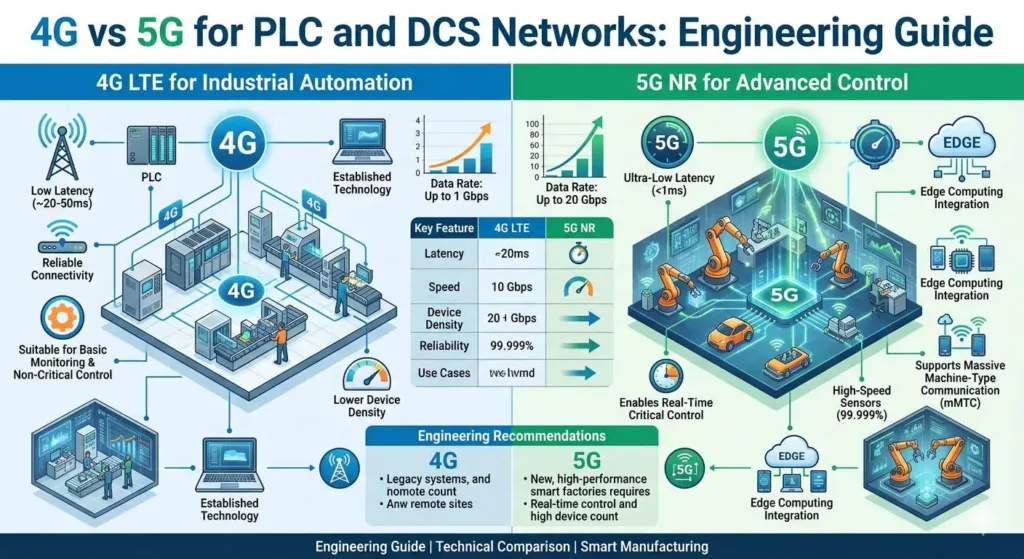
Latency remains a primary concern when moving away from wired control systems. Standard 4G networks usually deliver 30–50 ms of delay. However, 5G can drop below 10 ms in specific URLLC scenarios. This difference determines how you use the technology on the factory floor.
- ✅ Use 5G for near real-time monitoring and high-density sensor arrays.
- ✅ Reserve LoRa for non-critical tasks like environmental tracking.
- ✅ Avoid using wireless for high-speed motion control loops.
At PLCDCS HUB, we recommend wireless for SCADA and IIoT layers. It does not yet replace high-speed fieldbus for PID control. Use it to enhance visibility rather than replace your core DCS backplane.
Overcoming EMI and Structural Obstructions in Factories
Heavy machinery and steel structures create a hostile environment for radio signals. Electromagnetic interference (EMI) and metal walls often cause signal attenuation of up to 40 dB. Consequently, simple consumer-grade hardware will fail in these settings.
Industrial-grade devices must support wide temperature ranges from -20°C to +70°C. Furthermore, antenna placement dictates your actual signal quality more than raw transmit power. We often see “unreliable” complaints that actually stem from poor RF planning near VFD panels or high-voltage lines.
Ensuring Protocol Compatibility for PLC and DCS Integration
Wireless gateways must speak the language of existing factory automation hardware. Most units support Modbus TCP, OPC UA, or MQTT. However, the real challenge lies in how these protocols handle network jitter.
- ⚙️ Select gateways that offer robust store-and-forward buffering.
- ⚙️ Verify if your PLC supports the non-deterministic timing of wireless.
- ⚙️ Implement precise data timestamping to maintain record integrity.
Critical Installation Practices for Industrial Wireless
Field experience shows that antenna installation is more vital than device selection. Always mount antennas high above major metal obstructions. You should also use low-loss coaxial cables to prevent signal leakage at the connector level.
In addition, never ignore surge protection in outdoor settings like solar farms. Lightning can easily destroy sensitive communication modules. Therefore, install external surge arresters and ensure solid grounding for every remote node. Perform a 72-hour stability test before you sign off on commissioning.
Application Case: Remote Tank Farm Monitoring
A manufacturing plant recently used 4G gateways to bridge remote sensors to a central PLC. By selecting hardware with built-in protocol conversion, they avoided expensive trenching. This setup provided 99.9% uptime for non-critical level alarms.
Need reliable hardware for your next wireless project? Visit PLCDCS HUB Limited to find industrial-grade communication modules and controllers.
Industrial Wireless FAQ
When should I choose 5G over 4G for my plant?
Choose 5G if you need to connect hundreds of devices in a small area. It is also better for applications requiring latency under 20 ms, such as mobile robotics.
Is wireless safe for critical emergency shutdown systems?
Generally, no. We recommend keeping safety-instrumented systems (SIS) on dedicated, hard-wired paths. Use wireless only for monitoring and secondary alerts to ensure maximum safety.
How do I handle signal drops in a high-EMI environment?
Use high-gain directional antennas and move the gateway away from variable frequency drives (VFDs). Shielded cabling between the antenna and the router also reduces noise pickup.
Related Posts


No Comments