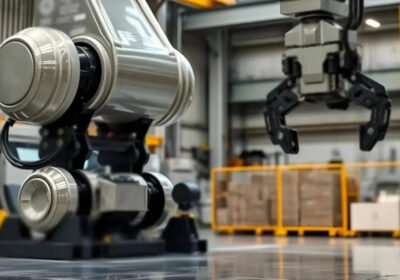
Integrating SCADA and IIoT for Enhanced Factory Automation
SCADA vs. IIoT: Convergence Strategies for Modern Industrial Automation
Defining the Roles of SCADA and IIoT in OT
Modern industrial environments often view SCADA and IIoT as competing technologies. However, at PLCDCS HUB, we see them as two sides of the same coin. SCADA provides the essential foundation for real-time monitoring and deterministic control. Meanwhile, IIoT extends these capabilities by offering superior data accessibility and advanced cloud analytics.

The Critical Importance of Deterministic Control
SCADA systems excel in environments requiring millisecond-level precision. Industries like pharmaceuticals and oil and gas depend on this deterministic response to maintain safety. These systems typically utilize robust protocols such as Modbus TCP or DNP3. Consequently, they handle mission-critical closed-loop controls where latency is not an option.
Scaling Operational Insights with IIoT Technology
IIoT platforms introduce IT-level scalability to the factory floor. By using lightweight protocols like MQTT, these systems aggregate massive datasets for predictive maintenance. However, engineers must remember that IIoT operates asynchronously. Therefore, you should never route primary control signals through high-latency IIoT gateways.
Bridging the Protocol Gap via OPC UA
Integrating legacy PLCs with modern IIoT platforms presents significant technical challenges. Many older controllers do not natively support cloud-friendly languages. We recommend using OPC UA as a universal bridge to simplify this integration. This approach reduces engineering hours and ensures seamless interoperability across different hardware brands.
Hardening Hardware for Harsh Industrial Climates
Environmental reliability remains a major differentiator between OT and IT hardware. Standard IIoT gateways often fail in high-humidity or high-vibration zones. Always specify edge devices that meet IEC 61000 and IEC 60068 standards. Investing in industrial-grade equipment prevents costly downtime and preserves your data pipeline integrity.
Implementing Mandatory Network Segmentation
Merging control traffic with data-heavy IIoT traffic creates significant cybersecurity risks. A flat network architecture often leads to broadcast storms and increased latency. We advise implementing strict VLAN segmentation. This isolation protects the core SCADA network while allowing IIoT devices to function efficiently.
Protecting Edge Assets from Electrical Surges
Field deployments, especially in outdoor settings, face constant threats from lightning and power fluctuations. Many compact IIoT gateways lack sufficient internal protection. Engineers should install external surge protection devices (SPD) on all communication lines. Additionally, ensure your grounding system measures less than 4Ω for maximum safety.
Ensuring Physical Reliability in High-Vibration Zones
Mechanical stress frequently causes standard RJ45 connectors to loosen over time. In areas with rotating machinery, these small failures stop production. We suggest using M12 industrial locking connectors for all critical Ethernet links. Proper cable strain relief and reinforced DIN rail mounting further enhance system longevity.
PLCDCS HUB Expert Perspective
At PLCDCS HUB, we believe the “SCADA vs. IIoT” debate misses the point. The goal is a unified architecture where SCADA ensures stability and IIoT drives optimization. Success depends on selecting the right interface hardware. Visit PLCDCS HUB Limited to explore high-performance components for your next automation project.
Technical Best Practices Checklist
- Select edge devices with wide operating temperature ranges.
- Use industrial firewalls to isolate the control layer.
- Verify that your PLC supports native OPC UA.
- Install external SPDs on all outdoor gateway installations.
- Avoid using consumer-grade hardware for 24/7 industrial operations.
- Map data tags carefully to prevent network congestion.
Practical Application Scenarios
- Remote Pipeline Monitoring: Use SCADA for local valve control and IIoT for leak detection analytics.
- Smart Manufacturing: Deploy SCADA for high-speed assembly and IIoT for OEE tracking.
- Predictive Maintenance: Feed vibration sensor data from SCADA to IIoT-based machine learning models.
Frequently Asked Questions
Q: Can IIoT hardware handle safety-instrumented functions (SIF)?
A: No, IIoT hardware generally lacks the SIL ratings required for safety functions. Stick to certified PLCs and SCADA for emergency shutdowns.
Q: What is the most cost-effective way to modernize a legacy DCS?
A: Instead of a full rip-and-replace, deploy an industrial edge gateway. This allows you to extract data without disturbing the existing control logic.
Q: How do I choose between an edge gateway and a PC-based collector?
A: Choose an edge gateway if space and power are limited. Use a PC-based collector if you require heavy local data processing.