HMI vs SCADA: Choosing the Right Industrial Control Hierarchy
HMI vs. SCADA: Why Your Factory Needs Both for True Operational Intelligence
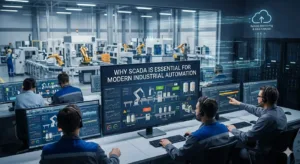
Many plant managers view a Supervisory Control and Data Acquisition (SCADA) system as merely a “larger HMI.” At PLCDCS HUB, we have observed that this misconception often leads to significant data bottlenecks. While a Human-Machine Interface (HMI) excels at local machine control, an upper-level system serves a fundamentally different purpose: enterprise-wide coordination and historical depth.
The Critical Functional Divide in Industrial Automation
In high-stakes sectors like pharmaceuticals and petrochemicals, the HMI handles immediate, tactical actions. It answers the urgent question: “Is the motor running now?” However, the upper-level system provides the strategic context. It investigates why that motor failed three times this month and how that failure impacted the overall production quota across multiple lines.
Data Logging and High-Resolution Historical Analysis
Standard HMIs face hardware limitations that restrict data storage to a few days. Conversely, SCADA systems utilize robust industrial servers to archive years of high-resolution telemetry. This capability is vital for factory automation teams performing root-cause analysis on intermittent faults. For instance, detecting a 2% temperature drift over a fiscal quarter is impossible without the historical resolution an upper system provides.
- ✅ Enables compliance with FDA 21 CFR Part 11 for electronic records.
- ✅ Identifies long-term equipment degradation patterns before a total breakdown occurs.
- ✅ Supports complex data visualization for executive-level decision-making.
Scaling Communication Protocols Across Heterogeneous Networks
Modern factories are rarely “single-brand” environments. An HMI typically talks to a specific PLC or a small cluster of controllers. Upper systems act as universal data hubs, integrating DCS, VFDs, and power analyzers into a single pane of glass. By using OPC UA gateways, these systems eliminate “data islands” where machines operate in isolation, hindering total plant optimization.
Advanced Alarm Management and System Safety
Relying solely on local HMI alarms often leads to “alarm flooding,” where operators are overwhelmed by non-critical notifications. High-level systems implement the ISA-18.2 standard for alarm management. These systems prioritize alerts, correlate related events, and escalate critical warnings to the right personnel via mobile or email if the local operator does not respond within a set timeframe.
Network Architecture and Cybersecurity Best Practices
A common mistake in control systems deployment is placing the HMI and SCADA on the same flat network. Our technical team recommends segmenting your architecture using VLANs or industrial firewalls. This separation ensures that a spike in supervisory data traffic does not interfere with time-critical PLC-to-HMI communication, significantly hardening your facility against cyber threats.
Ensuring System Stability and Power Reliability
Industrial PCs (IPCs) running upper-level software are far more sensitive to power quality than ruggedized HMIs. During commissioning, we frequently see systems crash due to voltage sags. Therefore, you must install an Uninterruptible Power Supply (UPS) and dedicated surge protection. Furthermore, you should optimize polling rates to prevent “network choking” on large-scale deployments.
Expert Insight from PLCDCS HUB
Transitioning from simple machine control to a layered supervisory architecture is not just a hardware upgrade. It is an investment in operational intelligence. A well-integrated SCADA system transforms raw electrical signals into actionable business insights. If your goal is Industry 4.0 readiness, the HMI is your eyes on the ground, but the SCADA system is the brain in the command center.
For high-quality industrial components and expert guidance on your next automation project, visit the specialists at PLCDCS HUB Limited today.
Practical Application Scenarios
- 🔧 Pharmaceutical Production: Using the upper system to generate automated batch reports for regulatory audits.
- 🔧 Multi-Line Manufacturing: Coordinating conveyor speeds across three different PLC brands to prevent bottlenecks.
- 🔧 Predictive Maintenance: Tracking vibration data over six months to schedule bearing replacements during planned downtime.
Frequently Asked Questions (FAQ)
Q1: Should I prioritize an HMI or a SCADA system when starting a small-scale pilot project?
If you are managing a single standalone machine, a high-performance HMI is usually sufficient for basic operation. However, if you plan to expand to three or more machines within a year, we recommend installing a small SCADA node early to avoid the high cost of retrofitting data logging later.
Q2: My SCADA system is lagging; do I need a faster PLC?
Not necessarily. Lag is often caused by aggressive polling rates (e.g., requesting data every 100ms when 1s is sufficient). Before upgrading hardware, try optimizing your communication tags and implementing “Report by Exception” (RBE) to reduce network load.
Q3: Is it possible to use a standard office PC as my “upper system” to save costs?
We strongly advise against this. Office PCs lack the thermal management, ECC memory, and vibration resistance required for 24/7 industrial environments. Investing in a dedicated Industrial PC (IPC) prevents costly production stoppages caused by consumer-grade hardware failure.