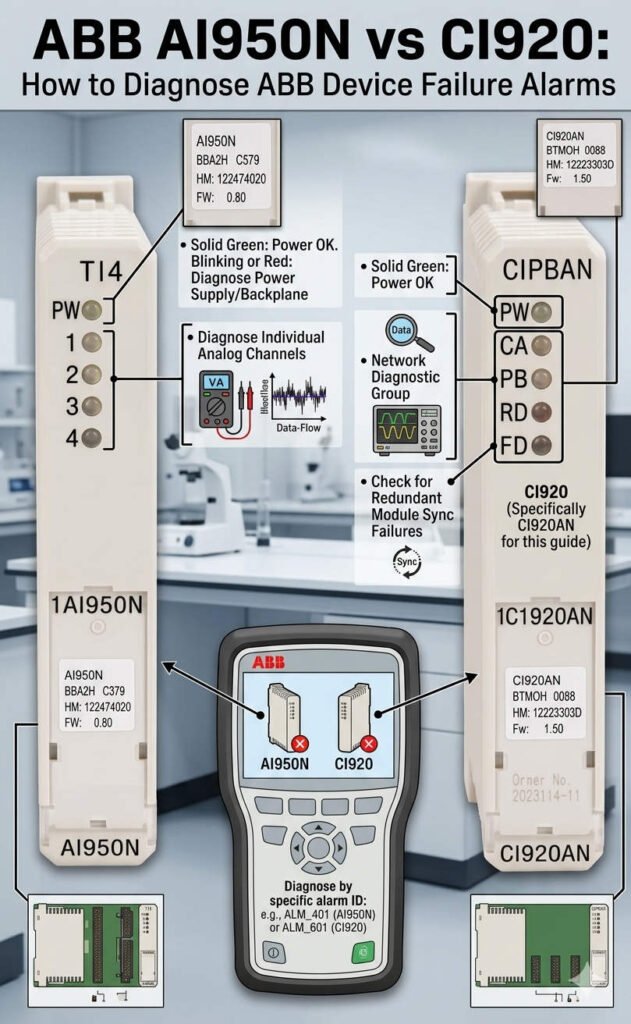
ABB AI950N vs CI920: How to Diagnose ABB Device Failure Alarms
Diagnosing Device Failure: ABB AI950N vs. CI920 Bus Interface
In ABB Advant/800xA remote I/O systems, a “Device Failure” alarm often causes confusion. It does not always mean the analog input module is defective. In fact, over 60% of these alarms stem from communication or power issues rather than hardware failure. For industrial automation professionals, distinguishing between an AI950N fault and a CI920 bus head fault is vital. Replacing the wrong component leads to unnecessary costs and extended process downtime. A structured diagnostic approach helps maintenance teams lower the Mean Time To Repair (MTTR).
Identifying Channel-Level vs. Station-Level Failures
The first step involves analyzing the scope of the alarm. If only a specific analog channel reports bad quality, the AI950N is the likely culprit. This often results from internal A/D conversion errors or field wiring problems. However, if multiple modules disappear simultaneously, the CI920 bus interface becomes the primary suspect. Station-level instability suggests a broader issue within the communication layer or the DCS network. Understanding this distinction prevents the common mistake of replacing healthy I/O modules.
Expert Insight from PLCDCS HUB: We frequently observe that intermittent station dropouts occur due to electromagnetic interference. In many petrochemical plants, engineers overlook the impact of VFD noise on the ModuleBus. Always verify your grounding before condemning the hardware in your control systems.
Utilizing LED Indicators for Rapid Diagnostics
ABB hardware provides immediate visual feedback through onboard LEDs. A faulty AI950N typically shows a red error light on its specific faceplate. Neighboring modules in the same rack usually remain healthy and active. In contrast, CI920 failures trigger irregular flashing on the communication LED. You may see the entire remote I/O node reset cyclically in the controller diagnostics. Consequently, a restarting bus head causes all downstream signals to flicker between “Good” and “Bad” status.
The Impact of Power Quality on ModuleBus Stability
The CI920 interface is highly sensitive to the quality of the 24 VDC supply. Excessive voltage ripple can trigger communication timeouts even when hardware is functional. Moreover, loose ModuleBus connectors in high-vibration areas like turbine skids cause intermittent connectivity. Therefore, ensure your cabinet sections share a common, low-impedance ground point. Proper factory automation maintenance requires periodic inspection of DIN rail continuity to prevent these phantom alarms.
Maintenance Protocols and Troubleshooting Procedures
Applying a “swapping method” remains the most effective way to isolate hardware faults in the field. Technicians should follow these technical steps:
- ✅ Slot Swapping: Move the suspect AI950N to a known healthy slot position.
- ✅ Follow the Alarm: Replace the AI950N if the fault follows the module.
- ✅ Stay at Slot: Inspect the CI920 or backplane if the fault remains at the original slot.
- ✅ Counter Analysis: Check communication retry counters in the engineering software.
Strategic Procurement and Compatibility Checkpoints
When buying replacement parts, verify the firmware revision of your existing PLC or controller. Older CI920 revisions might not support the advanced diagnostic features of newer I/O modules. Furthermore, ensure that your 800xA version recognizes the specific hardware signature of the replacement. For critical manufacturing plants, we recommend validating module interoperability in a staging environment. This practice avoids unexpected integration hurdles during a live system startup.
Application Scenarios and Solutions
- Refinery Tank Farms: Isolates loop power fluctuations from actual AI950N hardware failures.
- Pharmaceutical Batch Control: Ensures consistent timestamping by maintaining stable CI920 communication links.
- Continuous Manufacturing: Prevents total node dropouts by identifying failing bus interfaces early.
For authentic ABB components and professional technical support, visit PLCDCS HUB Limited today. We help you find the right parts to keep your systems running smoothly.
Frequently Asked Questions (FAQ)
1. Why does my new AI950N show a failure even though the wiring is correct?
Check the backplane connector for dust or bent pins. If the module works in another slot, the issue is likely a localized backplane fault or a configuration mismatch in your software.
2. Can a failing CI920 cause the controller CPU to enter a “Stop” state?
Usually, the controller handles I/O failure gracefully, but high-frequency interrupts from a chattering bus head can increase CPU load. It is best to isolate the faulty node immediately to preserve system stability.
3. What is the standard lifespan for these ABB communication interfaces?
In a climate-controlled room with clean power, these modules often last over 10 years. However, high heat and 24V ripples significantly shorten the life of the internal capacitors.