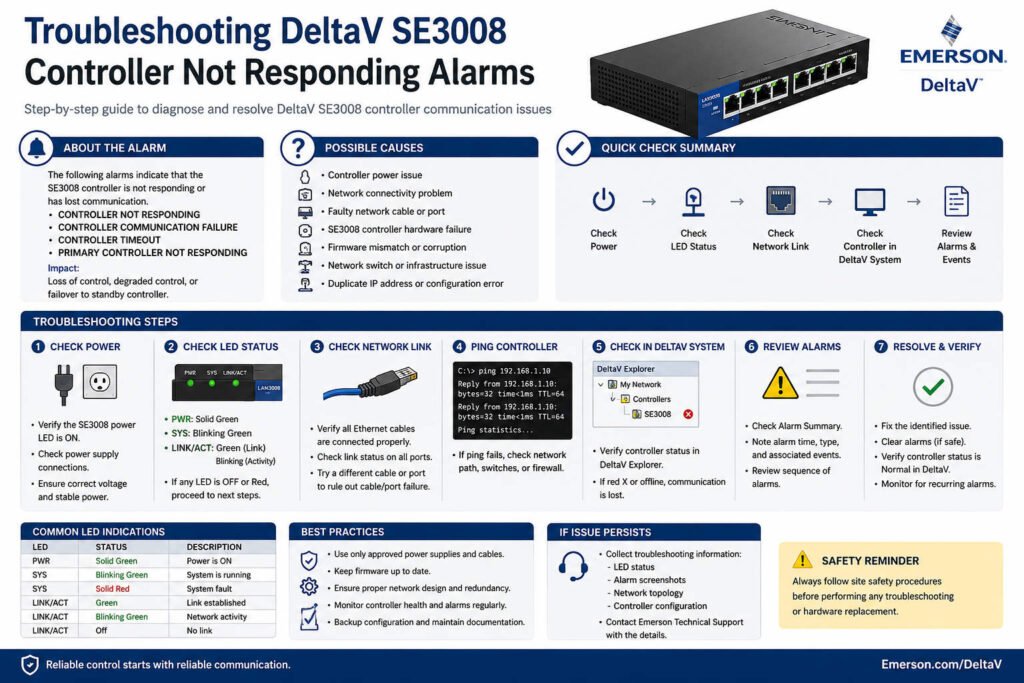
Troubleshooting DeltaV SE3008 Controller Not Responding Alarms
Troubleshooting DeltaV SE3008 “Controller Not Responding” and Redundancy Switchover
The SE3008 “Controller Not Responding” alarm in an Emerson DeltaV system indicates a critical communication failure. Usually, the primary controller loses its connection to the control network or suffers a hardware fault. In a redundant controller pair, the system should trigger an automatic switchover to maintain operations. However, if the automatic transition fails, engineers must diagnose the root cause before forcing a manual switchover. For industries like oil, gas, and chemicals, incorrect handling can freeze I/O signals or drop critical batch data.
The Operational Value of Controller Redundancy
Redundancy in industrial automation serves to prevent full-scale plant shutdowns during hardware failures. A healthy standby controller mirrors the database and control strategies of the primary unit in real-time. Therefore, a successful switchover occurs within milliseconds without disturbing PID loop outputs or safety interlocks. Maintaining this “hot standby” state is vital for continuous fermentation or refining processes. Moreover, reliable redundancy prevents the loss of historical data and batch phases.
Expert Insight from PLCDCS HUB: At our facility, we often see engineers rush into a manual switchover when they see the SE3008 alarm. However, a “Force Switchover” on an unsynchronized pair can cause a total CPU crash. Always verify synchronization before taking action to protect your control systems.
Technical Deep Dive: Synchronization and Scan Times
DeltaV controllers require a perfect memory image match to ensure a “bumpless” transfer. You must check the redundancy status in the DeltaV Diagnostics tool first. The standby controller should display a “Synchronized” or “Standby Ready” status. If it shows “Out of Sync” or “Warm Restart,” a switchover will likely fail. High CPU loading also degrades redundancy performance significantly. Consequently, Emerson suggests maintaining a long-term CPU load below 60% for maximum stability.
Analyzing Control Network Health and Integrity
Many SE3008 alarms originate from the network layer rather than the controller hardware. Issues like switch port flapping or CRC errors can trigger false communication alarms. Furthermore, mismatched network card speeds—such as one port set to “Auto” and another to “100M”—cause jitter. You must verify both primary and secondary networks are functioning correctly. In addition, ensure that spanning tree protocols are configured properly to prevent broadcast storms in factory automation racks.
Installation and Maintenance Protocols
Maintaining DCS reliability requires disciplined maintenance schedules and specific technical procedures:
- ✅ Verify Sync State: Never force a switchover if the standby shows “Out of Sync.”
- ✅ Inspect Hardware: Check RJ45 connectors for oxidation and ensure proper fiber bend radii.
- ✅ Scan Time Audit: Remove unnecessary logic blocks if CPU utilization exceeds 80%.
- ✅ Scheduled Testing: Perform a manual switchover test during every plant turnaround.
Strategic Procurement and Compatibility Guide
A “Controller Not Responding” alarm does not always mandate a full hardware replacement. Often, aging power modules or mismatched firmware revisions cause intermittent failures. When purchasing replacements, ensure the firmware versions match your existing redundant pair exactly. Mismatched M-series and S-series hardware may cause synchronization errors even if the system allows them to join. Therefore, standardized hardware profiles are essential for regulated industries.
Application Scenarios and Solutions
- Continuous Refining: Ensures the main distillation column maintains pressure control during a primary CPU failure.
- Batch Pharmaceutical Processing: Prevents “Phase Abort” errors that could ruin high-value drug batches during controller restarts.
- Offshore Oil Platforms: Enables remote diagnostics to identify if a fault is a cable break or a CPU error.
For authentic Emerson DeltaV parts and expert system integration support, please visit PLCDCS HUB Limited. We provide the technical expertise to keep your systems running at peak performance.
Frequently Asked Questions (FAQ)
1. Can I replace a failed controller without shutting down the entire node?
Yes, if your redundancy is healthy and synchronized, you can perform a “Hot Swap.” Always ensure the new controller has the correct firmware before insertion. The standby unit will automatically begin the synchronization process once the new hardware is detected.
2. Why does the standby controller remain in a “Warm Restart” state for a long time?
This often happens due to excessive network traffic or database mismatches between the primary and standby. Check the Event Chronicle for “Database Mismatch” errors. You may need to perform a full download to the controller pair to resolve deep synchronization issues.
3. Does high ambient temperature affect the SE3008 alarm frequency?
Absolutely. Overheating in the control cabinet can trigger the controller’s watchdog timer, leading to frequent resets. Ensure your cooling fans and air filters are clean to prevent thermal-induced errors in your PLC components.