
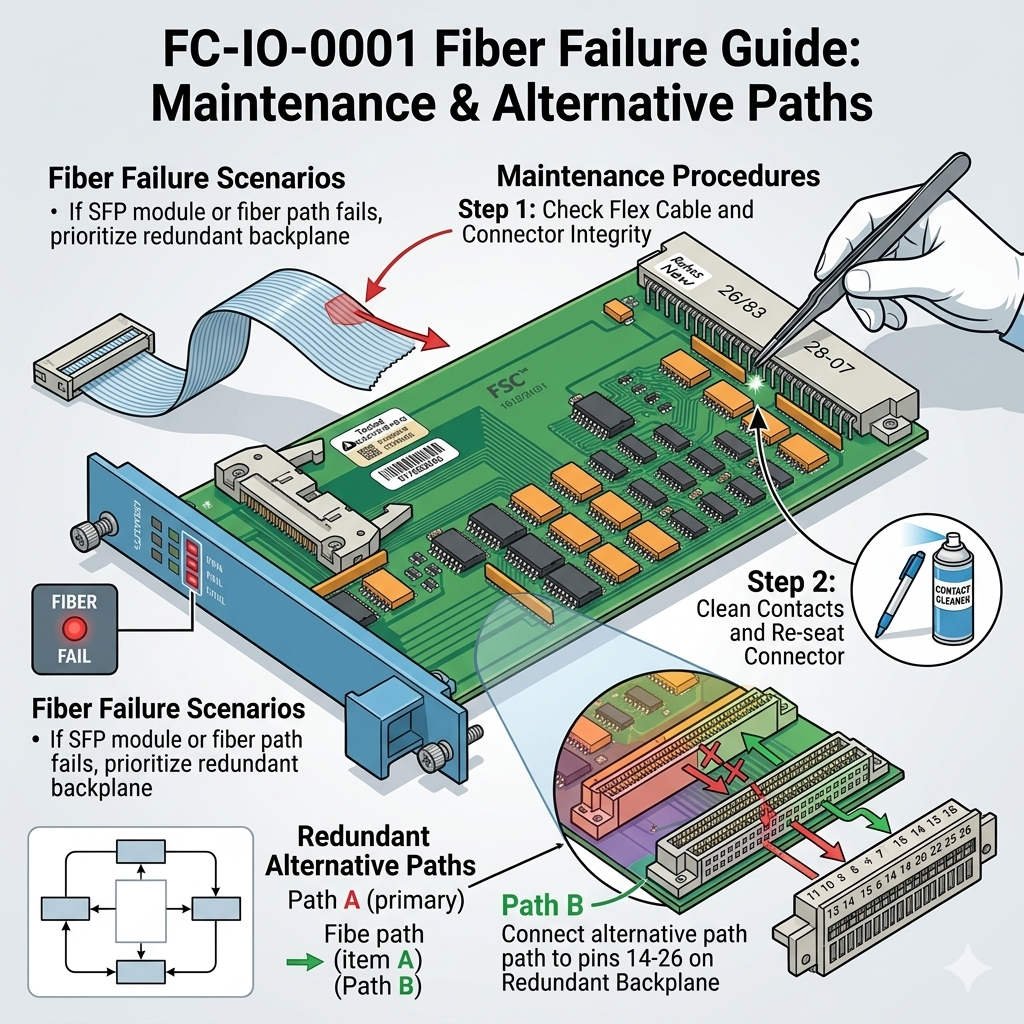
FC-IO-0001 Fiber Failure Guide: Maintenance & Alternative Paths
Managing FC-IO-0001 Communication Risks in Critical Automation Networks
The FC-IO-0001 module serves as a vital node in high-speed industrial automation. When its fiber interface fails, the system loses its primary noise-immune communication path. In oil and gas or chemical plants, this interruption threatens control loop stability and system uptime. Operators must implement reliable alternative paths like copper Ethernet or serial fallback to prevent unplanned shutdowns. Maintaining deterministic data flow ensures that DCS platforms continue to receive accurate field information during emergencies.
Comparing Transmission Media: Fiber vs. Copper Ethernet
Fiber optics allow for transmission distances exceeding 2 kilometers with total electromagnetic immunity. In contrast, copper Ethernet typically limits runs to 100 meters. Copper is also more susceptible to EMI from high-power equipment like variable frequency drives. Therefore, switching to copper may introduce latency jitter or packet loss in high-noise environments. Engineers must evaluate the local electrical environment before deploying copper cables for real-time control systems.
Expert Insight from PLCDCS HUB: In our experience, many users underestimate the “distance debt” when switching from fiber. A 90-meter cable plus patch leads can easily exceed the 100-meter Ethernet limit. Always test signal attenuation with a certified cable analyzer during the transition.
Protocol Behavior and Timing Consistency Challenges
Switching from fiber-based Modbus TCP to copper usually preserves software compatibility. However, falling back to serial RS-485 introduces significant bandwidth limitations. A standard 10ms Ethernet scan cycle might degrade to 300ms over a serial link. As a result, fast control loops may experience instability or timing errors. Always verify that your factory automation logic can handle these slower update rates without triggering safety interlocks.
Maintaining Redundancy and Network Topology Integrity
Fiber networks often utilize resilient ring topologies such as RSTP or MRP. Replacing fiber with point-to-point copper links can accidentally eliminate your system redundancy. Continuous production environments cannot afford single points of failure. Consequently, you must integrate additional managed switches to maintain a robust network architecture. Reliable PLC communication depends on a topology that survives cable damage or hardware faults.
Essential Technical Checkpoints for Maintenance
Successful field repairs require adherence to strict engineering standards. Follow these guidelines to ensure stability:
- ✅ EMI Protection: Use shielded twisted pair (STP) cables for all copper replacements.
- ✅ Grounding Logic: Ground the shield at one end only to prevent ground loops.
- ✅ Termination Rules: Install 120Ω resistors on both ends of any RS-485 fallback link.
- ✅ Bending Radius: Avoid sharp turns in fiber jumpers to prevent internal core fractures.
Strategic Selection and Procurement for FC-IO-0001
If fiber ports fail frequently, investigate the root cause before buying new modules. Mechanical stress from cabinet doors often damages fiber jumpers over time. While external media converters offer a quick fix, they add extra failure points. For high-reliability industrial automation, we recommend replacing the module or upgrading the protective conduit. Consistent hardware performance is the most cost-effective strategy for long-term plant health.
Practical Application Scenarios
- Remote Wellhead Clusters: Provides long-distance connectivity over fiber to resist lightning strikes.
- Refinery Motor Control: Switches to STP copper for short runs within high-EMI power rooms.
- Chemical Batch Processing: Utilizes redundant rings to ensure zero-loss data for critical temperature loops.
For authentic parts and expert technical support on your FC-IO-0001 hardware, visit PLCDCS HUB Limited today. We provide the high-performance components your control systems require.
Frequently Asked Questions (FAQ)
1. Can I mix fiber and copper links in the same FC-IO-0001 network?
Yes, provided you use managed switches that support both SFP and RJ45 ports. Ensure the network protocol settings match across all media types to prevent communication “blackouts.”
2. How can I tell if my fiber failure is the module or the cable?
Use a basic optical power meter to check the light level at the module input. If the signal strength is within the module’s specification (usually -3dBm to -20dBm), the issue likely resides in the internal transceiver.
3. Is it worth repairing a damaged fiber port on an old module?
In most cases, no. Industrial modules are often sealed or require specialized calibration after component replacement. Replacing the entire unit through a trusted supplier ensures your system maintains its original safety and performance certifications.