
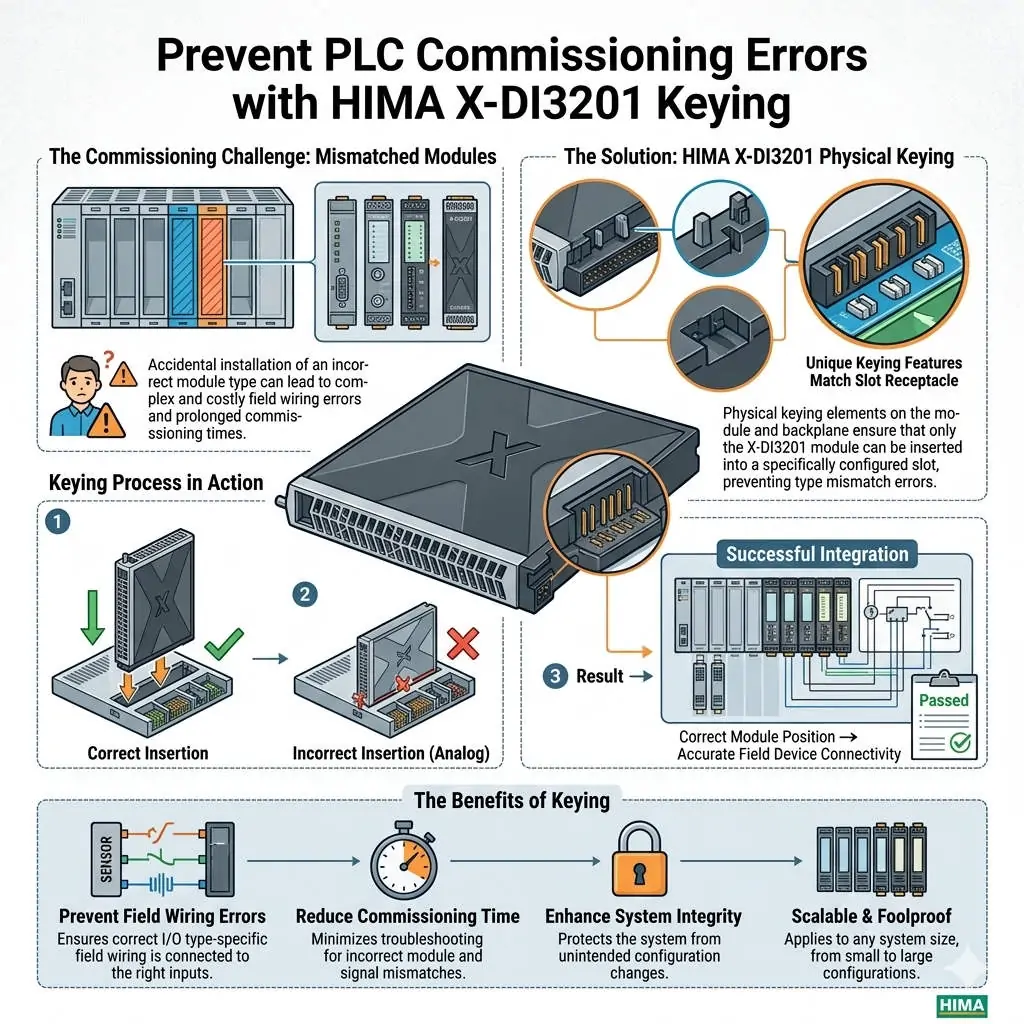
Prevent PLC Commissioning Errors with HIMA X-DI3201 Keying
Ensuring Safety System Integrity with HIMA X-DI3201 Slot Keying
The HIMA X-DI3201 digital input module incorporates advanced slot keying to safeguard industrial automation environments. This mechanical and logical barrier prevents incorrect module insertion. Misplaced modules often cause commissioning delays or latent faults in safety PLC systems. In critical sectors like oil & gas and pharmaceuticals, maintaining SIL integrity is mandatory. Therefore, this mechanism eliminates human error during maintenance or system expansion.
The Mechanics of Physical and Logical Validation
HIMA utilizes mechanical coding pins and backplane indexing to enforce hardware discipline. Each slot accepts only its designated module type. Consequently, technicians cannot accidentally insert an analog module into a digital input slot. This physical restriction protects sensitive components from misalignment or bent pins. Moreover, the engineering environment mirrors this physical assignment. The system flags inconsistencies during startup if the software and hardware do not match.
Expert Insight from PLCDCS HUB: In our experience, many “ghost faults” stem from poor physical connections. Dual-layer validation—both physical and digital—is a hallmark of high-end control systems. It ensures the system remains robust throughout its decades-long lifecycle.
Protecting Backplane Communication and Hardware Longevity
Correct slot keying ensures perfect alignment with the backplane bus connectors. These connectors transmit vital power and communication signals across the factory automation rack. Even partial misalignment can cause signal loss or intermittent faults. Furthermore, replacing a damaged backplane is significantly more expensive than replacing a single module. Proper keying acts as a physical insurance policy for your most critical hardware investments.
Installation and Maintenance Protocols for Engineers
Strict adherence to installation sequences prevents costly hardware damage. Technicians should prioritize these technical steps:
- ✅ Pre-configure Keying: Set coding pins before you energize the cabinet.
- ✅ Verify Retrofits: Check for leftover keying pins during system upgrades.
- ✅ Cross-Check Documentation: Match physical pins with the latest software I/O list.
- ✅ Zero Force Policy: Stop immediately if a module does not slide in smoothly.
Strategic Procurement for Safety Systems
Procurement teams must specify “pre-keyed baseplates” when ordering new DCS or PLC racks. For spare parts, always verify if the order includes coding clips. In regulated industries, configuration control is a primary focus for safety audits. Furthermore, verify backward compatibility between HIMax and HIMatrix platforms. Mechanical keying standards often change between hardware generations. Mixing incompatible systems can bypass protection mechanisms and compromise the entire safety loop.
Application Scenarios and Solutions
- Emergency Shutdown (ESD) Systems: Ensures that 24V DC input loops remain correctly mapped.
- Chemical Reactor Monitoring: Prevents accidental swaps between safety and non-safety components.
- Offshore Platform Maintenance: Simplifies module replacement for technicians in high-pressure environments.
To secure genuine HIMA components and expert technical guidance, please visit PLCDCS HUB Limited today. We help you maintain the highest standards of safety and efficiency.
Frequently Asked Questions (FAQ)
1. What should I do if a module resists insertion despite the correct part number?
Never apply force. Check the slot for leftover pins from a previous configuration or a bent guide. Even a small plastic obstruction can prevent a secure connection to the backplane bus.
2. Can I bypass slot keying in an emergency to keep the plant running?
We strongly advise against this. Bypassing mechanical keys risks permanent backplane damage and violates functional safety standards like IEC 61508. Always use the correct module to maintain your SIL rating.
3. Does the X-DI3201 require specific software versions for slot validation?
Yes, ensure your SILworX or ELOP II version matches the module revision. The engineering tool must recognize the specific hardware signature to perform the logical validation check during startup.


