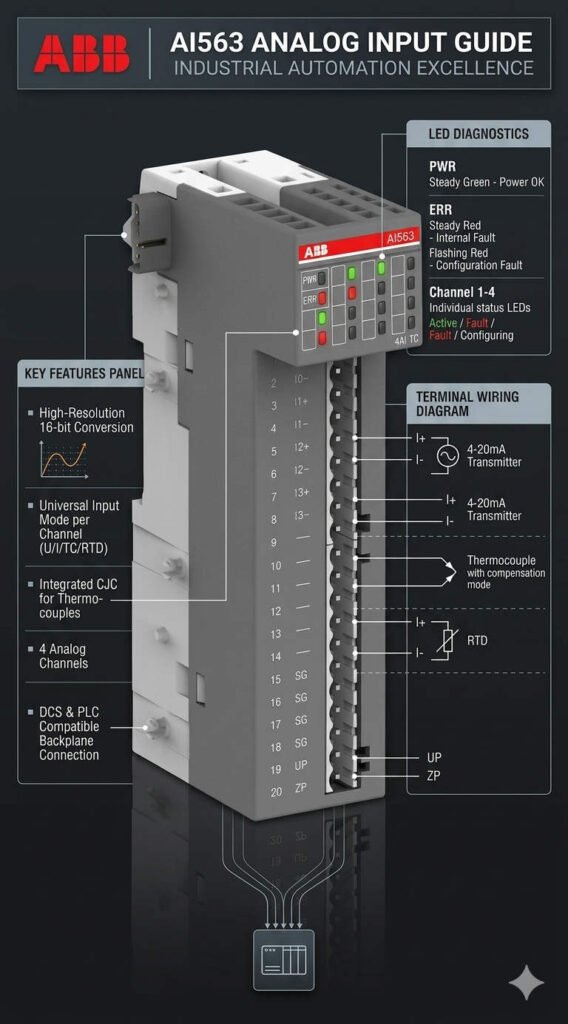
ABB AI563 Analog Input Guide | Industrial Automation Excellence
Optimizing 4–20 mA Signal Integrity with the ABB AI563 Analog Module
The ABB AI563 analog input module plays a vital role in modern DCS and industrial automation projects. It provides a stable interface for 4–20 mA field signals in refinery and pharmaceutical environments. However, engineers often face challenges when field transmitters show normal current but the AI563 reads zero. Usually, the issue stems from loop power architecture rather than hardware defects. Understanding the relationship between input impedance and excitation power is essential for successful commissioning.

The Impact of Input Impedance on Loop Voltage
The AI563 features a standard current input impedance of approximately 250 Ω. This impedance acts as a loop burden, consuming roughly 5 V at a full-scale 20 mA signal. Consequently, engineers must account for this voltage drop when calculating the total loop budget. Cable resistance, safety barriers, and isolators further reduce the available voltage. If the remaining margin falls below the transmitter’s minimum requirement, the loop will fail. This scenario frequently occurs during factory automation upgrades where legacy cards had lower burden ratings.
Expert Insight from PLCDCS HUB: At PLCDCS HUB, we frequently see commissioning delays caused by “ghost” power expectations. Never assume a DCS card provides excitation unless the datasheet explicitly states it is an active sourcing module. Proper loop design is the bedrock of system reliability.
Clarifying the Passive Nature of AI563 Inputs
One major point of confusion is that the AI563 provides passive analog inputs. It measures current but does not internally source power to the transmitter. Therefore, a two-wire transmitter requires an external 24 VDC power supply to function. Incorrect wiring often leaves the transmitter unpowered, leading to zero-mA readings and HART communication failures. In offshore platforms and brownfield projects, always verify the loop power source before finalizing the marshaling cabinet design.
Ensuring Noise Immunity in High-Interference Zones
Signal stability is critical in areas containing large motors or variable-frequency drives (VFDs). The AI563 requires strict grounding practices to prevent signal oscillation or random spikes. Poor shielding often triggers intermittent “BAD” quality alarms within the ABB control systems. For long-distance runs, you should terminate the shield at the control cabinet end only. This practice prevents ground loop currents from distorting the sensitive analog measurement.
Technical Guidelines for Successful Commissioning
A robust startup procedure prevents the misdiagnosis of healthy hardware as faulty. Technicians should prioritize these technical checks:
- ✅ Voltage Verification: Measure the transmitter terminal voltage under full load.
- ✅ Headroom Check: Ensure the supply margin covers barriers and AI563 burden.
- ✅ Grounding Integrity: Avoid sharing negative returns between isolated and non-isolated loops.
- ✅ IS Barrier Math: Account for the 6–10 V drop typical of intrinsic safety barriers.
Buyer’s Strategic Guide for ABB AI Modules
Before procuring the AI563 for a retrofit, evaluate your existing field instruments. Check the minimum operating voltage of your transmitters and the total loop resistance. If the burden approaches the limit, consider using isolated signal conditioners or four-wire transmitters. Furthermore, verify the HART transparency and scaling configuration for backward compatibility. Modernizing a PLC or DCS cabinet requires a deep dive into these electrical characteristics to avoid hidden performance bottlenecks.
Application Scenarios and Solutions
- Refinery Revamp: Replacing legacy I/O while maintaining old 4–20 mA pressure transmitters.
- Chemical Batch Control: Ensuring high-precision temperature acquisition near high-power agitators.
- Pharmaceutical Water Systems: Integrating smart flowmeters into an existing ABB automation architecture.
For authentic ABB components and expert technical support, visit PLCDCS HUB Limited today. We provide the reliable parts your industrial automation systems require.
Frequently Asked Questions (FAQ)
1. Why does my transmitter work in the workshop but fail at the site?
Long cable runs and the addition of safety barriers increase voltage drop. The workshop test likely used a short cable without the 5 V burden of the AI563. Always calculate the “worst-case” voltage budget before installation.
2. Can the AI563 support HART communication diagnostics?
The AI563 is a standard analog module. While it passes the 4-20 mA signal, HART transparency depends on the specific revision and the presence of any non-transparent isolators in the loop.
3. Is it possible to use the AI563 with 4-wire transmitters?
Yes. Since 4-wire transmitters have their own power source, they drive the current into the AI563 passively. This eliminates the loop power concerns associated with 2-wire devices.