

PLC vs. Edge Computing: Understanding the Modern Control Layer
Decoding Edge Computing: Does it Live Inside the PLC?
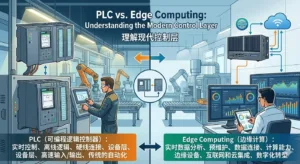
Field engineers often debate whether a Programmable Logic Controller (PLC) qualifies as an edge device. Technically, a PLC executes local logic, which aligns with basic edge principles. However, modern industrial automation requires more than simple ladder logic. True edge computing involves complex data processing that traditional controllers cannot handle alone. Therefore, we must view the PLC and the Edge as complementary but distinct layers in factory automation.
Edge computing resolves the data bottleneck between field instruments and the cloud. In critical sectors like pharmaceuticals or oil and gas, processing data locally reduces latency. This proximity ensures faster response times and protects control systems from network outages. While the PLC handles real-time machine control, the edge layer focuses on analytics and high-level integration.
Scan Time Stability and Deterministic Control
Traditional PLCs operate on deterministic scan times, usually between 1ms and 50ms. This cycle ensures the controller executes safety and logic loops with absolute consistency. However, edge tasks like AI inference or predictive modeling are non-deterministic. If you run these heavy workloads inside a standard PLC, you risk introducing jitter. As a result, the primary control loop might lose its timing accuracy.
At PLCDCS HUB, we recommend offloading non-control tasks to dedicated hardware. In a Honeywell DCS or similar environment, keeping the controller “lean” preserves system integrity. Modern engineers use edge gateways to handle data filtering while the PLC focuses strictly on I/O management.
Bridging Industrial Protocols with IT Standards
Most factory automation controllers communicate via Modbus TCP or PROFINET. These protocols work perfectly for local machine communication. However, they lack the native capabilities required for modern IT integration. Edge devices fill this gap by supporting MQTT, Sparkplug B, and REST APIs. These tools allow seamless connectivity to cloud platforms like AWS or Azure.
- ✅ Use Edge Gateways to convert Modbus data into secure MQTT streams.
- ✅ Implement TLS encryption at the edge layer to protect sensitive plant data.
- ✅ Reduce engineering hours by avoiding custom cloud-connector code in the PLC.
Hardware Constraints: CPU Power and Storage
PLCs prioritize reliability over high-performance computing power. They typically feature rugged CPUs and minimal onboard storage. In contrast, advanced industrial automation use cases require significant memory for historical buffering and containerized apps (Docker). Standard PLCs simply do not have the resources to host complex batch analytics or large databases.
Moreover, the Lack of support for high-level programming languages like Python limits PLC flexibility. If your project requires machine learning at the machine level, you need an Industrial PC (IPC). These devices offer the fanless, ruggedized hardware required for the factory floor while providing PC-level processing.
Strategic Network Segmentation and Security
Integrating edge devices introduces new cybersecurity risks to the control system. Improper network design can expose the operational technology (OT) layer to the open internet. Therefore, engineers must follow the IEC 62443 standard for network zones and conduits. This approach isolates the machine network from the enterprise network.
- 🔧 Segment PLC traffic using dedicated VLANs or industrial firewalls.
- 🔧 Route all external data through a “DMZ” hosted by the edge gateway.
- 🔧 Disable unused ports and services on both PLCs and edge hardware.
Environmental Resilience and Field Installation
Hardware failure often results from poor environmental planning. Many commercial-grade gateways cannot survive the heat of an unventilated control cabinet. If internal temperatures exceed 50°C, non-industrial hardware will fail prematurely. Always select hardware with an extended temperature range of -20°C to +70°C to ensure factory automation longevity.
In addition, consider vibration resistance and fanless designs. Moving parts like cooling fans are the first components to fail in dusty environments. Choosing the right industrial-grade components saves thousands in maintenance costs later. For high-reliability parts and expert advice, visit PLCDCS HUB Limited to browse our specialized inventory.
Application Scenario: Predictive Maintenance in Chemical Plants
In a chemical processing plant, a vibration sensor monitors a high-pressure pump. The PLC manages the pump’s start/stop logic and safety interlocks. Simultaneously, an edge gateway collects high-frequency vibration data. The gateway performs a Fast Fourier Transform (FFT) locally to detect early bearing failure. It sends only a “health score” to the SCADA system, saving bandwidth and PLC CPU cycles.
Expert Recommendations and FAQ
Can I upgrade my current PLC to perform edge analytics?
Only if the manufacturer offers a specific “Edge” module or co-processor. Attempting to program complex math into standard ladder logic usually results in CPU overutilization. For most legacy systems, adding an external gateway is the most cost-effective path.
How do I choose between an Edge Gateway and an Industrial PC?
Gateways are ideal for protocol conversion and simple data forwarding. If your application requires a local HMI, large databases, or running Windows-based software, choose an IPC. Consider the complexity of the local data processing before making a purchase.
Is data security better at the PLC level or the Edge level?
The edge level is generally more secure for external communication. Most PLCs lack modern encryption features like TLS 1.3. By using an edge device as a “security buffer,” you protect the controller from direct internet exposure and cyber threats.
For more technical insights and premium automation hardware, please explore our full catalog at PLCDCS HUB Limited. We help you bridge the gap between legacy reliability and modern innovation.


