
Why Your GE IS200EPSMG1A Module Trips Breakers: Troubleshooting Guide
Solving DC Bus Breaker Trips During GE EX2100 Module Installation
Understanding High-Inrush Current Challenges
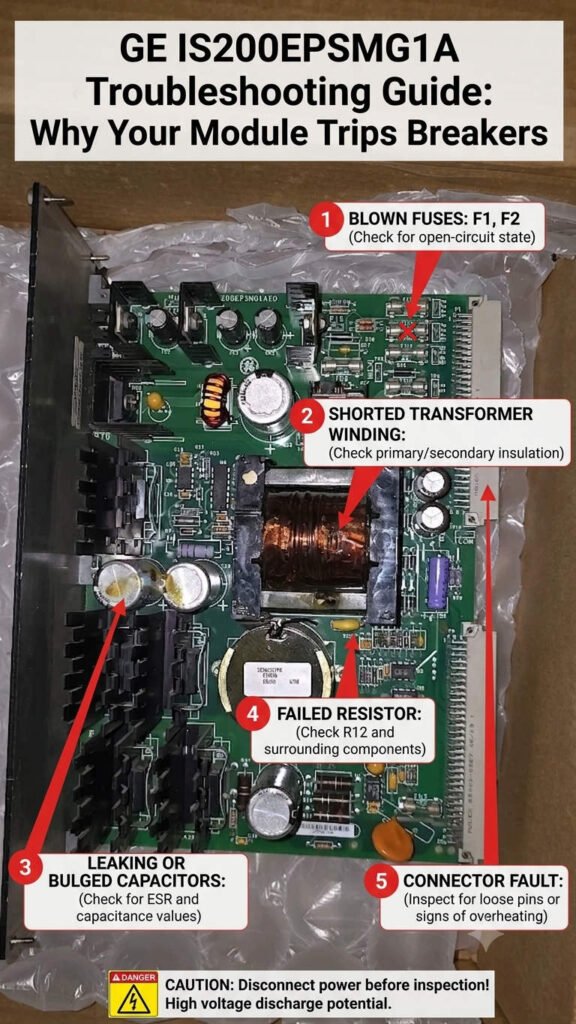
When you install a new GE IS200EPSMG1A power supply, the DC bus breaker may trip instantly. This issue often stems from the module’s internal filtering capacitors. These capacitors have extremely low Equivalent Series Resistance (ESR) when new. Consequently, they draw massive inrush current the moment you apply power. This surge often exceeds the magnetic trip threshold of your upstream protection devices. Therefore, your breaker identifies this normal charging spike as a short circuit.
The Critical Role of Pre-Charge Circuits
In sophisticated excitation systems like the EX2100, the pre-charge circuit prevents these dangerous current spikes. However, field technicians frequently encounter bypassed or failed pre-charge contactors. If the circuit fails to limit the initial flow, the module receives full voltage immediately. As a result, the resulting surge causes visible flashover or nuisance tripping. From my experience at PLCDCS HUB, I have found that replacing the module is rarely the solution if the pre-charge path remains faulty.
Ensuring System Compatibility and Standards
Industrial automation environments require precise hardware-to-firmware matching. Installing a modern revision of the IS200EPSMG1A into an older cabinet can sometimes cause communication or startup anomalies. You must verify that your system configuration aligns with the module’s voltage ratings. Mismatched hardware often leads to unpredictable protection behavior during the commissioning phase. Always consult the latest GE technical documentation before finalizing your hardware integration.
Best Practices for Troubleshooting and Startup
Before you replace any expensive control system components, perform a systematic diagnostic check. Follow these professional steps to ensure a smooth energization process:
- ⚙️ Measure the resistance of all pre-charge resistors to ensure they remain within specs.
- ⚙️ Check the event logs to verify that the pre-charge contactor timing is accurate.
- ⚙️ Use a megohmmeter to confirm there are no unintended grounds on the DC bus.
- ⚙️ Perform a gradual voltage ramp-up if your commissioning tools allow it.
- ⚙️ Inspect the entire power path for loose connections or oxidized contact points.
Author Insights: Beyond Component Replacement
Many maintenance teams rush to replace “defective” modules when breakers trip. At PLCDCS HUB, we emphasize that root cause analysis saves significant downtime. Most tripping issues originate from external factors like wiring errors or failed peripheral support circuits. We recommend prioritizing electrical path diagnostics over immediate hardware swapping. This strategic approach ensures long-term reliability for your factory automation systems.
Practical Solution Scenario
Imagine a scenario where a site technician replaces a power supply but the system still trips. Instead of assuming the new unit is faulty, the engineer inspects the DC contactor. They discover a welded contactor tip causing a failed pre-charge sequence. Replacing the contactor solves the issue instantly, saving the plant thousands in unnecessary hardware costs. For more technical guidance and reliable components, visit PLCDCS HUB to explore our extensive inventory and expert resources.
Frequently Asked Questions
How can I determine if my IS200EPSMG1A is truly at the end of its life?
Look for physical signs like burnt components or persistent internal fault codes. If the module passes a bench test but fails on the machine, the problem is likely external.
Does a newer revision of the module always offer better performance?
Not necessarily. While newer versions offer improvements, they may require specific firmware updates. Always verify compatibility with your existing control system before installation.
What is the most common mistake during excitation system maintenance?
Technicians often ignore the pre-charge resistor status. Never assume the pre-charge circuit is functional just because the contactor clicks; verify the actual resistance values.