
GE IS200VVIBH1CAB: Can It Process Piezoelectric Accelerometers?
Can the GE IS200VVIBH1CAB Process Piezoelectric Accelerometer Signals Directly?
Understanding the IS200VVIBH1CAB Functionality
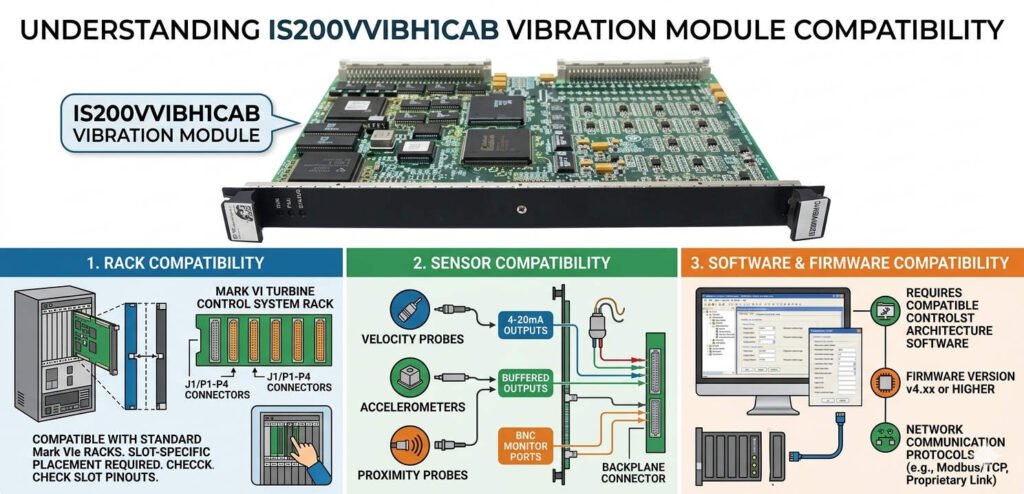
The GE IS200VVIBH1CAB is a specialized vibration monitoring board for EX2100 and Mark VI/VIe control systems. Engineers typically use this module for shaft vibration and position monitoring. It relies on eddy current proximity probes that comply with API 670 standards. These sensors measure relative shaft displacement rather than absolute casing acceleration. Therefore, the board’s hardware design lacks the specific circuitry required for piezoelectric sensors.
The Technical Mismatch Explained
Many technicians incorrectly attempt to wire piezoelectric accelerometers directly into the VVIB board. However, this approach causes significant signal distortion and unstable readings. Piezoelectric sensors output either high-impedance charge signals or constant-current (IEPE) voltage. In contrast, the VVIB board expects conditioned voltage signals from proximitors. This mismatch often leads to alarming measurement errors and false turbine trips during startup sequences.
- Impedance Mismatch: The board input cannot interpret high-impedance charge outputs correctly.
- Scaling Errors: Vibration trends become inaccurate without proper signal conditioning.
- Noise Issues: Direct wiring often introduces 50/60 Hz grounding noise into the system.
- Loss of Low-Frequency Data: The hardware architecture ignores critical low-frequency acceleration data.
Displacement versus Acceleration Measurement Philosophy
Understanding the difference between displacement and acceleration is vital for effective industrial automation. The VVIB architecture optimizes rotor displacement analysis for fluid-film bearings. Proximity probes provide the best protection for these turbine components. Conversely, piezoelectric accelerometers excel at monitoring bearing housing vibration and structural resonance. You should not treat the IS200VVIBH1CAB as a universal vibration acquisition module for all sensor types.
Proper Interface Solutions for Your System
If your control system requires acceleration monitoring, you must integrate external signal conditioning. Industry-standard solutions effectively bridge this gap in DCS and PLC environments:
- Use Charge Amplifiers: These convert high-impedance charge into manageable voltage signals.
- Deploy IEPE Conditioners: These provide the necessary constant-current excitation for modern accelerometers.
- Utilize 4–20 mA Transmitters: These simplify data integration into standard I/O modules.
- Install Dedicated Racks: Bently Nevada or third-party racks offer superior diagnostic capabilities for complex machinery.
PLCDCS HUB Perspective: Ensuring System Reliability
At PLCDCS HUB, we frequently consult with engineers facing “unexplained” vibration alarms. Often, these issues stem from forcing hardware compatibility where it does not exist. Our team strongly recommends evaluating your specific monitoring needs before integration. If you require advanced diagnostic data, consider implementing dedicated vibration monitoring alongside your main control system. For expert guidance on part selection or technical specifications, visit PLCDCS HUB to connect with our specialists.
Application Scenario: Retrofitting Old Turbines
Imagine a facility upgrading an aging Frame 6B turbine control system. The team wants to switch from proximity probes to casing accelerometers to detect gearbox wear. Direct integration into the existing VVIB modules will likely cause false trips. The correct approach involves installing external IEPE conditioners and routing the output to a high-speed analog I/O module. This strategy maintains the integrity of the original protection logic while adding modern diagnostic capabilities.
Frequently Asked Questions
- Q: Can I modify the IS200VVIBH1CAB firmware to accept accelerometer signals?
A: No. The limitation is strictly hardware-based, specifically regarding the input impedance and power supply requirements for piezoelectric sensors. - Q: What is the most common symptom of an incompatible sensor connection?
A: You will typically observe erratic vibration trends, constant channel saturation, or high-frequency “spikes” that trigger unnecessary system alarms during the startup ramp. - Q: How should I choose between proximity probes and accelerometers for my upgrade?
A: Choose proximity probes for protecting rotor-to-stator clearances in turbines. Select accelerometers if your primary goal is detecting bearing fatigue or gear mesh issues on external housings.


