
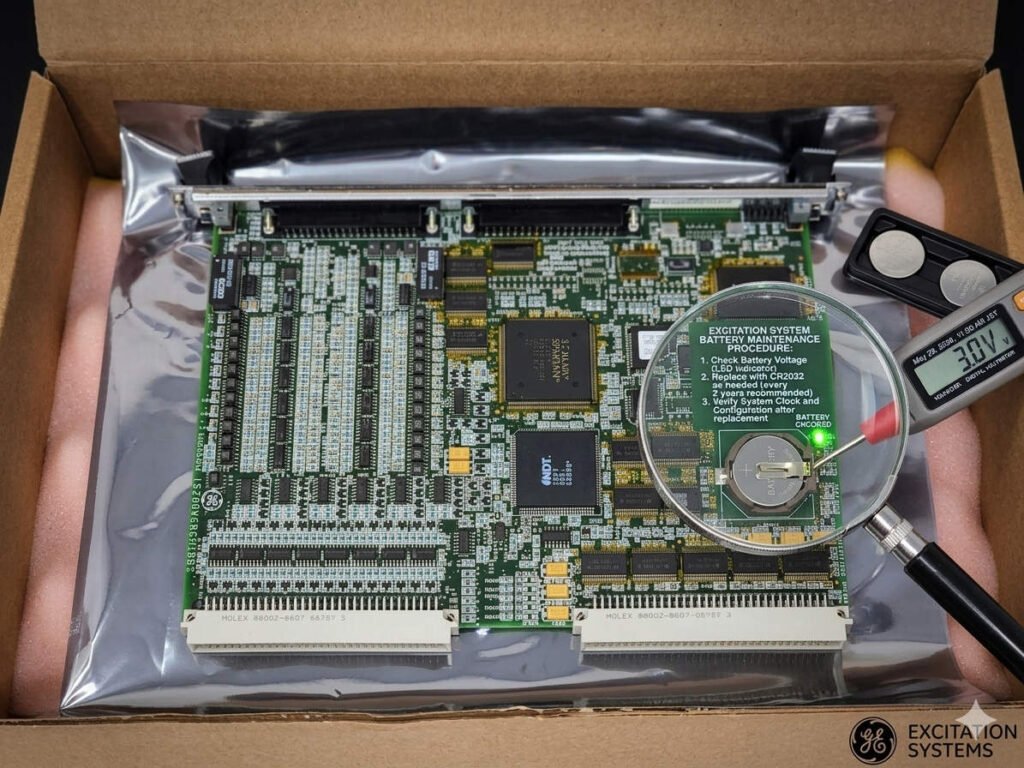
GE EX2100 Maintenance: IS200VCRCH1BBB Battery Inspection Guide
Essential Guide: Static Battery Voltage Testing for GE IS200VCRCH1BBB Control Boards
Understanding the Role of Backup Batteries in Excitation Systems
The IS200VCRCH1BBB control board serves as a cornerstone in GE EX2100 and Mark VI/VIe excitation systems. These boards utilize onboard backup batteries to preserve critical operational parameters and memory settings. During power outages, this battery ensures the controller remains in a ready state. Therefore, testing this battery during major overhauls is a vital preventive maintenance task for your industrial automation infrastructure. Neglecting this simple check often leads to memory loss, initialization failures, or costly startup delays.
Establishing Healthy Voltage Thresholds for Reliable Operations
Engineers must monitor battery health closely to avoid unplanned downtime in DCS or PLC-based control environments. Based on field observations, we categorize battery health into three distinct voltage levels:
- Healthy Range: The battery should measure between 3.0VDC and 3.6VDC.
- Preventive Threshold: Replace the battery if it drops below 2.8VDC.
- Critical Threshold: Immediate replacement is mandatory if the voltage falls below 2.5VDC.
Note: Batteries measuring between 2.5VDC and 2.8VDC may seem stable, but they often fail under the transient loads of a system startup.
Performing Accurate Static Voltage Inspections
Field experience highlights the importance of measuring voltage under true static conditions. Residual capacitance often leads to false high readings if you test the board immediately after isolation. Follow these expert steps to ensure measurement accuracy:
- Isolate all control power from the excitation cabinet.
- Wait at least 5 to 10 minutes for full residual discharge.
- Use a high-impedance digital multimeter to measure directly across the battery terminals.
- Clean the PCB surface to prevent leakage paths caused by dust or humidity.
- Document the voltage levels in your maintenance logs to track degradation trends.
Managing Environmental Factors and Battery Longevity
Environmental conditions heavily influence the service life of lithium batteries in factory automation. High ambient temperatures inside turbine enclosures or poorly ventilated cabinets accelerate chemical degradation.
- Operations below 25°C generally yield a service life exceeding 5 years.
- Continuous operation above 40°C can reduce battery life to just 2 or 3 years.
- Excessive heat often indicates a need for better cabinet cooling rather than frequent battery swaps.
Best Practices for Battery Maintenance and Replacement
Maintenance teams must prioritize hardware integrity alongside voltage checks. Vibration in industrial plants frequently causes fatigue in battery holders, leading to intermittent connection issues.
- Inspect solder joints carefully for cracks or signs of oxidation.
- Verify that the battery holder maintains firm terminal pressure.
- Always use ESD protection to prevent damage to sensitive electronic components.
- Avoid “hot-swapping” batteries unless you follow specific OEM-validated procedures to prevent EEPROM corruption.
PLCDCS HUB Perspective: Ensuring Long-Term Reliability
At PLCDCS HUB, we frequently observe that operators wait for a total system alarm before addressing battery health. This reactive approach is risky for high-availability systems. We strongly recommend integrating battery health monitoring into your annual preventive maintenance schedule. Consistent tracking allows you to replace components during planned windows, effectively eliminating the risk of startup failure during commissioning. For high-quality replacement parts and technical support, visit PLCDCS HUB to ensure your control systems maintain peak performance.
Application Case: Preventing Startup Failures
In a recent project involving a gas turbine peaking unit, the system failed to synchronize due to recurring initialization alarms. Diagnostic testing revealed the IS200VCRCH1BBB battery was at 2.6VDC—technically “active” but insufficient for memory retention during the high-demand startup sequence. Replacing the battery and cleaning the mounting contacts resolved the issue immediately. This case highlights why proactive, rather than reactive, battery management is critical for site reliability.
Frequently Asked Questions
- Q: Can I use a generic lithium battery replacement for the IS200VCRCH1BBB?
A: We strongly advise using exact OEM-specified batteries. Generic alternatives may lack the necessary discharge characteristics required for mission-critical industrial control systems. - Q: My battery voltage is 2.9VDC. Should I replace it now or wait until the next outage?
A: If your facility is heading into a major commissioning phase, replace it now. It is safer to invest in a low-cost battery today than to troubleshoot a memory-related controller fault during a critical startup. - Q: Does the board revision affect my battery replacement strategy?
A: Yes, earlier hardware revisions may be more sensitive to transient voltage dips. Always verify your specific PCB revision and check the OEM documentation or consult PLCDCS HUB for compatibility guidance before performing maintenance.


