

Configuring the IS200VAICH1C Filter Time Constant for Control Systems
Optimizing the IS200VAICH1C Filter Time Constant for Industrial Control Systems
Understanding Signal Conditioning in Industrial Automation
The IS200VAICH1C analog input board plays a vital role in GE EX2100 and Mark VI/VIe control systems. It processes critical sensor data, including pressure, flow, and vibration inputs. In harsh industrial environments, electrical noise and interference often corrupt these raw signals. Therefore, engineers use a software-configurable filter time constant to stabilize inputs. Proper tuning improves PID loop stability and reduces false alarms in factory automation and power generation.
Locating and Configuring Filter Settings
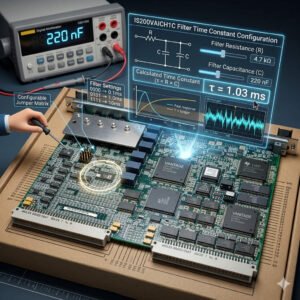
Many technicians incorrectly look for physical hardware adjustments on the board. However, the IS200VAICH1C relies on software-based filtering managed through ControlST or ToolboxST. You can typically find these settings within the analog input channel or signal conditioning blocks.
- Common Configuration Paths:
- Access the I/O Pack signal processing tab in your application software.
- Locate parameters labeled as “Filter Time Constant” or “First-Order Lag.”
- Adjust values based on the specific noise profile of your instrumentation.
- Use short intervals (10–100 ms) for fast-response control loops.
- Set longer intervals (2s+) for high-noise environments to ensure smooth feedback.
The Impact of Filtering on Loop Dynamics
The filter time constant fundamentally balances signal clarity against control responsiveness. Increasing this value creates a smoother signal but introduces significant phase lag. This lag can cause the controller to react too slowly during critical process changes. Conversely, a filter that is too small leaves the system vulnerable to process spikes and electrical noise.
- Control Loop Balancing Act:
- Small constants provide faster response but increase sensitivity to noise.
- Excessive filtering leads to sluggish PID behavior and potential process “hunting.”
- First-order filters follow the equation G(s) = 1 / (τs + 1).
- Monitor both raw and filtered signals to observe the actual phase delay.
Best Practices for Reliability and Equipment Health
Improper filter settings affect more than just signal quality. They directly influence the mechanical wear of your servo actuators and control valves. If the filter is too aggressive, the system may detect process deviations too late, which risks turbine protection integrity. Before increasing filter values, always verify your cabling and shield grounding. Often, noise issues stem from poor installation rather than a need for software smoothing.
PLCDCS HUB Expert Insights
At PLCDCS HUB, we see many engineers treat symptoms instead of causes. Relying on software filters to hide ground loops or electromagnetic interference (EMI) is a dangerous shortcut. We recommend inspecting your shielding and common-mode wiring before modifying control parameters. If you need technical guidance or replacement parts for your control systems, visit PLCDCS HUB to connect with our expert team and ensure your facility operates at peak efficiency.
Practical Scenario: Stabilizing a Fuel Control Loop
Consider a gas turbine fuel control loop experiencing oscillations during steady-state operation. The maintenance team initially planned to increase the filter time constant to suppress the noise. However, our diagnostic review revealed the noise resulted from a degraded cable shield rather than sensor instability. By repairing the grounding, the team eliminated the noise without sacrificing loop response speed. This approach maintained high-speed protection requirements and avoided unnecessary process lag.
Frequently Asked Questions
- Q: Does replacing my old IS200VAICH1C card affect my existing filter settings?
A: Yes, migrating logic or replacing hardware can reset parameters. Always export and verify your configuration files against your previous project database before commissioning. - Q: How can I tell if my current filter setting is causing a “hidden” lag?
A: Trend your filtered signal against the raw input signal during a step change. If the filtered signal takes more than three time constants to reach a steady state, your filter may be too aggressive for fast-acting loops. - Q: Should I prioritize software filtering over hardware upgrades when dealing with noisy sensors?
A: Never. Software filters should complement high-quality, properly grounded instrumentation. If your sensors are inherently noisy, upgrading to shielded, high-impedance cabling is a more sustainable solution than aggressive software smoothing.


