
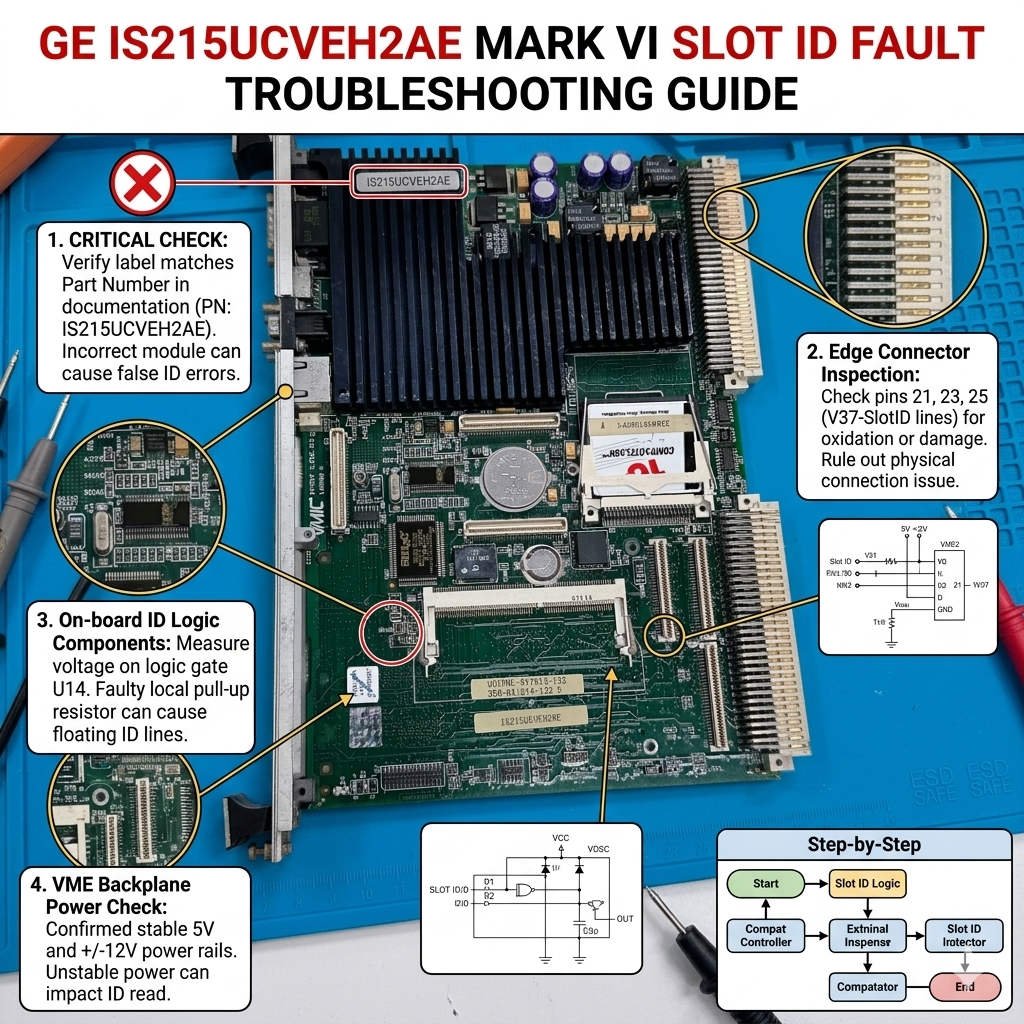
GE IS215UCVEH2AE Mark VI Slot ID Fault Troubleshooting Guide
Resolving GE IS215UCVEH2AE VME Control Card Slot ID Faults in Mark VI Systems
The GE IS215UCVEH2AE is a critical VME-based main control processor board running inside Mark VI and EX2100 architectures. When the rack reports a “Slot ID Fault” after board insertion, firmware rarely acts as the sole culprit. Instead, the issue typically stems from VME backplane communication errors, incorrect physical positioning, or compromised power integrity. In power generation and oil and gas compressor stations, this fault halts initialization and disrupts critical controller redundancy. Therefore, identifying the exact root cause remains vital to avoid failed turbine startup sequences.
Understanding VME Backplane Slot Address Recognition Mechanics
The Mark VI rack utilizes hardware-defined geographical addressing lines embedded directly across the VME backplane infrastructure. Each specific slot delivers a unique physical identity signal to the inserted main controller board. If the card cannot read these address lines, it cannot determine its proper position in the network. Common physical field causes include bent connector pins, oxidized backplane contacts, or micro-cracks resulting from continuous turbine vibration. Consequently, long-term thermal cycling inside the cabinet often causes intermittent connection drops during cold startup routines.
Expert Insight from PLCDCS HUB: Many site technicians swap the processor board immediately when a Slot ID error appears. However, our field diagnostics show that physical backplane damage causes nearly half of these specific alarms. At PLCDCS HUB, we always recommend verifying backplane pin integrity before ordering expensive hardware replacements for your control systems.
Evaluating Power Supply Stability and Boot-Up Initialization Timing
The IS215UCVEH2AE card requires extremely stable voltage parameters during its initial Power-On Self-Test (POST) sequence. Excessive ripple voltage or delayed 5V stabilization from aging power modules can easily corrupt slot identification timing. Shared grounding schemes with adjacent excitation cabinets also introduce transient voltage fluctuations into the VME bus. For legacy systems, DC bus stability during the first three seconds of power application dictates boot-up success. Technicians must monitor these initial voltage behaviors to prevent false identification failure logs.
Resolving Configuration Firmware and Board EEPROM Incompatibilities
Firmware mismatches between the UCVE controller, Toolbox software configuration, and backplane EEPROM data represent another significant challenge. For instance, refurbished cards cloned from another turbine frame often retain incompatible rack topology data inside their EEPROM. This mismatch blocks proper data exchange during initialization and locks the board out of RUN mode entirely. Maintaining strict firmware consistency across main processors, communication modules, and backups helps eliminate these integration bugs in factory automation networks.
Essential Installation and Maintenance Protocols for Field Engineers
Correcting VME communication issues requires a precise, structured engineering approach during scheduled plant outages. Maintenance personnel should execute the following procedures:
- ✅ Slot Layout Verification: Cross-reference the controller assignment inside ToolboxST with the original layout diagram.
- ✅ Pin Inspection Magnification: Turn off rack power and check DIN41612 connectors for recessed female contacts.
- ✅ Oxidation Chemical Removal: Clean dirty backplane connection joints using approved, non-residue contact spray solutions.
- ✅ Ground Loop Optimization: Test cabinet bonding resistance levels to ensure single-point grounding compliance.
- ✅ Retention Bracket Enforcement: Install additional card mechanical brackets to stop micro-movements on high-vibration skids.
Strategic Procurement Guidance and Backward Compatibility Warnings
Only purchase a replacement processor board after completing a cross-slot validation test inside an active rack enclosure. If the same IS215UCVEH2AE board triggers errors in multiple racks, the board circuitry itself requires replacement. Although older UCVE variants look mechanically identical, direct substitution depends heavily on your specific turbine application firmware. Mixing functional revisions without adjusting the central database can introduce major initialization errors. Always validate your spare cards inside an offline test rack before execution on your main PLC data highway.
Application Scenarios and Solutions
- Gas Compressor Stations: Overcomes intermittent controller initialization blocks by reinforcing VME backplane connector retention brackets.
- Combined-Cycle Power Plants: Prevents redundant processor mismatch alarms by replacing aged, ripple-heavy VME power supply modules.
- Petrochemical Steam Turbines: Eliminates false Slot ID faults by isolating sensitive control electronics grounding from high-current drives.
For fully certified GE Mark VI components and expert hardware diagnostic advice, visit PLCDCS HUB Limited today. We provide the genuine parts and technical expertise needed to secure your industrial automation infrastructure.
Frequently Asked Questions (FAQ)
1. How does a cross-slot validation test help isolate the main cause of a Slot ID fault?
If the suspected board functions normally when placed into a separate, healthy rack, the problem lies within the original backplane or power supply. If the fault follows the board, the internal logic circuitry has failed.
2. Why do cabinet grounding issues trigger VME communication faults on healthy processor cards?
Poor grounding allows high-frequency noise from nearby equipment to corrupt the geographical address lines on the backplane. The processor then misinterprets these noisy signals as an invalid slot configuration.
3. What should I check if a replacement board fails to sync with active redundant partners?
Verify the firmware baseline of the new board matches your system configuration file exactly. Even small revision variances between redundant cards can cause the master controller to reject synchronization.


