
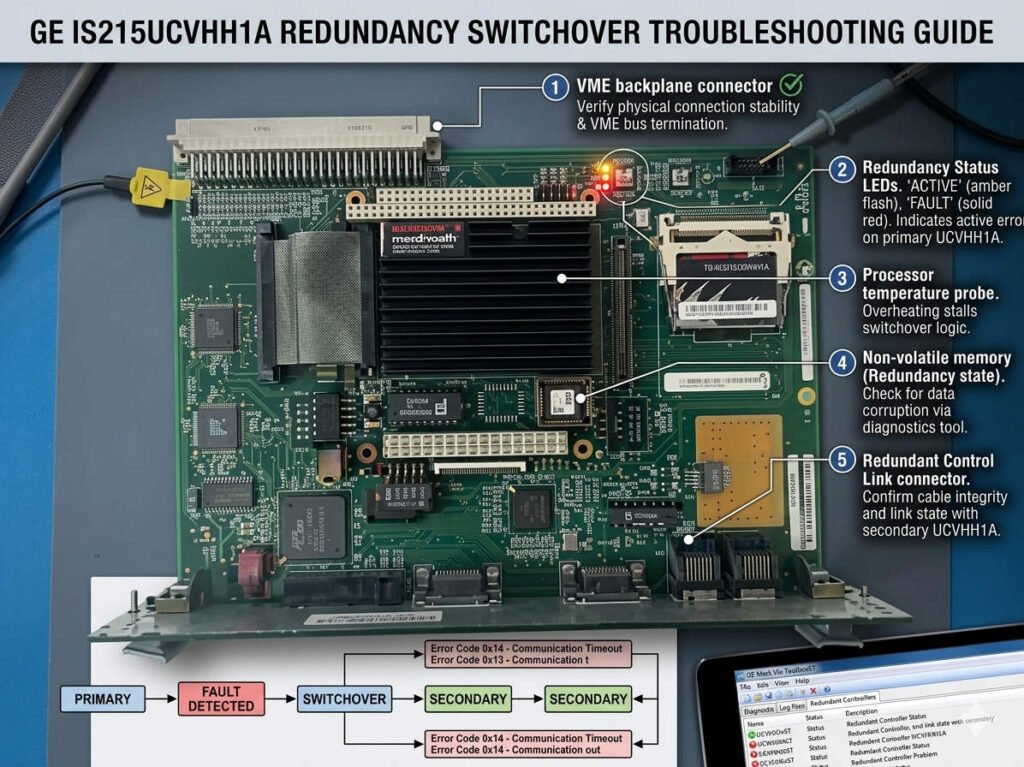
GE IS215UCVHH1A Redundancy Switchover Troubleshooting Guide
Analyzing GE IS215UCVHH1A Master Control Card Redundancy Switchover Logs
The GE IS215UCVHH1A serves as a core UCVH processor board within EX2100 and Mark VIe systems. This heavy-duty controller executes complex control algorithms, coordinates high-speed I/O data exchanges, and manages critical network synchronization functions. When the active R controller suddenly passes control to the standby S controller, plant operators must act quickly. Understanding the root cause helps determine if a transient glitch or hardware degradation triggered the event. Consequently, proper log analysis prevents unnecessary system trips during delicate power generation sequences.
The Core Application Value of Smooth Controller Redundancy
In power plants, refineries, and petrochemical complexes, continuous operation depends heavily on redundant control systems architectures. A seamless control transfer prevents single-point processor failures from causing catastrophic industrial turbine trips. Moreover, the redundancy layer ensures that critical network communications and high-speed I/O scanning functions remain entirely uninterrupted. For EX2100 excitation systems, stable processor synchronization directly maintains Automatic Voltage Regulator (AVR) performance. Failures in this transfer mechanism can induce sudden excitation current fluctuations and dangerous generator VAR swings.
Expert Insight from PLCDCS HUB: A successful redundancy switchover indicates that your safety net worked exactly as designed. However, plant engineers often misinterpret the switchover event as a total hardware failure. At PLCDCS HUB, we emphasize investigating the root cause immediately after a control transfer occurs. Leaving an underlying network fault unresolved compromises the backup line and leaves the plant vulnerable.
Technical Analysis of the Redundancy Synchronization Mechanism
The IS215UCVHH1A processor utilizes continuous memory mirroring, periodic EGD data exchanges, and real-time IONet health validation checks. Under normal operating conditions, the R controller runs as active while the S controller remains a hot backup. However, specific hardware or software anomalies will immediately force a redundancy switchover. Common triggers include processor heartbeats timeouts, CPU application overruns, application code mismatches, and severe IONet communication loss. Field experience shows that a brief network disruption often reports a “Primary Controller Health Fail” alarm first.
Decoding Typical Primary Alarm Messages on the HMI Terminal
When a control transfer occurs, the ToolboxST software interface populates the Sequence of Events (SOE) log. Operators frequently find messages like “UCVH Controller Redundancy Switchover from R to S” or “Controller Redundancy Switchover.” Concurrently, auxiliary diagnostic warnings such as “Primary Controller Communication Failed” or “IONet Node Timeout” appear on screen. If a transient network jitter caused the transfer, the system stabilizes without tripping the unit. Therefore, tracking the precise timestamps of these interlocking alarms simplifies the troubleshooting process.
Why IONet Communication Reliability Controls Redundancy Behavior
Many field teams assume that a redundancy switchover always indicates a physically broken master control board. However, industrial site statistics confirm that over 60% of redundancy switchovers stem from communication network vulnerabilities. High-voltage variable frequency drives (VFD) and non-standard grounding practices frequently inject extreme electromagnetic interference into data lines. Furthermore, exceeding the minimum bend radius of fiber optic cables causes high signal attenuation. These environmental factors introduce EGD packet delivery loss and ultimately break the controller synchronization loop.
Field-Proven Installation and Preventative Maintenance Protocols
Isolating erratic redundancy behavior on the IS215UCVHH1A processor requires a methodical, hands-on maintenance routine. Field maintenance teams should prioritize the following diagnostic actions:
- ✅ Fiber Power Verification: Measure the optical transceiver power budget before replacing high-value control boards.
- ✅ Network Error Analysis: Monitor the IONet switch error counter logs to identify hidden CRC communication defects.
- ✅ Clock Synchronization Audit: Maintain consistent NTP master time clock inputs to prevent database sync faults.
- ✅ Backplane Connection Cleaning: Clean the VME chassis slot contacts regularly to remove oxidation layers.
- ✅ Chassis Torque Calibration: Tighten all UCVH board retention screws to withstand continuous turbine vibration.
Strategic Procurement and System Backward Compatibility Guidelines
Sourcing a replacement IS215UCVHH1A card requires thorough cross-referencing of active firmware baselines and software tool revisions. Mismatched BootROM files or application CRC signatures will prevent the R and S controllers from establishing synchronization. Consequently, procurement departments must verify the exact hardware revision of the existing backplane and matching I/O packs. For critical retrofit projects, engineers should upgrade redundant pairs together using identical production batches. This practice eliminates compatibility gaps and ensures dependable execution within your factory automation loop.
Application Scenarios and Solutions
- Thermal Power Plant Excitation: Safeguards generator stability by maintaining AVR regulation continuity during sudden hardware transitions.
- Combined-Cycle Gas Turbines: Prevents nuisance safety trips by isolating low-voltage IONet lines from noisy motor control centers.
- Petrochemical Compressor Controls: Maintains uninterrupted high-speed I/O scanning sequences during periodic maintenance hot-swaps.
For genuine GE control components and expert hardware diagnostic evaluations, visit PLCDCS HUB Limited today. We provide the certified parts and industrial technical support required to maximize your industrial automation reliability.
Frequently Asked Questions (FAQ)
1. Does a single R to S switchover event mean my UCVH board needs immediate replacement?
No, transient network noise or power distribution fluctuations often cause isolated switchover events. You should only replace the board if the diagnostic logs report persistent watchdog timeouts or CPU halts.
2. How does a significant time drift between controllers impact the redundancy layer?
Time drift causes severe sequence of events logging errors and breaks the database validation handshake. If the drift exceeds the software tolerance limit, the secondary controller drops out of synchronization completely.
3. Can I install a newer revision IS215UCVHH1A card alongside an older version card?
We do not recommend mixing different hardware revisions in a redundant pair. Mismatched hardware often introduces timing discrepancies and firmware version conflicts that disable the automatic hot-backup feature.


