

How to Calibrate GE IS200CSLA Boards | Excitation Troubleshooting
Calibrating Zero Residual Voltage on GE IS200CSLA Conditioning Boards
Understanding Hall Effect Sensor Drift in Industrial Automation
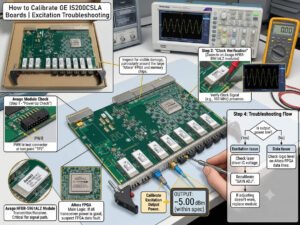
The GE IS200CSLAH1PR1, IS200CSLAH1A, and IS200CSLAH4A boards are essential in EX2100 and Mark VI/VIe systems. These modules condition signals from Hall Effect sensors for precise current measurement. However, magnetic hysteresis and thermal shifts often cause residual voltage offsets. Therefore, periodic calibration is vital to maintain measurement accuracy in power generation and petrochemical facilities.
Why Precise Zero-Point Calibration Matters
Even a slight offset in the Hall sensor signal can introduce significant errors in excitation control. Inaccuracies during startup or low-load conditions often lead to instability in your control systems. Moreover, technicians frequently mistake these offsets for software bugs. At PLCDCS HUB, we recommend verifying your zero-point settings to ensure your AVR performs optimally under all operating loads.
Step-by-Step Calibration Procedure
Follow these professional steps to stabilize your current feedback signals. Always perform this during a scheduled maintenance window when the generator is offline.
- ⚙️ Isolate the generator current to ensure a true zero-load state.
- ⚙️ Allow the excitation cabinet to warm up for 30 minutes.
- ⚙️ Connect a precision digital multimeter to the CSLA board input terminals.
- ⚙️ Locate the board’s offset potentiometer for fine-tuning.
- ⚙️ Adjust the potentiometer until the output reads as close to 0 mV as possible.
- ⚙️ Compare the multimeter reading with the feedback values in the PLC/DCS interface.
Best Practices for Long-Term Reliability
Environmental factors significantly impact board performance in factory automation settings. High-vibration areas can loosen terminal connections, leading to intermittent signal noise. Furthermore, improper grounding creates ground loops that mimic sensor drift. We suggest using shielded twisted-pair cables and inspecting connectors annually. Proper maintenance prevents unnecessary component replacement and enhances the lifespan of your control systems.
Author Insights: Diagnostic vs. Replacement
Many engineers prematurely replace these boards when experiencing feedback issues. However, our technical team at PLCDCS HUB consistently finds that clean, calibrated setups resolve most reported faults. If the offset remains stable after adjustment, the board is likely healthy. Only replace the unit if the amplifier circuitry fails or if physical damage exists. Always verify your specific hardware revision before ordering spares to ensure full system compatibility.
Application Scenario: Stability During Startup
A customer reported erratic excitation behavior during turbine synchronization. After checking the excitation cabinet, the team discovered a 15 mV offset on the IS200CSLAH1A board. They performed a zero-point calibration during a brief outage. The system regained stability instantly, confirming that minor signal drift caused the original instability. For further expert guidance or high-quality GE spares, visit PLCDCS HUB.
Frequently Asked Questions
How can I tell if the board needs recalibration versus full replacement?
Perform a bench test. If the board responds to potentiometer adjustments and holds a stable zero, it simply needs recalibration. If the output remains erratic or drifts continuously, consider a replacement.
Are all IS200CSLA variants fully interchangeable?
No. While they share the same base design, firmware and hardware revisions may vary. Always cross-reference your part number with your EX2100 system configuration before installing a spare.
Does ambient temperature affect the zero-point calibration?
Yes. Hall sensors drift with temperature changes. Always calibrate the board after the cabinet reaches its normal operating temperature to ensure accurate readings throughout the shift.


