
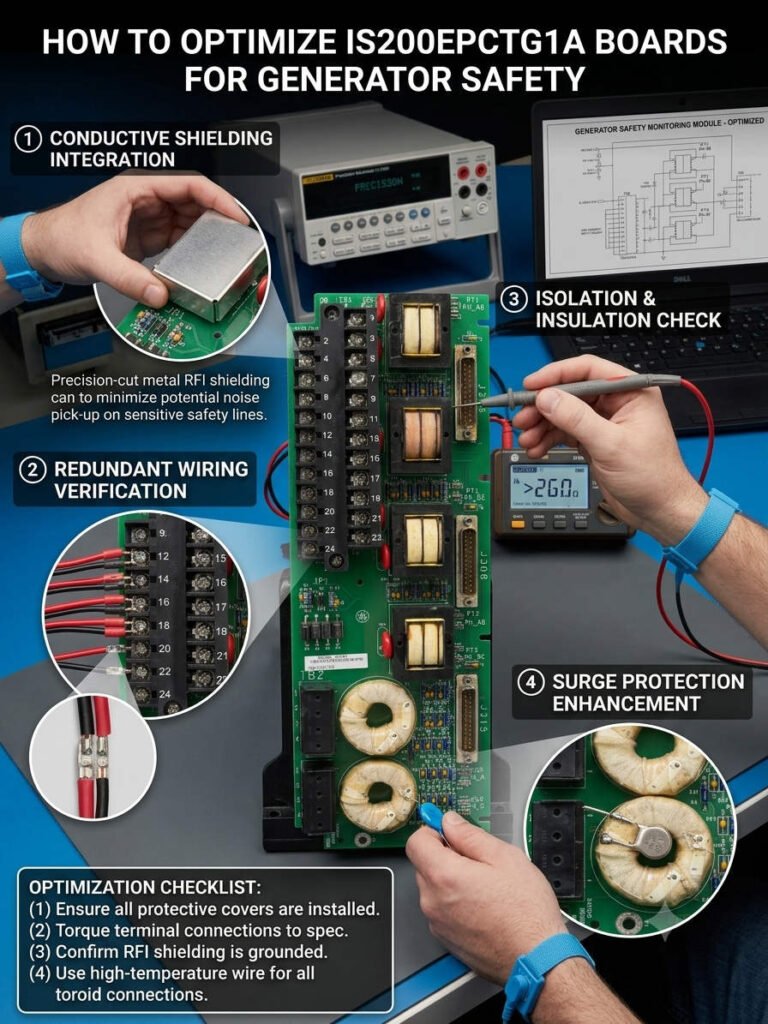
How to Optimize IS200EPCTG1A Boards for Generator Safety
Optimizing Rotor Ground Fault Protection with GE EX2100 Conditioning Boards
Understanding Rotor Insulation Monitoring in Industrial Systems
Large synchronous generators face significant risks from rotor-to-ground faults. A single fault often remains hidden during initial operation. However, a second fault can lead to catastrophic magnetic flux issues and forced shutdowns. GE IS200EPCTG1A and IS200ECTBG2A boards provide essential signal conditioning for these systems. By interfacing with external isolation amplifiers, these components maintain critical protection standards in power generation and large-scale industrial automation environments.
High-Impedance Signal Processing for Fault Sensitivity
Effective ground fault monitoring requires precise signal injection into the rotor circuit. The IS200EPCTG1A and IS200ECTBG2A boards process these low-level signals with high input impedance. This design prevents signal disturbance and ensures accurate detection of early-stage insulation degradation. Consequently, plant operators can plan maintenance during scheduled outages rather than reacting to emergency equipment failures.
Leveraging Isolation Amplifiers for Signal Integrity
Rotor circuits often operate at high DC voltages, which create significant electrical noise. External isolation amplifiers provide the necessary galvanic separation between the rotor and sensitive PLC control electronics. This setup effectively rejects common-mode voltage fluctuations. As a result, your system avoids nuisance alarms and transient disturbances that often plague less sophisticated excitation control systems.
Best Practices for Commissioning and Maintenance
Reliable fault detection depends on correct installation techniques. At PLCDCS HUB, we often see commissioning errors involving improper grounding of the isolation amplifiers. Follow these professional steps to ensure optimal system performance:
- ⚙️ Verify that input and output grounds remain electrically isolated per manufacturer guidelines.
- ⚙️ Use shielded twisted-pair cables for all low-energy measurement signals.
- ⚙️ Maintain physical separation between monitoring wires and high-current power conductors.
- ⚙️ Ground cable shields at exactly one designated point to prevent ground loops.
- ⚙️ Analyze historical insulation resistance trends to predict potential winding failure.
Author Insights: Prioritizing Diagnostics Over Replacement
Many maintenance teams replace conditioning boards immediately when rotor ground alarms occur. In my experience at PLCDCS HUB, hardware failure is rarely the primary culprit. Most issues stem from wiring errors, contaminated signal paths, or faulty isolation amplifiers. We strongly recommend performing a full signal integrity check before procuring new hardware. A methodical diagnostic approach protects your budget and improves long-term reliability in your factory automation facility.
Application Scenario: Avoiding Unnecessary Downtime
Consider a power plant experiencing intermittent rotor ground alarms after a system retrofit. The technical team initially suspected a defect in the new IS200EPCTG1A board. However, our diagnostic review revealed an incorrect grounding scheme on the isolation amplifier. By simply correcting the ground reference, the team eliminated the nuisance alarms entirely. For professional guidance and high-quality excitation components, visit PLCDCS HUB to support your critical infrastructure needs.
Frequently Asked Questions
How do I verify if my rotor ground fault alarms are genuine?
Compare the alarm triggers against historical insulation resistance data. If the resistance values fluctuate rapidly, inspect your cabling and isolation amplifiers for noise interference before assuming a board failure.
Are IS200EPCTG1A and IS200ECTBG2A interchangeable with all GE systems?
Not always. Hardware compatibility depends heavily on your specific EX2100 software revision and rack configuration. Always cross-reference your assembly numbers with the latest OEM documentation before installation.
What is the primary sign that an isolation amplifier needs replacement?
Frequent measurement drift or failure to maintain electrical isolation are clear indicators. If the amplifier output becomes unstable during standard excitation operations, replace it to restore accurate protection logic.


