
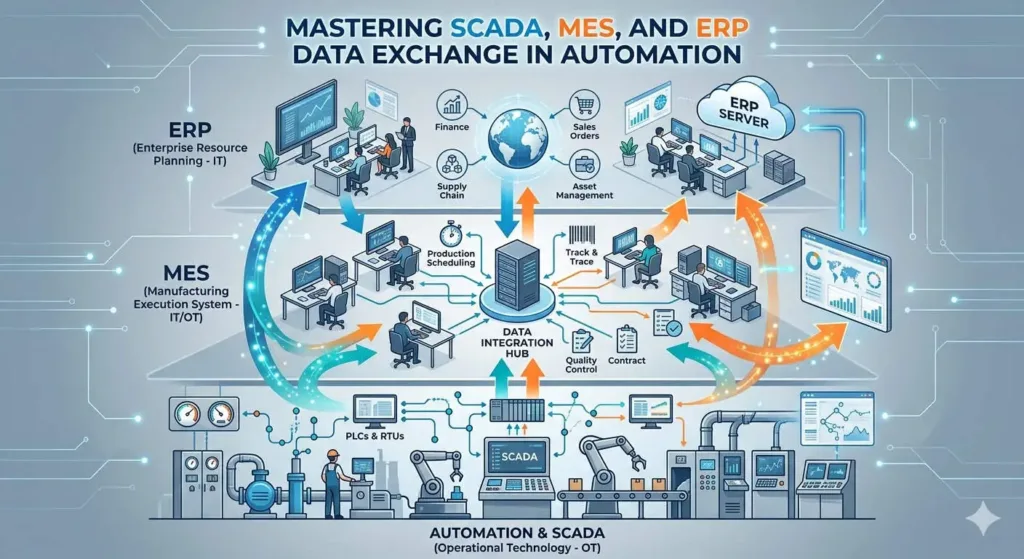
SCADA to ERP Integration: Bridging OT and IT for Smart Factories
Seamless SCADA to ERP Integration: Driving Actionable Intelligence in Industrial Automation
Modern industrial automation relies on bridging the gap between shop-floor data and high-level business strategy. SCADA systems capture real-time production metrics, yet this data often remains isolated from enterprise platforms. Integrating SCADA with ERP and MES systems transforms raw numbers into actionable business intelligence.
This connectivity is vital for sectors like oil and gas, pharmaceuticals, and complex manufacturing. Automated synchronization eliminates manual entry errors and ensures full production traceability. Moreover, it empowers leaders to make faster decisions based on live equipment status and inventory levels.
Standardizing Data Flow with Advanced Communication Protocols
Protocol selection dictates the reliability of your OT-to-IT data pipeline. Choosing the wrong standard can lead to expensive custom coding and maintenance headaches. Industry experts prioritize interoperability through modern, platform-independent standards.
- ✅ OPC UA: Offers secure, structured data modeling for complex industrial environments.
- ✅ MQTT: Provides a lightweight, “publish-subscribe” model perfect for cloud-based architectures.
- ✅ REST APIs: Connects easily to web-based ERP systems like SAP or Oracle.
At PLCDCS HUB, we recommend OPC UA for most factory automation projects. It reduces integration time by up to 50% compared to legacy drivers. Modern controllers now treat these protocols as native features, simplifying the overall architecture.
Ensuring Data Consistency through Buffering and Latency Management
ERP systems do not require millisecond updates, but they demand absolute data integrity. Network outages should never result in missing production records. Implementing a “store-and-forward” mechanism protects your history during communication drops.
MES systems typically require updates every 1 to 5 seconds for effective tracking. In contrast, ERP systems function well with updates every 10 to 60 seconds. However, high-compliance industries like pharmaceuticals must adhere to FDA 21 CFR Part 11. Proper buffering ensures zero data gaps, maintaining regulatory standing and audit readiness.
Contextualizing Raw Data for Enterprise Systems
Raw PLC tags often lack the context required for business software. A tag labeled “FLOW_001” means nothing to a financial officer. Data mapping translates these technical variables into meaningful business terms.
- ⚙️ Normalization: Convert technical units into standard business reporting formats.
- ⚙️ Association: Link sensor data directly to specific batch numbers or work orders.
- ⚙️ Synchronization: Align timestamps across all layers to ensure accurate historical analysis.
Poor mapping often causes inventory discrepancies. We have seen cases where mismatched unit scales led to a 12% error in stock reporting. Using middleware to define these relationships creates a “single source of truth” for the entire organization.
Best Practices for Network Security and Maintenance
Security remains the biggest concern when connecting SCADA to IT networks. Directly exposing your control system to the internet or enterprise LAN is dangerous. Engineers must follow the ISA/IEC 62443 standard to protect critical infrastructure.
- 🔧 Network Segmentation: Isolate OT and IT traffic using firewalls and DMZs.
- 🔧 Time Sync: Use a unified NTP server for all PLCs and enterprise servers.
- 🔧 Decoupling: Implement middleware to prevent ERP upgrades from breaking SCADA connections.
Ransomware often enters through poorly secured business apps and migrates to the factory floor. We strongly advise against direct database connections between SCADA and ERP. A dedicated integration layer acts as a vital security buffer.
The PLCDCS HUB Perspective on Digital Transformation
True digital transformation is not just about moving data. It involves creating a responsive ecosystem where the shop floor informs the boardroom. Many companies fail because they focus only on the software and ignore the underlying hardware compatibility.
Always verify if your existing DCS or SCADA components support modern encryption. If your hardware relies on outdated Windows versions or legacy OPC DA, consider an upgrade. Reliable integration starts with robust, modern hardware and a clear protocol strategy.
To find the right hardware for your integration project, visit our specialists at PLCDCS HUB Limited. We offer the latest controllers and gateways to secure your automation future.
Application Scenario: Pharmaceutical Batch Management
A major pharmaceutical firm integrated their SCADA system with an MES for real-time batch reporting. By using an OPC UA middleware, they automated the generation of Electronic Batch Records (EBR). This eliminated four hours of manual documentation per shift and reduced compliance errors to nearly zero.
Frequently Asked Questions
How can I tell if my legacy SCADA system is ready for ERP integration?
Evaluate its communication capabilities first. If the system only supports proprietary drivers or legacy OPC DA, you likely need a gateway. Modern integration requires encrypted protocols like OPC UA or MQTT to meet IT security standards.
Is middleware always necessary for connecting these systems?
While some SCADA platforms offer direct “hooks,” middleware is highly recommended for scalability. It decouples the systems, meaning you can upgrade your ERP without needing to reprogram your entire SCADA or PLC logic.
What is the most common failure point in SCADA-ERP projects?
Timestamp misalignment is a frequent but overlooked issue. If your PLC and ERP clocks differ by even a few seconds, root-cause analysis becomes impossible. Always synchronize your entire network to a single, high-precision NTP source.

No Comments