
Cross-Brand PLC Interoperability: Engineering Tips & Best Practices
Maximizing Interoperability in Multi-Vendor Industrial Automation Systems
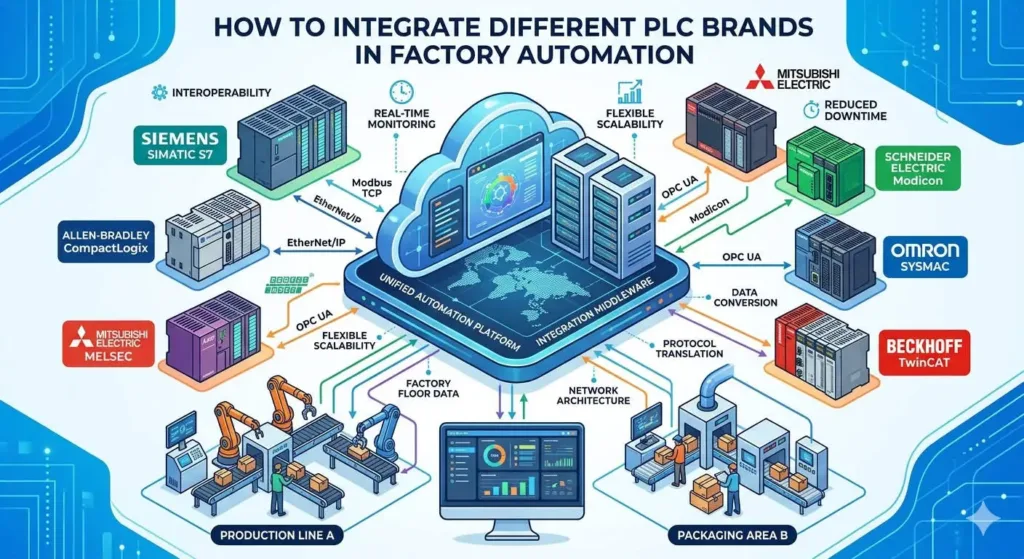
Integrating different PLC brands remains a significant challenge for modern engineers. Many factories operate as “brownfield” sites with legacy equipment. Replacing an entire control system is often too expensive. Therefore, cross-brand communication becomes the most practical way to modernize a plant.
In sectors like chemical processing, system uptime is vital. Seamless data flow between controllers ensures consistent production. By bridging heterogeneous systems, companies achieve centralized monitoring without massive capital expenditure.
Selecting the Right Industrial Communication Protocols
Protocol compatibility serves as the foundation for any multi-vendor integration. Most modern controllers support standard options like Modbus TCP, EtherNet/IP, or PROFINET. However, simple support does not guarantee instant success.
- ✅ Verify register mapping early to avoid addressing errors.
- ✅ Check protocol implementation details for specific vendor quirks.
- ✅ Prioritize open standards over proprietary manufacturer-specific languages.
At PLCDCS HUB, we often see engineers struggle with Modbus register offsets. Even small mismatches between “holding” and “input” registers can stall a project. Always validate your addressing schemes during the initial bench testing phase.
Managing Latency and Data Synchronization Speed
Communication speed directly impacts high-speed manufacturing performance. Protocols offer different levels of determinism. For instance, PROFINET IRT provides real-time precision, while Modbus TCP involves higher latency.
Inconsistent data exchange can disrupt synchronized movements in robotics or packaging. We once observed a retrofit where a high-speed Siemens PLC fought with a slower third-party unit. This 100ms lag caused mechanical misalignments. Adding buffering logic eventually stabilized the operation, but choosing high-speed protocols from the start is better.
Overcoming Data Mapping and Memory Hurdles
Every PLC brand utilizes a unique memory architecture. Siemens uses Data Blocks (DBs), while Rockwell relies on Tag-based structures. This difference can lead to significant misinterpretation of process values.
- ⚙️ Establish a strict data contract before writing any code.
- ⚙️ Standardize byte order (Endianness) to prevent data corruption.
- ⚙️ Define scaling factors clearly for all analog sensor signals.
Endianness mismatch is a classic trap in factory automation. If one system reads “Big-Endian” and the other “Little-Endian,” your floating-point numbers will be unrecognizable. Consistent documentation prevents these “ghost” errors in the field.
Implementing Protocol Gateways for Seamless Connectivity
Native compatibility is ideal, but it is not always possible. In these cases, industrial gateways act as essential translators. These devices bridge the gap between mismatched protocols like Modbus and PROFINET.
However, hardware quality matters immensely. Cheap gateways often fail under high polling loads in mission-critical environments. We recommend using robust converters from reputable brands to ensure long-term reliability. Always calculate your required data throughput before selecting gateway hardware.
Optimizing Network Infrastructure for Control Systems
A robust physical layer is the backbone of any control system. In high-noise environments like steel mills, electromagnetic interference (EMI) is a constant threat. Proper grounding and shielding are non-negotiable requirements.
- 🔧 Use shielded twisted-pair cables to minimize signal noise.
- 🔧 Implement VLAN segmentation to isolate control and IT traffic.
- 🔧 Assign static IP addresses to all critical automation hardware.
Mixing office traffic with PLC data leads to packet loss and jitter. Dedicated industrial switches help maintain the deterministic timing required for reliable automation.
Real-World Application: Chemical Plant Retrofit
In a recent chemical processing upgrade, a client needed to link a legacy Schneider Electric system with a new Emerson DeltaV DCS. By utilizing a dedicated Modbus TCP gateway and a structured data map, the plant achieved full transparency. This integration allowed the operator to monitor pressure and temperature from a single HMI, improving safety and response times.
If you are looking for high-quality components to bridge your automation gaps, explore our extensive inventory at PLCDCS HUB Limited. We provide the hardware you need to make complex systems talk.
Frequently Asked Questions
Do I need a gateway if both PLCs support the same protocol?
No, direct communication is usually possible if the physical layers match. However, a gateway might still be useful for electrical isolation or to manage high network traffic.
What is the biggest risk when mixing American and European PLC brands?
The primary risk is “Endianness” or byte-order mismatch. If not handled in the code, your integer and floating-point data will display incorrect values across the network.
How do I choose a PLC for a future-proof system?
Select hardware that strictly adheres to IEC 61131-3 standards and supports multiple open protocols. Avoid vendors that lock you into proprietary communication cycles.