

Terminal Block Reliability in Industrial Automation & DCS Systems
Enhancing Reliability in Industrial Automation with High-Quality Terminal Blocks
Engineers often overlook terminal blocks as low-cost accessories. However, these components form the backbone of signal integrity in industrial automation. In complex DCS architectures like Honeywell or Emerson, a single loose connection can trigger a system-wide shutdown. High-quality terminals ensure stable electrical paths for years. They significantly reduce the intermittent faults that haunt maintenance teams in chemical or oil and gas plants.
Extreme conditions like high vibration and corrosive gases demand robust connectivity. In these environments, the choice of terminal block directly impacts long-term factory automation stability. Substandard components lead to unexpected downtime and increased operational costs over time.
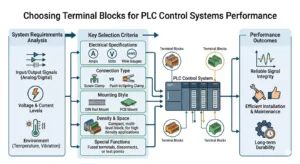
Ensuring Contact Resistance Stability for Signal Precision
Stable contact resistance is vital for accurate data transmission in 4–20 mA analog loops. Cheap terminals often oxidize, which increases resistance and degrades signal quality. As a result, control systems may receive drifted process readings, causing loop instability.
- ✅ Prevent signal drift by using terminals with high-grade copper alloys.
- ✅ Reduce fire risks by eliminating localized heat buildup at connection points.
- ✅ Avoid “random” PLC alarms caused by aging or oxidized contact surfaces.
At PLCDCS HUB, we have observed many “ghost” alarms that vanish during inspection. Frequently, the root cause is an unstable terminal connection in the marshalling cabinet. Investing in premium contacts prevents these costly troubleshooting marathons.
Vibration Resistance and Mechanical Retention Standards
Heavy machinery like compressors and turbines creates constant vibration. This mechanical stress can loosen standard screw-type terminals over time. Consequently, PLC systems may suffer from intermittent digital input losses or complete disconnection.
Spring-clamp technology often outperforms traditional screws in high-vibration zones. However, users must ensure these components meet IEC vibration standards for industrial use. Proper mechanical retention minimizes the need for frequent manual re-tightening during routine maintenance cycles.
Environmental Durability in Corrosive Control Environments
Industrial sites often expose electronics to temperature swings and harsh chemicals. Terminal blocks must withstand H₂S in oil fields or solvents in pharmaceutical labs. Insulation failure can lead to short circuits or dangerous leakage currents in the control systems.
- ⚙️ Select materials like polyamide PA66 with UL94 V-0 flame ratings.
- ⚙️ Verify compliance with IEC 60947-7 for low-voltage switchgear safety.
- ⚙️ Use corrosion-resistant coatings for metal parts in high-humidity areas.
Best Practices for Installation and Torque Management
Improper tightening torque remains a leading cause of failure in the field. Over-tightening strips the threads or damages the conductor. Conversely, under-tightening creates high-resistance joints that eventually fail. Therefore, technicians must use calibrated torque screwdrivers for every installation.
We recommend re-checking the torque after the first 72 hours of operation. This period allows for initial thermal cycling and mechanical settling. Proper cable management and segregation between power and signal lines further prevent electromagnetic interference.
Integrating Surge Protection and Grounding Discipline
Standard terminal blocks lack inherent surge protection. For outdoor I/O lines, lightning strikes pose a massive risk to expensive DCS modules. Adding dedicated surge suppression terminals is a proactive way to safeguard your hardware investment.
- 🔧 Install surge modules for field instruments in lightning-prone areas.
- 🔧 Maintain strict grounding discipline to ensure protection devices function correctly.
- 🔧 Use partition plates to physically separate different voltage classes.
Application Scenario: Refining Plant Marshalling Upgrade
A refinery faced constant intermittent alarms on their temperature sensors. Investigation revealed that old, corroded terminal blocks were causing 5-ohm resistance fluctuations. By upgrading to gas-tight, spring-clamp terminals, the plant eliminated the alarms. This simple hardware change saved thousands in unnecessary sensor replacements.
For high-performance components and expert support for your DCS or PLC systems, visit PLCDCS HUB Limited. Find the reliability your facility deserves.
Frequently Asked Questions
When should I consider replacing my current terminal blocks?
If you notice unexplained signal fluctuations or visible discoloration on plastic housings, replace them immediately. Aging systems over ten years old in humid environments are high-risk candidates for upgrades.
Are different terminal block brands interchangeable on the same DIN rail?
While they fit the rail, accessories like jumpers and end covers are brand-specific. Mixing brands complicates maintenance and may lead to improper insulation gaps between modules.
Which clamping technology is best for offshore applications?
Spring-cage or tension-clamp technology is superior for offshore use. It provides constant pressure regardless of temperature changes or the heavy vibrations common on drilling platforms.


