
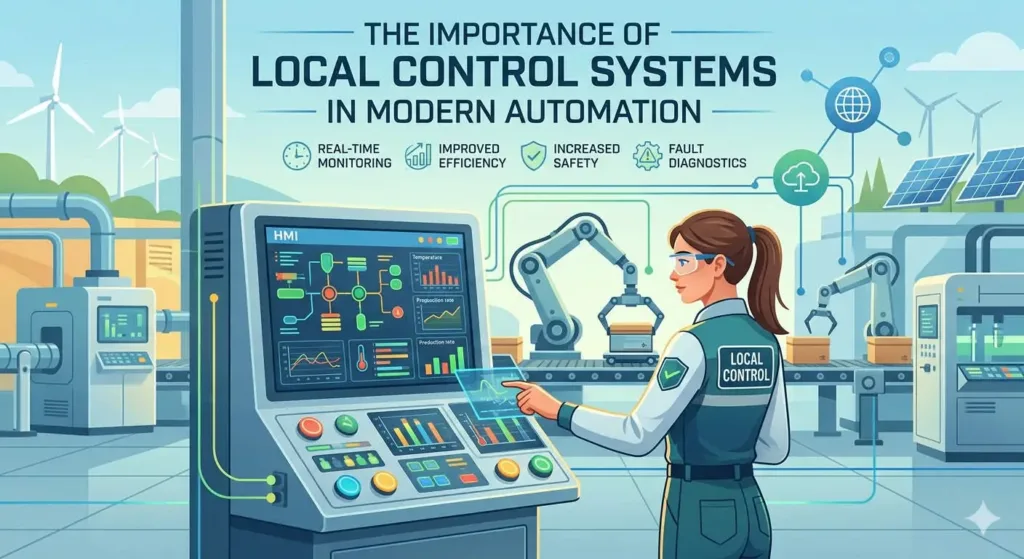
The Importance of Local Control Systems in Modern Automation
Why Local SCADA Remains Essential in the Era of Industrial Cloud Platforms
Modern industrial automation often emphasizes cloud-based transformation. However, local SCADA systems remain the backbone of real-time control. Industries like oil and gas or pharmaceuticals cannot risk latency or network dependencies. A local architecture ensures deterministic control and operational continuity when external connections fail.
While cloud platforms offer excellent fleet-level optimization, they complement rather than replace local systems. At PLCDCS HUB, we believe a hybrid approach provides the best balance of safety and innovation. Local nodes handle critical shutdowns, while the cloud manages long-term data analytics and reporting.

Ensuring High-Speed Response Times and Determinism
Cloud systems introduce inherent delays during data transmission over wide-area networks. In contrast, local SCADA environments typically maintain response times under 100 milliseconds. This speed is vital for time-sensitive factory automation tasks.
- ✅ Local systems manage emergency shutdown sequences (ESD) instantly.
- ✅ Operators rely on low-latency feedback for high-speed interlocks.
- ✅ Deterministic timing prevents off-spec batches in pharmaceutical lines.
Even a 500ms delay can trigger safety trips in high-pressure refinery blending units. Therefore, engineers must prioritize local processing for all safety-critical control loops.
Maintaining Uptime During Network Disruptions
WAN connectivity is often unreliable in remote mining sites or offshore platforms. A local SCADA layer provides 100% operational autonomy regardless of internet status. It functions as a reliable Level 2 supervisory layer within the Purdue Model.
Moreover, Honeywell Experion PKS and similar DCS environments utilize local nodes to maintain visualization. If the cloud connection drops, the local HMI continues to provide full process transparency. This resilience prevents costly production halts during routine network maintenance or unexpected outages.
Integrating Legacy PLC and DCS Protocols
Local SCADA systems excel at communicating with diverse hardware via Modbus, OPC UA, or Profinet. Cloud platforms usually require additional edge gateways for protocol conversion. Each extra layer increases system complexity and potential failure points.
- ⚙️ Local drivers provide direct access to legacy controller memory.
- ⚙️ Engineers reduce integration risks by avoiding complex data mapping.
- ⚙️ Native protocol support simplifies the maintenance of brownfield sites.
From our experience at PLCDCS HUB, retaining a local supervisory layer simplifies lifecycle management. It bridges the gap between old serial-based PLCs and modern Ethernet-based information systems.
Best Practices for Installation and Cybersecurity
Security is a major concern when connecting control systems to the cloud. Engineers must implement strict network segmentation to protect Level 1 and Level 2 assets. Always use industrial firewalls and DMZs to isolate the control network from the business network.
- 🔧 Use GPS-synced NTP servers for consistent local timestamps.
- 🔧 Configure redundant SCADA server pairs for high availability.
- 🔧 Implement local historian buffering to prevent data gaps.
Inconsistent timestamps can ruin batch traceability during regulatory audits. Therefore, avoid relying on internet-based time services for pharmaceutical or food production records.
Solution Scenario: Hybrid Control Architecture
In a recent chemical plant retrofit, we deployed a hybrid solution. The local SCADA handled all real-time valve control and alarm management. Simultaneously, an edge gateway pushed filtered data to a cloud platform for predictive pump maintenance. This setup ensured site safety while leveraging advanced AI analytics.
To find the right hardware for your hybrid control system, visit PLCDCS HUB Limited today. We stock the essential DCS and PLC components to keep your plant running.
Expert Insights: Frequently Asked Questions
Can cloud platforms handle safety-critical interlocking?
No, current cloud latencies and connection risks make them unsuitable for safety interlocks. Always keep logic and visualization for safety-critical tasks on a local, redundant SCADA or DCS node.
How do I handle data synchronization in a hybrid system?
Deploy a local NTP server to provide a single “source of truth” for time. Ensure your SCADA system buffers data locally so it can backfill the cloud historian once the network restores.
What hardware is best for connecting old PLCs to modern SCADA?
Look for multi-protocol communication modules or OPC UA servers. These devices translate old serial or proprietary data into formats that modern supervisory software can easily digest.
Related Posts

No Comments