
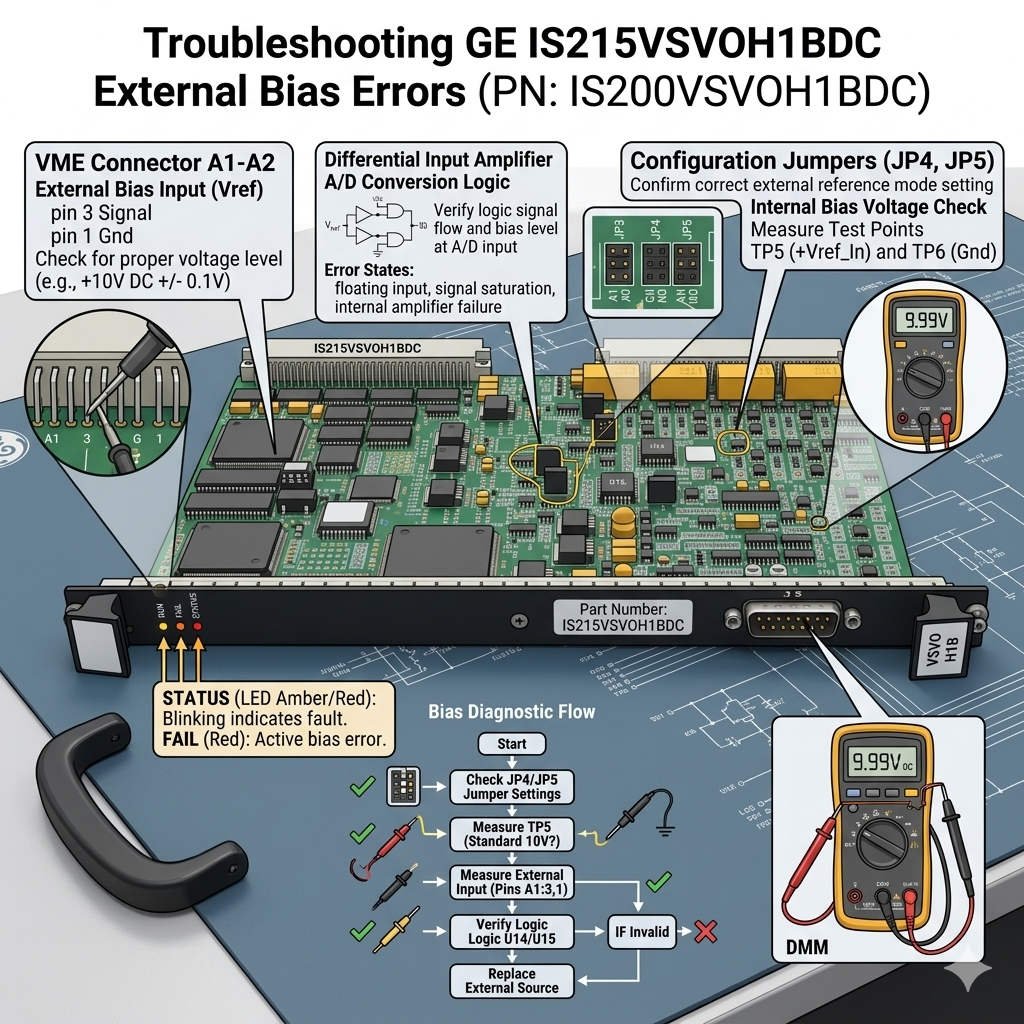
Troubleshooting GE IS200VSVOH1BDC External Bias Errors
GE IS200VSVOH1BDC Servo Output Fail-Safe Logic: Managing External Bias for Safe Valve Closure
The GE IS200VSVOH1BDC servo output board drives critical turbine actuators where losing positioning control threatens equipment safety. In gas turbines, steam turbines, and compressor control systems, uncontrolled servo behavior causes overspeed or combustion instability. What differentiates this architecture is its reliable external bias-assisted fail-safe mechanism. When cabinet power or servo excitation disappears suddenly, the servo output stage does not simply float. Instead, predefined external bias circuitry forces the hydraulic loop to drive the valve toward a known safe position.
Understanding External Bias Mechanisms in Control Systems Safeties
During normal plant operations, the VSVO board generates a precise servo current to regulate electro-hydraulic valves. However, sudden DC bus loss or I/O rack failures collapse the servo amplifier stage rapidly. The fail-safe behavior relies heavily on an externally engineered bias resistor network to maintain a negative current polarity. This negative bias combines with hydraulic actuator spring force to shift the valve spool toward the shutdown side. As a result, fuel, steam, or inlet guide vane (IGV) valves snap safely closed during emergencies.
Expert Insight from PLCDCS HUB: Many field technicians focus entirely on software parameters when troubleshooting trip failures. However, field diagnostics reveal that aging bias resistor networks often cause sluggish valve movement during partial power drops. At PLCDCS HUB, we advise engineering teams to verify bias voltage dynamically under simulated power loss conditions rather than relying on static multimeter tests.
Optimizing Servo Output Response for Process Stability
The IS200VSVOH1BDC board delivers the exceptionally fast analog servo response times required by modern compressor anti-surge loops. Fast response characteristics significantly improve combustion stability and load rejection handling in complex factory automation networks. However, replacing older legacy Moog or Woodward hardware with high-speed boards changes the loop dynamics. Because the newer outputs react much faster, existing PID tuning constants often become unstable. Engineers must recalibrate null bias settings after hydraulic oil temperatures fully stabilize to prevent premature seal wear.
Enhancing Isolation and Noise Immunity in High-Energy Plant Environments
Servo output boards installed near large VFD cabinets face severe electromagnetic interference (EMI) and transient ground potential differences. In heavy industrial environments, poor cable shielding introduces subtle servo ripple currents that mimic erratic command signals. Floating shields on the cabinet side frequently create noticeable valve jitter during motor startup cycles. Therefore, field installations exceeding 30 meters require twisted-pair shielded cables and strict single-point grounding. These practices block inductive spikes from distorting low-level analog feedback signals within your control systems.
Essential Field Maintenance Protocols for Turbo-Machinery Controls
Securing the fail-safe operational path of the VSVO board requires systematic field maintenance procedures. Technical teams should execute the following checklist before restarting production loops:
- ✅ Dry-Loop Simulation: Verify the actuator moves toward the closed position during simulated signal failure tests.
- ✅ Polarity Validation: Confirm the physical wiring configuration rather than relying on wire insulation colors alone.
- ✅ Thermal Drift Monitoring: Allow hydraulic oil to warm up for 45 minutes before recording final null current baselines.
- ✅ Surge Protection Inspection: Install DIN-rail surge suppressors on analog lines in lightning-prone remote facilities.
- ✅ Cable Routing Isolation: Separate low-voltage servo control cables from high-current ignition lines inside the wire ducts.
Strategic Procurement Advice and Hardware Compatibility Guide
When upgrading aging turbine systems, complete board failure is less common than degraded analog component stability. Before purchasing a new module, verify hydraulic oil cleanliness, check LVDT calibration, and measure terminal block contact resistance. If you choose to replace hardware, remember that backward compatibility depends on specific firmware revisions and terminal board types. Mixing different generations of servo blocks without validating terminal wiring can compromise the shutdown logic. Always confirm firmware-to-I/O mapping to ensure a safe PLC or DCS retrofit.
Application Scenarios and Solutions
- Turbine Emergency Trip Systems: Guarantees rapid fuel valve closure during total power outages via hardware-enforced negative bias.
- Compressor Anti-Surge Control: Prevents destructive compressor surge cycles by maintaining high-speed analog actuator tracking.
- Petrochemical Steam Bypass Networks: Eliminates valve hunting and control loop oscillation through optimized PID tuning and noise isolation.
For certified GE hardware and specialized industrial diagnostic support, visit PLCDCS HUB Limited today. We supply the genuine components and technical expertise needed to protect your industrial automation infrastructure.
Frequently Asked Questions (FAQ)
1. Why does my valve drift slowly instead of snapping closed when I pull the board?
This dangerous behavior indicates that your external bias resistor network is either incorrectly sized or physically damaged. Without sufficient bias current, the valve relies solely on mechanical spring force, which increases closure time.
2. How does hydraulic oil temperature affect the IS200VSVOH1BDC calibration?
As hydraulic oil warms up, its viscosity drops, which directly shifts the mechanical null position of the servo valve. Calibrating the system while the oil is cold causes tracking errors and minor valve creep later.
3. Can I swap a VSVO board with a different suffix version during an emergency shutdown?
We strongly advise against arbitrary swaps because different revision suffixes alter the external bias values and firmware requirements. Check your system configuration database to ensure the new board revision matches your active application project.


