
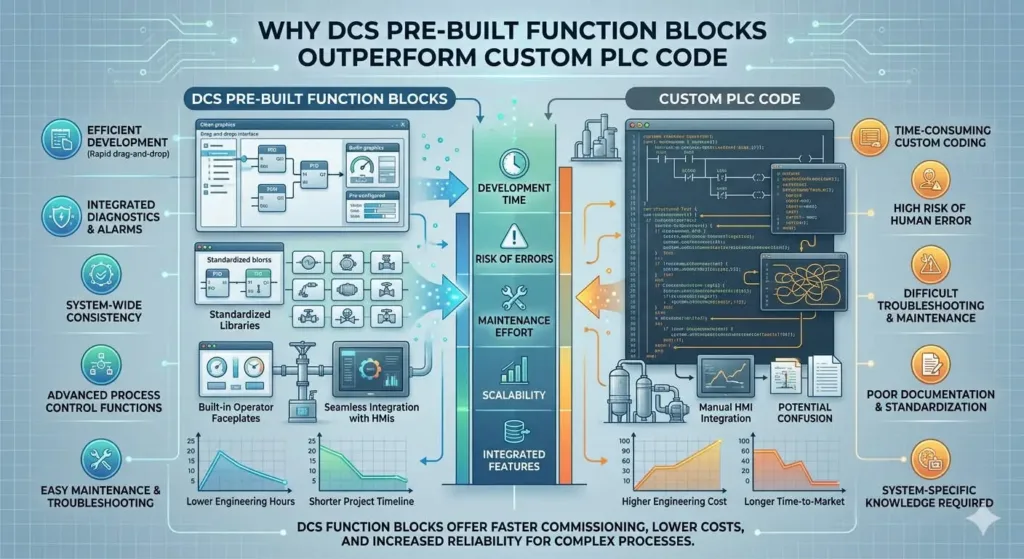
Why DCS Pre-built Function Blocks Outperform Custom PLC Code
Maximizing Efficiency with Pre-Configured PID and Motor Control in DCS
A Distributed Control System (DCS) serves as the brain for continuous, process-heavy industries. It excels in oil & gas, chemical processing, and pharmaceutical sectors. These platforms prioritize control stability and engineering efficiency. By embedding pre-configured PID and motor control blocks, they eliminate repetitive low-level programming. Consequently, engineers reduce commissioning time significantly. These built-in strategies encapsulate decades of field-proven expertise. This ensures standardized, reliable control loops for every facility.
Reliable Scan Time Consistency in Control Loops
In a DCS, PID blocks integrate tightly into the system scheduler. This ensures deterministic execution cycles, often at 100 ms or faster. Stable loop performance is vital for reactor temperature or distillation pressure. However, custom-coded logic in a generic PLC may suffer from variable timing. A consistent scan cycle reduces oscillation and process overshoot. Therefore, it improves final product quality and minimizes the need for operator intervention.
Standardized Motor Control with Integrated Interlocking
Modern motor control blocks offer more than simple start and stop logic. They include built-in interlocks, permissives, and feedback monitoring. Most follow international standards like IEC 61131-3 and ISA guidelines. This prevents unsafe operations, such as starting a pump without lubrication. Using these templates reduces engineering errors during the design phase. PLCDCS HUB Limited notes that custom logic often leads to maintenance confusion and inconsistencies between engineers.
Seamless System Integration and Communication
Native DCS blocks communicate effortlessly with common industrial automation protocols. They support Modbus, Profibus, and Foundation Fieldbus natively. This allows for faster integration with field instruments and Motor Control Centers (MCC). Moreover, unified engineering tools simplify diagnostics and troubleshooting. Relying on native blocks reduces the risk of communication mismatches during system startup. In contrast, manual tag mapping in legacy systems often delays commissioning schedules.
Essential Installation and Maintenance Best Practices
Even though systems allow customization, using standard templates is highly recommended. Heavy modifications often complicate future troubleshooting for maintenance teams. Follow these technical guidelines for the best results:
- ✅ Scaling Accuracy: Verify transmitter ranges match the DCS input configuration exactly.
- ✅ Loop Testing: Always test loop responses with simulated signals before live startup.
- ✅ Signal Isolation: Install signal isolators if your hardware lacks built-in isolation.
- ✅ Shielding Discipline: Use shielded cables with single-point grounding in high-noise zones.
Strategic Advantages of DCS Block Libraries
The choice to use built-in blocks is a deliberate engineering decision. It standardizes control strategies across the entire enterprise. This reduces engineering risk and ensures long-term operational stability. While factory automation requires flexibility, process industries demand the rigorous validation these blocks provide. Therefore, adopting a DCS-centric approach protects your capital investment and operational integrity.
Explore high-quality spare parts and technical solutions at PLCDCS HUB Limited. Our team provides the reliable hardware you need for stable control systems.
Case Study: Distillation Column Optimization
A chemical plant replaced custom PLC logic with standard DCS PID blocks. This change reduced temperature fluctuations by 15% within the first month. As a result, the plant achieved higher purity in its final product. Standardizing the motor interlocks also reduced accidental equipment trips during maintenance cycles.
Industrial Automation Frequently Asked Questions
1. Why are built-in blocks better than custom code for process safety?
Standard blocks undergo rigorous vendor testing and adhere to global safety standards. Custom code depends entirely on an individual programmer’s skill. Standardized blocks ensure that any qualified engineer can understand and maintain the safety logic years later.
2. How do I handle hardware migration with existing function blocks?
Most major brands maintain configuration-level backward compatibility. However, you must check firmware execution requirements before upgrading. We recommend using vendor-specific conversion tools to avoid the errors associated with manual data entry.
3. What should I prioritize when selecting a system for a new facility?
Evaluate the library depth for your specific industry. If you run complex thermal processes, ensure the DCS has advanced PID features. For rotating equipment, prioritize blocks with comprehensive vibration and interlocking capabilities to save on engineering costs.


