
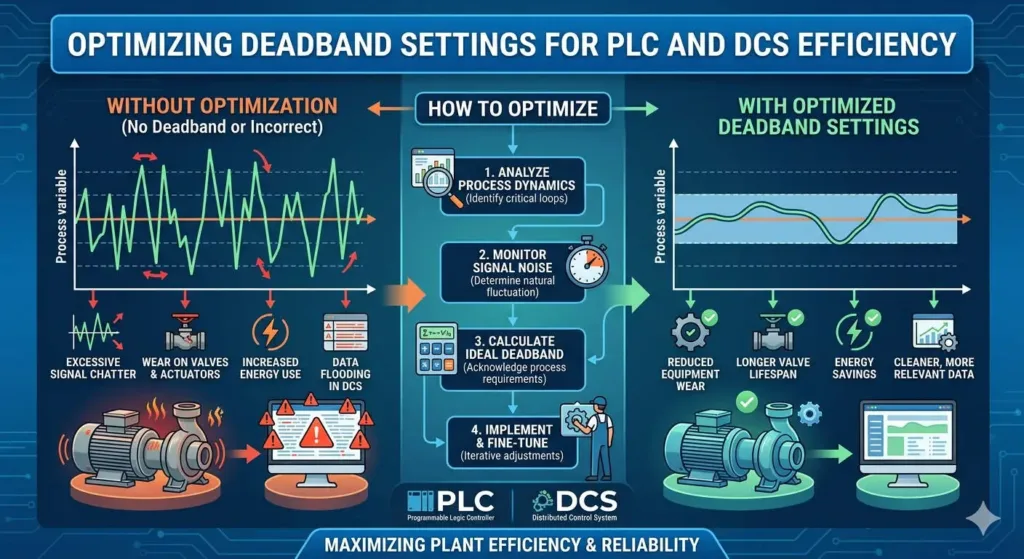
Deadband Strategy: Reducing Data Load in Control Systems
Maximizing System Efficiency Through Strategic Deadband Configuration
In the world of industrial automation, Deadband serves as a vital gatekeeper for process data. This parameter defines the minimum signal change required before a system records or transmits new information. Its primary function involves filtering out insignificant noise and minor fluctuations in process variables. By suppressing “jitter,” engineers significantly improve the stability of control systems. Moreover, effective Deadband settings prevent network congestion across oil, gas, and manufacturing facilities.
Technical Precision in Threshold Selection
Engineers typically define Deadband as an absolute engineering unit or a percentage of the total range. A well-tuned threshold prevents constant minor updates from overwhelming your SCADA historian and alarm management systems. For instance, setting a tiny 0.1% Deadband on a high-pressure transmitter can reduce data writes by over 60%. However, you must ensure the setting does not obscure meaningful process trends or critical deviations.
Expert Insight from PLCDCS HUB: We often see engineers leave default settings untouched during the design phase. This oversight leads to “noisy” databases that consume massive storage. We recommend a proactive review of all non-critical tags to optimize historian performance.
Syncing Scan Cycles with Communication Updates
Deadband does not operate in a vacuum; it interacts directly with the PLC or DCS scan time. If a controller scans every 50ms but the Deadband is too tight, the system generates excessive traffic. Conversely, a large Deadband might delay the detection of rapid process changes. Therefore, you must align these settings with specific process dynamics. Fast-moving loops like flow control require much tighter tolerances than slow-moving variables like tank levels.
Implementing Filtering at the Network Edge
Modern factory automation architectures often utilize edge gateways and MQTT protocols to manage data. Implementing Deadband at the gateway level significantly reduces upstream bandwidth requirements for cloud-connected systems. However, legacy protocols like basic Modbus RTU rarely support native Deadband. In these scenarios, you must implement filtering logic within the PLC code. While effective, this approach increases the CPU load on older hardware components.
Critical Maintenance and Installation Standards
Applying Deadband requires a balanced approach to maintain safety and accuracy. Consider the following best practices for your facility:
- ✅ Safety First: Follow IEC 61511 guidelines for safety-instrumented systems (SIS).
- ✅ Minimal Filtering: Disable or minimize Deadband for all safety-critical instrument tags.
- ✅ Live Tuning: Adjust settings during active commissioning rather than using theoretical values.
- ✅ Layered Approach: Filter signals at the sensor and apply Deadband at communication levels.
Optimizing Data Loads for Large-Scale Systems
Large-scale industrial automation projects with over 10,000 tags face significant data management challenges. Systems without optimized Deadband often generate five times more data than necessary. This leads to historian lag and slow SCADA screen refreshes. Properly configured Deadband reduces storage costs and eliminates “alarm flooding” for operators. Consequently, optimizing existing software settings is often more cost-effective than purchasing new server hardware.
For more technical insights and premium automation components, visit PLCDCS HUB Limited. Our team provides the expertise needed to keep your systems running at peak performance.
Industrial Application Scenario: Chemical Batch Processing
In a pharmaceutical batch plant, excessive signal noise on a temperature loop caused inconsistent reporting. The engineering team applied a 0.2°C Deadband alongside a low-pass filter. As a result, the batch reports became clean and repeatable. This change reduced database growth by 45% without losing critical cooling curve data. This demonstrates how small configuration changes solve complex data integrity issues.
Frequently Asked Questions (FAQ)
1. How do I identify if my control system needs Deadband optimization?
Monitor your historian database growth and check for “jagged” lines on your process trends. If you see thousands of identical data points stored every hour, your settings are likely too tight. High SCADA latency also signals a need for better data filtering.
2. Can Deadband negatively impact my PID control loops?
Yes, if you apply it within the feedback loop itself. Excessive Deadband creates a “limit cycle,” where the controller over-corrects because it cannot see small changes. Only apply significant Deadband to data transmission and historian logging, not to the core control logic.
3. What is the best way to choose an initial value for a new sensor?
Start by observing the “idle” noise of the instrument when the process is stable. Set the Deadband slightly higher than the peak-to-peak noise level. This ensures the system only records genuine process movements rather than electrical interference.


