
1756-IB16 vs 1756-IB32 RTB Compatibility Guide | PLCDCS HUB
Are 1756-IB16 and 1756-IB32 Removable Terminal Blocks Interchangeable?
In the world of industrial automation, technicians often ask if Allen-Bradley ControlLogix Removable Terminal Blocks (RTBs) are universal. Specifically, users frequently wonder if the RTBs for the 1756-IB16 and 1756-IB32 modules are interchangeable.
The short answer is no. While both modules belong to the same 1756 family, their RTBs feature distinct mechanical and electrical designs. Using the wrong component can lead to significant wiring errors or hardware damage.

Understanding Channel Density and Pinout Architecture
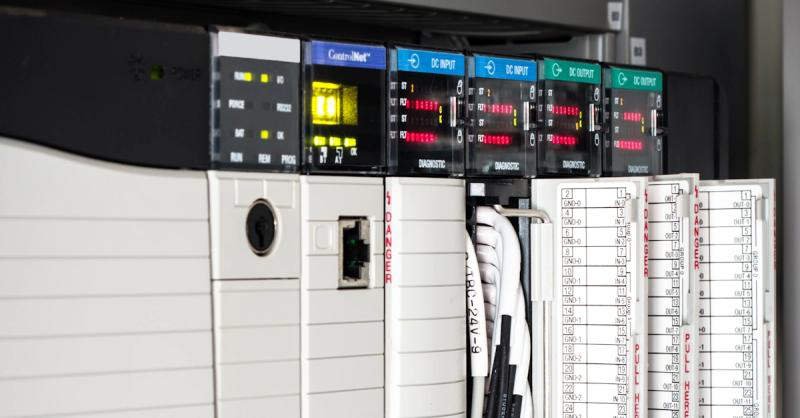
The primary difference lies in the input capacity of each module. The 1756-IB16 handles 16 digital input channels, whereas the 1756-IB32 manages 32 channels. Consequently, the IB32 requires a high-density RTB to accommodate double the wiring connections within the same physical footprint.
Rockwell Automation designs these RTBs with specific pinout routings. An RTB meant for a 16-point module physically lacks the connection points required for a 32-point module. Therefore, attempting to swap them will result in incomplete circuits and system failure during factory acceptance testing (FAT).
Electrical Grouping and Commoning Strategies
Internal bus routing differs significantly between these two units. The 1756-IB16 typically provides more space for larger gauge wires, which is ideal for heavy-duty factory automation environments. In contrast, the 1756-IB32 utilizes a tighter terminal spacing to fit 36 pins into the connector.
Moreover, the commoning strategy for input groups varies. Misaligning the RTB with the module’s internal common pins can create ground loops or “ghost” signals. From my experience at PLCDCS HUB, these subtle electrical mismatches often cause the most difficult troubleshooting headaches during site commissioning.
Selecting the Correct RTB Part Numbers
You must match the RTB family to the specific module point count. While you can choose between screw-clamp and spring-clamp styles, the point count is non-negotiable.
- 1756-IB16: Compatible with 20-pin RTBs (e.g., 1756-TBNH, 1756-TBSH).
- 1756-IB32: Requires 36-pin RTBs (e.g., 1756-TBCH, 1756-TBS6H).
Standardizing your spare parts inventory is vital. However, standardization should focus on the type of connection (like spring-clamp) rather than assuming one SKU fits every I/O card.
The Hidden Risks of Mechanical Keying
Rockwell Automation employs mechanical keying to prevent users from inserting the wrong RTB into a module. However, forceful insertion can bypass these tabs, leading to bent pins or short circuits.
In high-vibration industries like oil and gas, ensuring a perfect mechanical fit is paramount. We recommend verifying the keying positions against the manufacturer’s data sheet before applying power to the chassis. This proactive step prevents costly hardware replacements.
Maintenance Best Practices for ControlLogix Systems
Labeling is your best defense against field errors. In many large-scale PLC projects, technicians wire the RTBs before the actual I/O modules arrive on-site.
- Label every RTB with the specific module catalog number.
- Color-code the wiring bundles for 16-point versus 32-point inputs.
- Always perform a “tug test” on high-density 36-pin connectors.
- Use spring-clamp terminals for applications with constant machine vibration.
- Verify that the module’s electronic keying in Studio 5000 matches the hardware.
Expert Insight from PLCDCS HUB
At PLCDCS HUB, we have observed that most RTB failures stem from procurement oversights rather than equipment defects. When upgrading an existing system from 16-point to 32-point modules to save rack space, many engineers forget to budget for the new 36-pin RTBs. This oversight can stall a turnaround for days. Always treat the RTB as a critical, module-specific component.
For high-quality Allen-Bradley components and expert technical support, visit the PLCDCS HUB Limited website to explore our extensive inventory of ControlLogix solutions.
Application Scenario: Retrofitting a Wastewater Plant
Imagine upgrading a treatment plant’s control system to add more sensors without adding new chassis. You decide to replace three 1756-IB16 modules with 1756-IB32 modules.
The Solution: You must procure 36-pin 1756-TBCH connectors. You cannot simply move the old 20-pin arms to the new modules. By planning for the specific RTB requirements, you ensure the high-density migration is seamless and the I/O mapping remains accurate within the PLC code.
Frequently Asked Questions (FAQ)
1. Can I use a 36-pin RTB on a 16-point module just to be safe?
No, the physical dimensions and alignment pins will not allow a 36-pin RTB to seat correctly on a 16-point module. The physical housing is designed to be exclusive to the module’s density.
2. Which RTB connection style is better for long-term reliability?
While screw terminals are traditional, spring-clamp RTBs (like the 1756-TBS6H) are superior for environments with temperature fluctuations or vibration. They maintain constant pressure on the wire, reducing the need for periodic re-torqueing.
3. How do I identify an RTB if the label is missing?
Count the pins. A 1756-IB16 module uses a 20-pin connector, while a 1756-IB32 uses a 36-pin connector. Always cross-reference the physical pin count with the official Rockwell Automation selection guide before installation.
Related Posts


One Comment
Comments are closed.
Jason Reynolds
January 7, 2026 at 8:49 am
The comparison between the Allen-Bradley 1756-IB16 and 1756-IB32 modules highlights a strategic decision many U.S. manufacturers face — balancing I/O density with wiring complexity. The IB16’s 16 inputs suit smaller lines, while the IB32’s 32 inputs cut down chassis real estate and simplify centralized logic mapping. Both require proper removable terminal blocks (RTBs) for field wiring, so ensuring RTB compatibility upfront avoids costly install delays. In practice, a Midwest food-packaging facility recently standardized on the IB32 to consolidate sensor inputs for its automated sorters, reducing rack space and streamlining maintenance.