
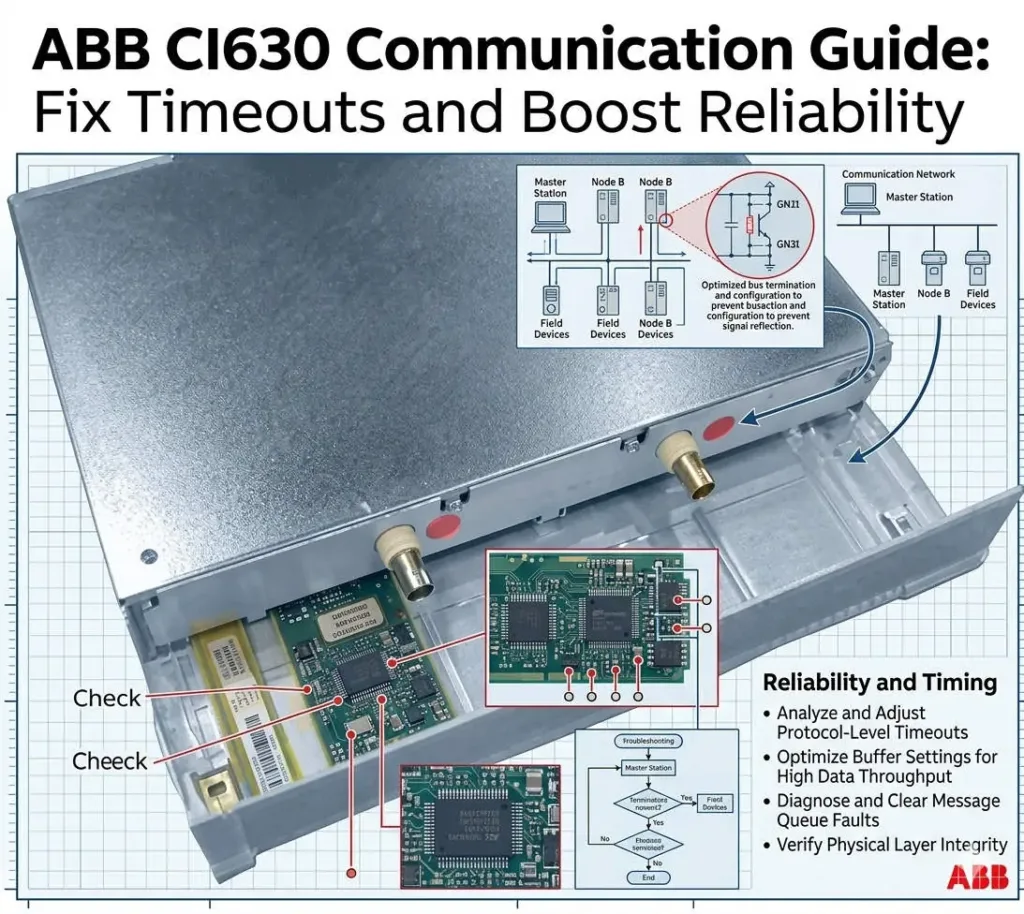
ABB CI630 Communication Guide: Fix Timeouts and Boost Reliability
Troubleshooting ABB CI630 Communication Timeouts: A Technical Guide
In the world of industrial automation, the ABB CI630 communication interface serves as a vital bridge. It connects complex controllers to critical field networks. However, a “timeout” fault often disrupts this connection. This error rarely stems from a single hardware failure. Instead, it usually indicates underlying instability within the communication layer. In sectors like pharmaceuticals and power generation, these delays can trigger costly process trips. Therefore, understanding the root causes is essential for maintaining a robust DCS environment.
Understanding the Communication Timeout Mechanism
The CI630 operates using a precise watchdog timer to verify cyclic data exchange. A timeout triggers when the module fails to receive a valid response within this window. While short timeout settings improve system responsiveness, they also increase sensitivity to electrical noise. Consequently, factory automation engineers must balance speed with stability. Mismatched timing parameters often lead to “ghost” faults that are difficult to replicate. Proper configuration ensures the system remains deterministic even under heavy data loads.
Expert Insight from PLCDCS HUB: We often see engineers tighten timeout windows to achieve faster control loops. However, without perfect cabling, this usually leads to intermittent failures. We recommend a conservative buffer during the initial control systems commissioning phase.
Addressing Schemes and Node Integrity
Every device on an industrial bus must possess a unique identity. Address conflicts typically cause persistent or pattern-based communication failures. Unlike random interference, these faults often appear immediately after a specific node becomes active. System expansions frequently introduce these logical errors. Maintaining a rigorous node registry prevents such overlaps. Therefore, verifying the software topology should always be your first step before inspecting physical hardware.
Physical Layer Robustness and EMC Immunity
The CI630 complies with international EMC standards like the IEC 61000 series. Nevertheless, real-world performance depends heavily on the quality of the installation. Poor shielding or improper grounding degrades signal integrity over time. High-power motors and VFDs generate significant electromagnetic interference (EMI). This noise forces the system to retransmit data constantly. Eventually, the error count exceeds the limit and triggers a timeout. High-quality cabling acts as the first line of defense in industrial automation.
Best Practices for Installation and Maintenance
Effective maintenance requires a structured diagnostic approach. Use these technical checkpoints to verify your network integrity:
- ✅ Shielding Protocol: Use shielded twisted-pair cables with single-point grounding to prevent loops.
- ✅ Cable Separation: Maintain physical distance between signal lines and high-voltage power cables.
- ✅ Diagnostic Tools: Use ABB software to monitor CRC errors and retry counters in real-time.
- ✅ Segment Isolation: Disconnect network segments one by one to pinpoint the source of instability.
- ✅ Firmware Alignment: Ensure all communication profiles and firmware versions match across the ecosystem.
Strategic Troubleshooting: Interference vs. Logic Conflicts
Distinguishing between EMI and address conflicts saves hours of downtime. If timeouts occur randomly and fluctuate with electrical load, suspect EMI. Check your grounding and proximity to drives. Conversely, if the fault is deterministic or follows a system modification, check for duplicate IDs. In retrofit projects, legacy hardware often causes both signal degradation and addressing inconsistencies. Always validate the logical configuration before replacing expensive interface modules.
Reliable Solutions for Your Industrial Network
Maximizing uptime requires both technical knowledge and high-quality hardware. Whether you are expanding an existing network or troubleshooting a legacy system, choosing the right components is critical. For genuine ABB parts and expert technical support, visit PLCDCS HUB Limited. Our team provides the reliable spare parts needed to keep your industrial automation systems running smoothly.
Frequently Asked Questions (FAQ)
1. Can a faulty CI630 module cause timeouts on other healthy nodes?
Yes. If a CI630 module experiences an internal hardware failure, it may “babble” or transmit noise onto the bus. This interference can drown out valid signals from other nodes, leading to a cascade of timeouts across the network.
2. How does cable length affect CI630 timeout settings?
Longer cable runs increase signal propagation delay and susceptibility to noise. If you extend your network significantly, you must increase the timeout parameters in the PLC configuration to account for these physical delays.
3. What is the most effective way to shield against VFD interference?
We recommend using double-shielded cables and ensuring that VFDs have proper output filters. Additionally, keeping the CI630 communication lines in a dedicated, grounded metal conduit provides the highest level of protection in high-noise environments.
Solution Scenarios
- Petrochemical Refineries: Implemented dedicated grounding for CI630 racks to eliminate intermittent trips caused by large pump startups.
- Power Plants: Resolved “Node Missing” errors by identifying duplicate addresses introduced during a hardware migration.
- Pharmaceutical Production: Optimized timeout windows to support high-speed batch recording while maintaining 100% data integrity.