CoaXPress Machine Vision Systems Guide | PLCDCSHUB
CoaXPress Revolution: High-Speed Vision Systems Transform Medical and Industrial Automation
CoaXPress Dominates High-Speed Machine Vision
It delivers unmatched speed and reliability for video transmission. The technology transfers data at 12.5 Gbps per cable. Single coaxial cables provide power, communication and control. This simplicity makes CXP ideal for demanding applications.
Beyond Industry: CXP’s Expanding Application Reach
CXP technology now serves diverse sectors beyond industrial automation. Defense, broadcast and medical imaging benefit from its capabilities. Lithuanian researchers recently demonstrated this expansion. They developed an advanced microscopy technique using CXP. Their system improves upon conventional Optical Coherence Tomography.
Breakthrough Medical Imaging Technology
The new d-FF-OCM system represents a significant advancement. It enables non-invasive deep tissue imaging with exceptional resolution. This capability enhances biological research and clinical diagnostics. The system outperforms traditional methods in several key areas.
Advanced System Architecture and Components
The microscopy system integrates multiple sophisticated technologies. Each component plays a crucial role in achieving high-performance imaging.
Key system elements include:
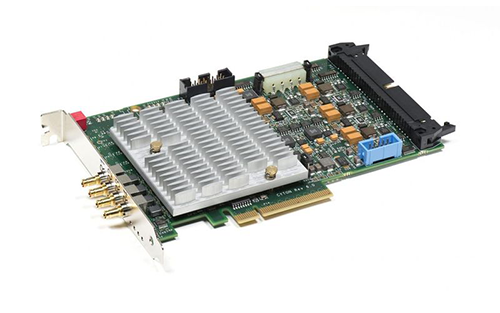
- BitFlow CXP frame grabber for data management
- High-brightness laser-pumped white light source
- Sophisticated interferometer with oil immersion objectives
- Precision transitional stage with stepper motor
- Reference mirror on piezo stack for accuracy
- NI DAQ card for data acquisition
Revolutionary Data Acquisition Performance
Data transfer capabilities define the system’s success. An Adimec 2-megapixel CMOS camera captures biological images. The BitFlow Cyton-CXP4 frame grabber manages data transfer. Four coaxial links enable remarkable 25 Gbps throughput. This configuration achieves virtually zero latency transmission.
Unprecedented Imaging Speed and Quality
The system acquires 1440 × 1440 resolution images at 500 fps. This represents a fivefold improvement over conventional systems. The enhanced speed extends frequency analysis to 250Hz. Faster dynamic processes generate superior image contrast. Biological structures separate more clearly for analysis.
Real-Time Data Processing and Analysis
Data reaches the host PC with exceptional speed. A customized LabVIEW application processes information in real-time. The software colors pixels according to spectral content. It stacks layers to create comprehensive RGB images. This enables immediate analysis and interpretation.
Validation Through Biological Testing
Researchers tested the system on ex vivo mouse tissue. Liver and small intestine samples demonstrated exceptional results. The technology achieved deep tissue high-resolution imaging. It completely eliminated coherent artifacts. These findings validate CXP’s value for medical research.
Industrial Automation Implications
From PLCDCSHUB’s perspective, this technology has broader implications. The same principles apply to industrial vision systems. High-speed inspection and quality control benefit from CXP performance. Manufacturing automation requires similar data transfer capabilities.
Future Applications Across Industries
The d-FF-OCM system shows promise for personalized medicine. It enables earlier and more precise diagnostics. Researchers gain deeper understanding of disease mechanisms. Industrial applications include high-speed manufacturing inspection. According to MarketsandMarkets, the machine vision market will reach $18.2 billion by 2027.
Implementation Considerations for Automation Engineers
Industrial applications require careful system planning. Several factors ensure successful CXP integration.
Critical implementation aspects:
- Cable length and signal integrity maintenance
- Proper frame grabber selection and configuration
- Camera compatibility and performance matching
- Integration with existing control systems
- Real-time processing requirements assessment
For expert guidance on industrial vision system integration, visit PLCDCSHUB’s automation solutions portal.
Technical Advantages Over Alternative Interfaces
CoaXPress offers distinct benefits for demanding applications. It outperforms USB3 Vision and GigE Vision in several areas. The standard provides deterministic performance and low latency. Power-over-cable capability simplifies system design. Long-distance transmission maintains signal quality.
Frequently Asked Questions
What makes CoaXPress suitable for industrial automation?
CXP delivers deterministic high-speed performance essential for manufacturing. It handles harsh industrial environments effectively.
How does CXP compare to USB3 Vision for factory applications?
CXP offers better cable length, determinism and reliability. It outperforms USB3 in demanding industrial conditions.
Can existing systems upgrade to CoaXPress technology?
Many systems can integrate CXP with appropriate frame grabbers and cameras. Compatibility depends on specific hardware and software configurations.
Related Posts