
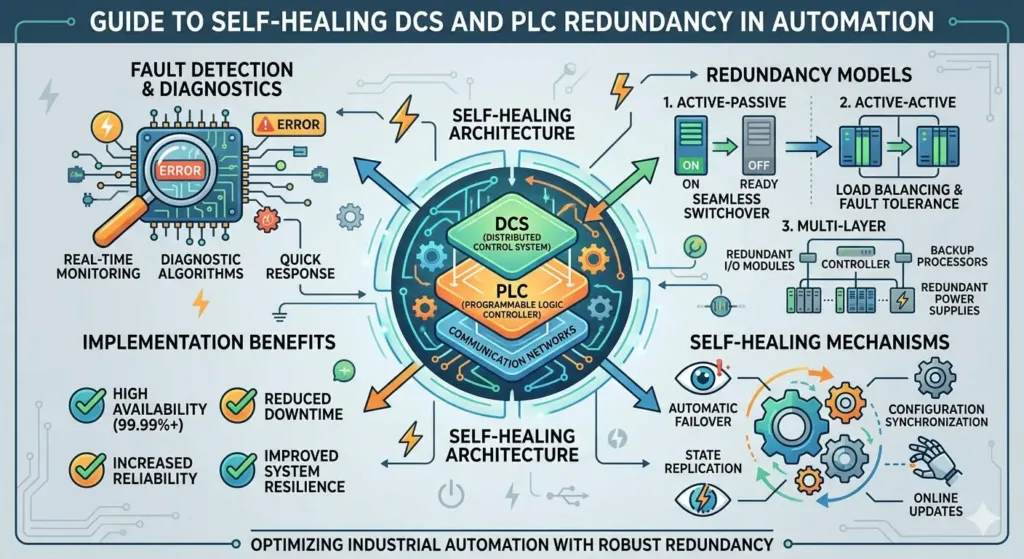
Guide to Self-Healing DCS and PLC Redundancy in Automation
Maximizing Uptime with Self-Healing Control Systems in Industrial Automation
A “self-healing” control system automatically detects, isolates, and resolves faults without requiring manual human intervention. In high-stakes industries like oil and gas or pharmaceuticals, this capability prevents catastrophic production losses. Continuous processes often lose thousands of dollars per minute during unplanned shutdowns. Therefore, self-healing architectures provide a vital safety net for modern factory automation.
At PLCDCS HUB, we believe resilience is the foundation of any successful control strategy. By implementing intelligent recovery protocols, engineers can maintain production continuity even during hardware failures. This proactive approach transforms reactive repair cycles into streamlined, automated responses.
Critical Metrics for Fault Detection and Recovery Time
Recovery speed defines the effectiveness of a self-healing system. Most advanced controllers respond to faults within milliseconds to prevent process disturbances. If a recovery delay exceeds two seconds in a refinery DCS, pressure excursions may occur. Consequently, fast failover is essential to avoid triggering emergency safety interlocks.
- ✅ Monitor millisecond-level failover benchmarks for critical loops.
- ✅ Ensure transient faults do not propagate into the wider network.
- ✅ Prioritize systems that offer “hot standby” synchronization modes.
Designing Robust Redundancy for High Availability
True self-healing relies on a multi-layered redundancy design covering controllers, networks, and I/O modules. Dual-controller setups ensure a seamless switchover if the primary unit fails. Furthermore, redundant communication networks like Parallel Redundancy Protocol (PRP) prevent single cable breaks from halting data flow. However, remember that reinitialization requirements can vary between different industrial automation brands.
- ⚙️ Deploy redundant I/O for safety-critical burner management systems.
- ⚙️ Utilize redundant power feeds from independent grid sources.
- ⚙️ Implement FTE (Fault Tolerant Ethernet) for backbone stability.
Advanced Diagnostics and Predictive Maintenance Integration
Modern self-healing systems provide deep diagnostic coverage to monitor hardware health continuously. These systems identify degrading components, such as failing power supplies, before a total collapse occurs. As a result, plants can transition from reactive repairs to planned, predictive maintenance. This alignment with IEC 61508 standards significantly improves the Safety Integrity Level (SIL) of the entire plant.
Our experience shows that precise fault localization reduces the Mean Time to Repair (MTTR). When the DCS points exactly to a faulty card, technicians save hours of troubleshooting time. We highly recommend investing in systems with high diagnostic transparency to protect long-term operational integrity.
Best Practices for Installation and Physical Layer Integrity
Redundancy often fails in the field due to poor physical separation. If both redundant cables share one tray, a single fire or mechanical impact destroys both paths. Therefore, engineers must route primary and backup lines through different physical locations. Additionally, robust grounding protects sensitive electronics from surge-related damage.
- 🔧 Separate redundant cable routes to prevent common-cause failures.
- 🔧 Install external surge protection for areas prone to lightning.
- 🔧 Conduct scheduled failover tests to verify system readiness.
Testing failover scenarios under real conditions is a step many facilities skip. However, unverified redundancy creates a false sense of security. Regularly simulate controller failures to ensure the process remains stable during transitions.
Buyer’s Strategy: Choosing a Self-Healing Architecture
Continuous processes in chemicals or polymers absolutely require self-healing capabilities. For discrete manufacturing, the decision depends on the financial impact of hourly downtime. When upgrading legacy DCS platforms, verify if existing I/O modules support the latest redundancy features. Incompatibility between firmware versions can often create hidden vulnerabilities in your control systems.
Are you looking to enhance your facility’s resilience with reliable hardware? Discover a wide range of redundant controllers and modules at PLCDCS HUB Limited. We specialize in providing the critical components that keep your plant running 24/7.
Application Scenario: Pharmaceutical Batch Protection
In a pharmaceutical batch process, a single controller crash can ruin millions of dollars in product. A leading manufacturer implemented a self-healing DCS with redundant I/O and hot-standby controllers. During a routine production run, a network switch failed due to a hardware short. The self-healing logic immediately rerouted traffic through the secondary network, preventing any batch loss or data corruption.
Frequently Asked Questions
What is the difference between simple redundancy and a self-healing system?
Redundancy provides the spare hardware, while self-healing includes the intelligent logic to detect and switch to that hardware automatically without stopping the process.
Can I implement self-healing features on an older PLC system?
It depends on the CPU’s firmware and communication capabilities. Most legacy systems require a processor upgrade to support true “bumpless” transfer and advanced diagnostics.
What is the most common reason self-healing systems fail during a crisis?
The most common cause is “common-mode failure,” such as both redundant power supplies being plugged into the same faulty circuit breaker or sharing a single ground point.
Related Posts

No Comments