Packaging Automation Market Growth 2024-2029 Analysis
Packaging Automation Market Set for $2.4 Billion Growth by 2029
The global packaging automation sector enters a significant growth phase. New research reveals strong market expansion through 2029. Industrial automation drives this transformation across manufacturing and warehousing.
Market Growth Projections and Regional Analysis
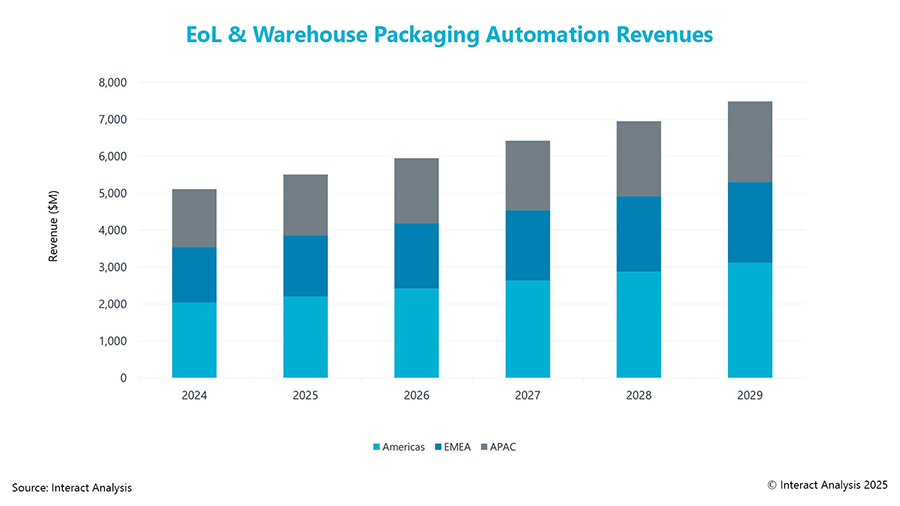
Interact Analysis projects substantial market value increases. The sector will grow from $5.1 billion in 2024 to $7.5 billion by 2029. This represents a 7.9% compound annual growth rate.
The Americas region leads this expansion. Warehouse packaging automation shows particularly strong momentum. Europe also demonstrates robust investment patterns. However, APAC growth stems from general manufacturing expansion.
Manufacturing Versus Warehouse Automation Trends
Manufacturing packaging automation currently dominates market share. It accounted for 61% of 2024 sector revenues. This includes established applications like case packing systems. However, warehouse automation grows at a faster rate.
Key manufacturing packaging applications include:
- ⚙️ Case packers and sealers
- ⚙️ Case erectors and palletizing systems
- ⚙️ Integrated packaging lines with PLC control
These systems generated over $2.1 billion in 2024 revenues. Manufacturing automation remains the foundation of packaging automation.
Warehouse Automation Acceleration Drivers
Warehouse packaging automation experiences rapid transformation. Several key technologies drive this growth. Right-fit boxers and bagging machines lead the expansion. Robotic palletizing systems also show strong adoption.
E-commerce demands fuel warehouse automation investments. Amazon sets industry standards for packaging efficiency. The company deploys right-fit boxers across European facilities. This creates competitive pressure throughout the industry.
Labor Costs and Regulatory Impacts
Rising labor costs accelerate automation adoption. The Americas and Europe face particular wage pressures. Companies automate to maintain competitive operations. Regulatory measures also influence packaging decisions.
New legislation penalizes material wastage in retail. This encourages efficient packaging automation solutions. Companies seek systems that minimize material usage while maintaining product protection.
Technology Implementation Insights
From PLCDCSHUB’s industrial automation experience, several trends emerge. Modern packaging systems require sophisticated control systems. PLC and DCS integration enables seamless operation. These systems manage complex packaging sequences efficiently.
✅ Successful implementations share common characteristics:
Modular control system architecture
Integrated safety and monitoring systems
Scalable automation platforms
Real-time performance analytics
Implementation Strategy Recommendations
Companies should approach packaging automation strategically. Begin with comprehensive process analysis. Identify bottlenecks in current packaging operations. Then select appropriate automation technologies.
Consider these implementation phases:
1. Current state assessment and requirement definition
2. Technology evaluation and vendor selection
3. System integration and commissioning
4. Performance optimization and staff training
Future Market Outlook and Opportunities
The packaging automation market shows strong long-term potential. Warehouse applications offer the highest growth rates. However, manufacturing automation maintains significant market share. Companies should monitor emerging technologies and market shifts.
Research analyst Vanessa Lopez emphasizes warehouse opportunities. Many packaging processes remain manual in warehousing. This creates substantial automation potential. Machine vendors should focus on this growing segment.
Frequently Asked Questions
What drives packaging automation growth in warehousing?
E-commerce demands and labor cost pressures are primary drivers. Regulatory requirements for material efficiency also contribute significantly.
Which packaging automation technologies show strongest growth?
Right-fit boxers and automated bagging systems lead growth rates. Robotic palletizing also demonstrates strong market expansion.
How does manufacturing packaging automation differ from warehouse applications?
Manufacturing focuses on high-speed, integrated production lines. Warehouse automation emphasizes flexibility and e-commerce fulfillment capabilities.
Strategic Implementation Guidance
Packaging automation offers significant operational benefits. Companies can achieve substantial cost reductions and efficiency improvements. However, successful implementation requires careful planning and execution.
Proper control system selection proves crucial for performance. Integrated automation platforms deliver the best results. They ensure seamless operation across packaging processes.
Explore packaging automation control solutions at PLCDCSHUB. Our expertise helps companies implement effective packaging automation systems.
Related Posts