
Honeywell Experion C300 Controller: Scalability & Performance Guide
Maximizing Process Efficiency with the Honeywell Experion C300 Controller
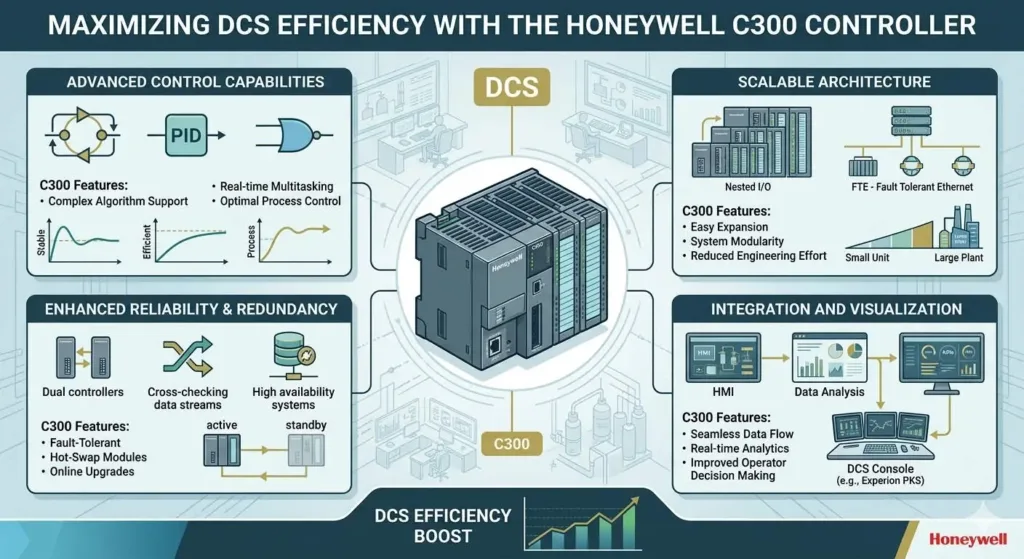
The Honeywell Experion PKS C300 controller represents a benchmark in industrial automation for large-scale operations. It manages high-availability tasks while maintaining strict deterministic performance. Engineers in oil, gas, and pharmaceutical sectors often face scaling challenges. The C300 solves this by offering a distributed architecture. This design allows for massive I/O expansion without sacrificing loop stability or speed. Consequently, it remains a top choice for complex control systems globally.
Optimizing I/O Capacity and System Scalability
A single C300 controller can technically manage up to 64,000 I/O points depending on network design. This high density significantly reduces the number of controllers required for a project. Therefore, companies benefit from lower hardware costs and simplified engineering. Moreover, fewer controllers reduce the latency often found in inter-controller communications. However, pushing a controller to its absolute limit can increase CPU loading. At PLCDCS HUB, we recommend maintaining a 30% performance margin for future expansion.
Deterministic Execution for Precise Process Control
The C300 environment ensures deterministic control execution within millisecond ranges. Fast scan times directly improve the stability of PID loops in high-speed processes. For instance, distillation columns and pressure vessels require rapid response to maintain safety. In addition, lower latency enhances the reliability of safety interlocks. Engineers must still monitor strategy complexity carefully. Overloading the controller with excessive logic blocks can unintentionally extend execution cycles. Always use official engineering tools to validate the CPU load before commissioning.
Network Integrity via Fault Tolerant Ethernet (FTE)
Reliability in factory automation depends heavily on robust networking. The C300 operates on Honeywell’s proprietary Fault Tolerant Ethernet (FTE) architecture. This setup provides seamless redundancy by eliminating single points of failure. As a result, the system continues to function even during a cable or switch fault. From our site experience, using non-qualified network hardware often causes intermittent communication drops. Therefore, you should always follow strict FTE guidelines and use managed switches to ensure maximum uptime.
Best Practices for Installation and Maintenance
Proper physical installation prevents long-term hardware failure. In high-density cabinets, heat management becomes a critical factor. High ambient temperatures often cause electronic components to fail prematurely. Additionally, electrical noise can degrade analog signal quality. Follow these technical guidelines for a stable installation:
- ✅ Thermal Spacing: Maintain adequate gaps between modules to allow natural airflow.
- ✅ Signal Shielding: Use single-point grounding to prevent troublesome ground loops.
- ✅ Active Ventilation: Install cabinet fans if the control room lacks climate control.
- ✅ Redundancy Checks: Perform live failover tests for power and network during commissioning.
Expert Insight from PLCDCS HUB: Many technicians skip redundancy testing to save time. However, verifying a “bumpless” transfer during a simulated fault is the only way to guarantee site safety.
Strategic Buyer’s Guide for System Upgrades
Choosing the right controller involves more than just counting I/O points. While the C300 is powerful, it is not always a drop-in replacement for legacy hardware. Upgrading from older systems like the TDC 3000 requires specialized gateways. Furthermore, a distributed design using multiple controllers is often safer than one oversized unit. This strategy spreads the operational risk across the plant. Always perform a thorough compatibility audit before purchasing any new DCS hardware.
Explore our extensive inventory of high-performance controllers and spare parts at PLCDCS HUB Limited. We provide the technical expertise and genuine components you need for successful system integration.
Application Scenarios and Solutions
- Large-Scale Refineries: Manage thousands of process loops with minimal hardware footprint.
- Pharmaceutical Batching: Achieve high-precision timing for critical chemical reactions.
- Offshore Platforms: Utilize FTE networking to ensure safety in remote, high-risk environments.
Frequently Asked Questions (FAQ)
1. Can I mix the C300 with older Series A I/O modules?
Direct compatibility is limited. While the Experion environment supports multiple I/O families, the C300 works best with Series C modules. You may need a fieldbus integration tool or a gateway for older hardware connections.
2. How does the C300 handle CPU redundancy?
The C300 supports 1:1 redundancy. A secondary “shadow” controller stays synchronized with the primary unit. If the primary fails, the secondary takes over without interrupting the process control logic.
3. Is it better to buy one C300 or several smaller controllers?
We recommend distributing your risk. For a plant with 10,000 I/O points, using two controllers is often more robust than one. This ensures that a single hardware failure does not shut down the entire facility.


