
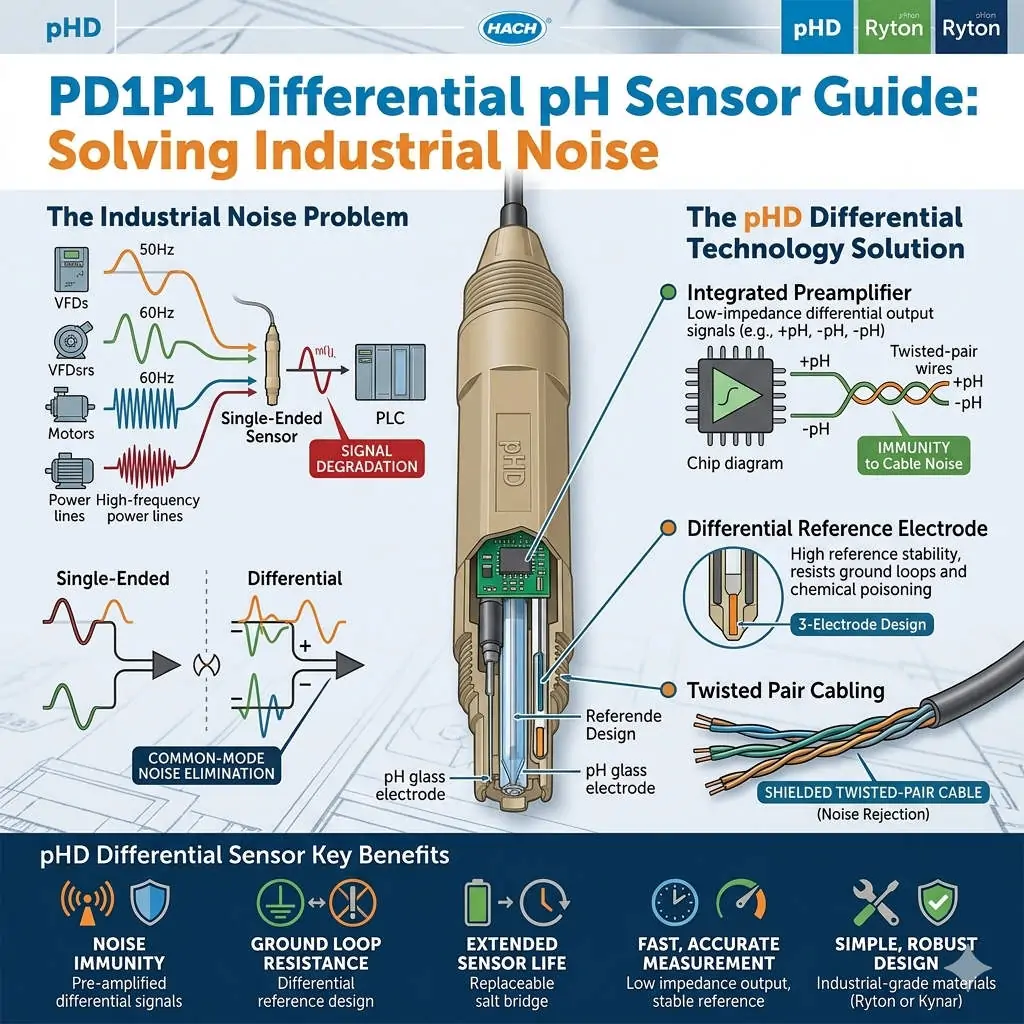
PD1P1 Differential pH Sensor Guide: Solving Industrial Noise
Understanding the PD1P1 Differential pH Sensor in Harsh Industrial Environments
The PD1P1 is indeed a differential pH sensor. However, it offers much more than a different wiring style. This sensor adopts a measurement principle that fundamentally differs from standard combination electrodes. Traditional sensors combine a measuring electrode and a reference electrode into one body. In contrast, the PD1P1 uses a third solution ground electrode. This design isolates the signal from ground loop interference. Consequently, it delivers superior accuracy in demanding industrial automation applications.
The Core Value of Differential Signal Acquisition
Process failure often occurs in chemical or wastewater plants due to reference poisoning or electrical noise. The PD1P1 addresses these issues by stabilizing the reference system against process-induced interference. As a result, operators experience longer calibration intervals and improved process stability. This is vital in high-solid media where standard sensors typically fail. Furthermore, reliable readings prevent the over-dosing of expensive chemicals in your control systems.
Expert Insight from PLCDCS HUB: In our experience, many “drifting pH” complaints are actually electrical noise issues. The PD1P1 solves this by ignoring the potential differences between the process and the instrument ground.
Technical Advantages Over Conventional Electrodes
Standard electrodes measure voltage between the glass and a reference junction. However, the PD1P1 measures both relative to a solution ground. This configuration eliminates errors caused by Variable Frequency Drives (VFDs) or poor plant grounding. Moreover, the design minimizes dependency on junction flow. This extends the sensor life in coating-prone processes like sludge or lime slurry. Therefore, you reduce maintenance frequency and lower long-term labor costs.
Installation Best Practices for Signal Stability
Successful deployment in factory automation requires strict adherence to grounding and mounting standards. Even differential sensors require a clean single-point ground at the transmitter side. In high-solids media, sensor coating remains a challenge. We recommend installing the PD1P1 in a flow-through assembly with self-cleaning capabilities. Additionally, protect your equipment with external surge devices in outdoor installations. Transient damage is a leading cause of premature system failure.
Strategic Buyer’s Guide: Choosing the Right Sensor
Selecting the PD1P1 should be a calculated decision based on your specific process conditions. If your application involves heavy contamination or high electrical noise, this sensor is essential. However, the PD1P1 is not a “drop-in upgrade” for every system. It typically requires specific analyzers designed for differential input. Always verify compatibility with your DCS or PLC controller before making a purchase. For clean water applications, a standard electrode may remain the more cost-effective choice.
- ✅ Noise Rejection: Eliminates ground loops from VFD-driven pumps.
- ✅ Durability: Resists reference poisoning in sulfides and proteins.
- ✅ Stability: Faster recovery after process upsets or chemical spikes.
- ✅ Efficiency: Reduces manual cleaning cycles in remote hazardous areas.
Application Scenarios and Solutions
- Wastewater Treatment: Reliable pH control in thick sludge and aeration tanks.
- Pulp and Paper: Withstands the harsh chemical recovery and bleaching processes.
- Chemical Processing: Maintains accuracy in high-conductivity and corrosive media.
To find the right PD1P1 sensor and receive expert technical support, visit PLCDCS HUB Limited today. We provide the robust instrumentation your systems require.
Frequently Asked Questions (FAQ)
1. Can I use the PD1P1 with any standard 4-20mA transmitter?
No, you cannot. Most differential sensors require a dedicated analyzer with a high-impedance differential input circuit. Connecting a PD1P1 to a standard single-ended transmitter will result in inaccurate data or no signal.
2. How does the PD1P1 lower my total cost of ownership (TCO)?
While the initial cost is higher, the PD1P1 lasts two to three times longer than combination electrodes. You save significantly on labor, chemical usage, and the replacement frequency of hardware.
3. What is the most critical maintenance tip for the PD1P1?
Always check the salt bridge. While the differential design is robust, the internal salt bridge is a consumable part. Replacing it periodically ensures the reference system remains unpoisoned and accurate.